Table of Contents
There is something almost poetic about a country defaulting on its debt just seven years after declaring itself a free market economy. Russia in 1998 did not simply have a financial crisis. It staged a masterclass in what happens when you build capitalism on a foundation of wishful thinking, borrowed money, and the assumption that oil prices only go up.
The story of the Russian financial crisis is not really about numbers on a screen or bond yields ticking upward. It is about the collision between ideology and reality, between what the West wanted Russia to be and what Russia actually was. And if you pay close attention, it is also a story about how the smartest people in the room can be spectacularly, catastrophically wrong.
The Setup Nobody Questioned
After the Soviet Union collapsed in 1991, Russia was handed a script. The script said: privatize everything, open your markets, let prices float, and prosperity will follow. This was the gospel of shock therapy, championed by Western economists who had never run a lemonade stand in Siberia but felt confident they could restructure the world’s largest country.
And to be fair, parts of the plan made sense on paper. The problem was that Russia was not paper. It was a place where entire cities existed solely to build one type of missile, where the concept of private property had been illegal within living memory, and where the informal economy ran on favors, connections, and occasionally actual vodka.
Privatization happened fast. Too fast. State assets worth billions were sold for fractions of their value through rigged auctions. A small group of well connected individuals acquired oil companies, banks, and media empires for prices that would not buy a decent apartment in Manhattan. These were the oligarchs, and they did not emerge from some free market meritocracy. They emerged from chaos, and they thrived in it.
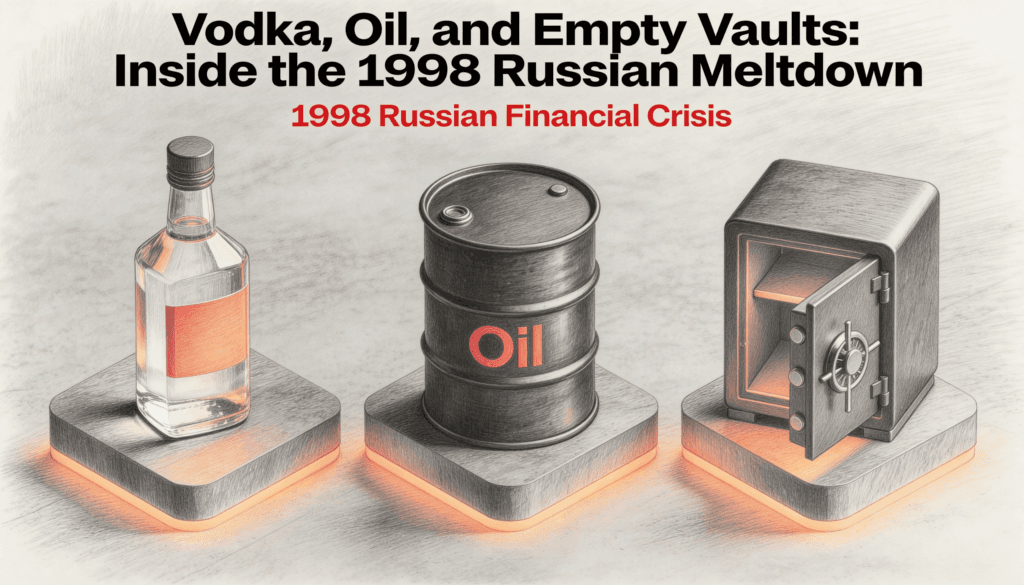
Meanwhile, the Russian government was spending more than it earned. This is not unusual for governments, but Russia was doing it with particular flair. Tax collection was almost optional. Large corporations negotiated their tax bills the way you might haggle at a flea market. Some paid in goods instead of cash. The government, in turn, sometimes paid its own workers in goods instead of cash. Teachers were reportedly compensated in vodka at one point, which tells you everything you need to know about the state of fiscal policy.
The Bond Market as a Band Aid
To cover the gap between what it spent and what it collected, Russia issued short term government bonds called GKOs. These were ruble denominated instruments with high yields, and for a while they were the hottest trade in emerging markets. Foreign investors piled in. The returns were extraordinary, sometimes exceeding forty percent annually.
Here is where the story gets interesting from an intellectual standpoint. The GKO market was essentially a confidence game in the most literal sense. It worked as long as everyone believed Russia would keep paying. And everyone believed Russia would keep paying because the International Monetary Fund kept lending Russia money, and the IMF kept lending Russia money because the West had a geopolitical interest in Russia not collapsing. The logic was circular, but circular logic can spin for a surprisingly long time before someone notices.
What investors were really buying was not Russian fiscal discipline. They were buying the implicit guarantee that the West would not let Russia fail. This is a recurring theme in financial history, and it never ends well. The assumption that someone bigger will always step in is comforting right up until the moment nobody steps in.
Oil, the Only Export That Mattered
Russia’s economy in the 1990s was, beneath all the reform rhetoric, an oil and gas economy wearing a suit. Energy exports generated the hard currency that kept the whole system from seizing up. When oil prices were stable, the illusion held. When oil prices dropped, the illusion crumbled.
In 1997 and 1998, oil prices fell sharply. The Asian financial crisis had crushed demand across the Pacific. Oil dropped to around ten dollars a barrel, a price at which Russia could not sustain its budget, its debt payments, or the fixed exchange rate it was desperately defending.
This is one of those counterintuitive aspects worth sitting with. Russia was simultaneously trying to be a modern market economy and remaining almost entirely dependent on a single commodity. The reforms were supposed to diversify the economy. Instead, they had mostly succeeded in transferring ownership of the old economy into private hands while leaving the underlying structure intact. The suit was new. The body underneath was the same.
The Ruble Defense and Its Inevitable Failure
The Russian central bank was defending a currency band for the ruble, keeping it within a narrow range against the dollar. This required burning through foreign reserves at an alarming rate. Every time the market pushed the ruble down, the central bank had to sell dollars and buy rubles to hold the line.
This is the financial equivalent of trying to hold back the ocean with a bucket. You can do it for a while if the waves are small. But when a real storm arrives, you just end up wet and out of buckets.
By mid 1998, Russia’s foreign reserves were evaporating. Interest rates were jacked up to absurd levels to attract capital and defend the currency, but sky high rates were simultaneously strangling the domestic economy. Businesses could not borrow. Banks were under pressure. The cure was accelerating the disease.
There is a lesson here that applies well beyond Russia: when a government is forced to choose between defending its currency and saving its economy, the currency eventually loses. The question is never whether they will let go. The question is how much damage they do to themselves before admitting they have to.
August 17, 1998
On August 17, the Russian government did three things simultaneously. It devalued the ruble. It defaulted on its domestic debt, the GKOs. And it declared a moratorium on foreign debt payments by commercial banks.
In the world of sovereign finance, this was the equivalent of flipping the table during a poker game. Countries are not supposed to default on domestic currency debt because, in theory, they can always print more of their own currency to pay it. Russia chose not to. This was partly because printing money to cover the debt would have triggered hyperinflation, and partly because the political will to keep playing the game had simply run out.
The default sent shockwaves through global markets. Not because Russia’s economy was that large in global terms, but because of who was holding Russian debt and what those holders had done with it.
The Long Arm of Contagion: When Genius Failed
This brings us to what might be the most instructive chapter of the entire saga, and it did not take place in Moscow. It took place in Greenwich, Connecticut, in the offices of a hedge fund called Long Term Capital Management.
LTCM was run by some of the most credentialed minds in finance. Its partners included Nobel Prize winners in economics. Their models were sophisticated, their leverage was enormous, and their positions were spread across global markets in ways that assumed historical correlations would hold. When Russia defaulted, those correlations broke. Markets that were supposed to move independently started moving in the same direction, which was down.
LTCM lost billions in weeks. Its collapse threatened to cascade through the global financial system because its counterparties, the major banks and brokerages, were exposed to its positions.
The irony is thick enough to cut. A crisis born from overconfidence in a transitioning economy nearly destroyed the financial system of the country that had prescribed the transition. Russia’s mess became Wall Street’s mess because leverage and interconnection do not respect borders.
What Russia Actually Learned
The aftermath in Russia was brutal in the short term. The ruble lost about seventy five percent of its value. Inflation surged. Savings were wiped out for ordinary Russians, many of whom had already lost their savings once during the Soviet collapse. The psychological damage was significant. Trust in reforms, in markets, in Western advice, cratered.
But here is the contrarian take that history actually supports: the crisis was, in a perverse way, the best thing that happened to the Russian economy in the 1990s.
The devalued ruble made Russian goods cheaper. Domestic production started to recover. Industries that had been crushed by cheap imports suddenly had room to breathe. Oil prices began climbing again in 1999 and kept climbing for most of the following decade. The combination of a cheap currency and expensive oil turned Russia’s fiscal situation around faster than almost anyone predicted.
Vladimir Putin came to power in late 1999, inheriting an economy that was already recovering. The narrative became that strong leadership fixed Russia, but the math suggests it was mostly currency devaluation and oil prices doing the heavy lifting. This is another one of those patterns worth noting: leaders who arrive at the bottom of a cycle often get credit for the recovery that was coming regardless.
The Lessons That Keep Not Being Learned
The 1998 Russian crisis offers a concentrated dose of financial wisdom that markets have cheerfully ignored multiple times since.
Fixed exchange rates under pressure always break. The cost of defending them is always higher than the cost of letting go earlier. Countries that depend on a single commodity are not diversified economies just because they have stock exchanges and private banks. And when investors are earning forty percent annual returns on government bonds, the correct response is not excitement. It is suspicion.
Perhaps the deepest lesson is about the relationship between models and reality. The Western advisors who designed Russia’s reforms had models. LTCM had models. The IMF had models. Every model assumed that the world would behave in certain predictable ways. Every model broke when the world decided not to cooperate.
Models are maps. Russia in 1998 was a reminder that the map is never the territory. The territory has vodka, oligarchs, collapsing oil prices, and millions of people whose lives do not fit neatly into a spreadsheet. Ignoring them does not make them disappear. It just means you are surprised when they show up.