Table of Contents
Most investors approach portfolio protection the way most people approach health insurance. They know they need it, they understand it costs money, and they hope never to use it. But here’s where the analogy breaks down in an interesting way. When it comes to protecting your investments, you’re not just choosing between different insurance policies. You’re choosing between insurance and income. Between safety and opportunity. Between the defensive crouch and the careful dance.
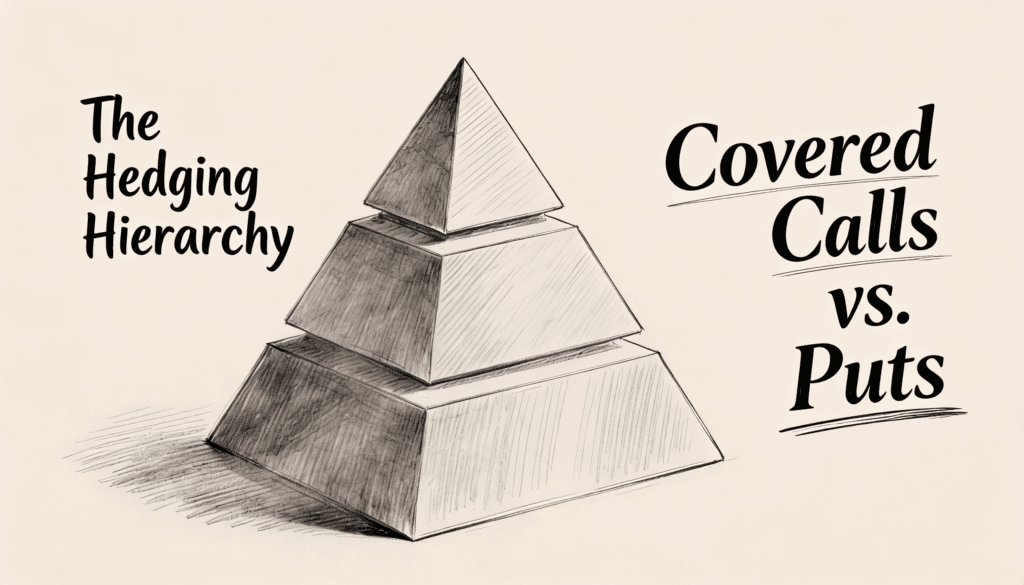
The two most popular hedging strategies for individual investors sit at opposite ends of the protection spectrum. Covered calls let you collect premiums by capping your upside. Protective puts let you pay premiums to cap your downside. One strategy pays you to accept limits. The other costs you to eliminate them. And which one belongs at the top of your hedging hierarchy depends less on mathematics than on something far more slippery: your relationship with regret.
The Philosophy of Selling Caps
When you sell a covered call, you’re making a deal with the market. You own the stock, and you’re willing to sell it at a predetermined price if someone wants it badly enough. In exchange for this willingness, you pocket a premium immediately. The transaction sounds almost too simple, which is partly why it attracts so many investors who are new to options. You get paid today for agreeing to a sale that might happen tomorrow.
But the simplicity masks a deeper commitment. You’re not just agreeing to sell. You’re agreeing to cap your joy. If the stock you own suddenly catches fire and doubles, you don’t get to participate in that doubling. You sold away that right for a modest premium collected weeks or months ago. And this is where human psychology enters the room uninvited and refuses to leave.
We’re wired to feel the pain of missing out more acutely than we feel the pleasure of dodging a bullet. Or, losing 100 dollars produce a stronger feeling than gaining 100 dollars. Behavioral economists have demonstrated this repeatedly. The regret of watching a stock you own soar past your strike price, knowing you locked in gains that now seem almost embarrassingly small, can sting worse than a modest loss. Yet covered calls remain wildly popular, which tells us something important about how investors actually think about risk.
The strategy appeals because it feels productive. You’re not just sitting there hoping your stocks go up. You’re actively generating income. You’re doing something. And in the long stretches when markets move sideways or drift modestly higher, covered calls can seem almost magical. You collect premium after premium, watching your yield tick upward, feeling like you’ve discovered a clever wrinkle the market somehow overlooks.
The irony is that covered calls work best precisely when you need protection least. In calm, meandering markets, the premiums you collect are modest but consistent. When volatility spikes and you could really use some defense, the covered calls you sold last month offer almost no protection on the downside. The premium you collected might cushion a small decline, but if your stock drops twenty or thirty percent, that premium looks like a bandage on a broken leg.
The Cost of Freedom
Protective puts operate from an entirely different premise. You’re not generating income. You’re spending it. You buy the right to sell your stock at a predetermined price, which means you’ve bought insurance against catastrophic loss. If your stock collapses, your put gives you the freedom to walk away at a price you locked in when times were better.
This feels safer, and in the pure arithmetic sense, it is. You’ve capped your downside. You can sleep at night knowing that no matter what happens, you have an exit plan. But this peace of mind costs you real money, and unlike covered calls, you’re paying it rather than receiving it. Month after month, you watch those premiums disappear into the void, buying protection you hope to never use.
The psychology here is fascinating because it flips the covered call dynamic. With puts, you feel the constant sting of paying premiums. Every month that passes without a market crash feels like money wasted. You start to question whether you’re being too cautious, too fearful. The market keeps climbing, and you keep paying for insurance you don’t seem to need. The regret isn’t about capped gains. It’s about mounting costs that seem to deliver nothing except the absence of disaster.
And yet, when disaster does arrive, protective puts reveal their value in a way covered calls never can. The market drops twenty percent, thirty percent, and you’re protected. You have an exit. While others panic and sell at the bottom, you have the psychological freedom to wait, to think, to make decisions from a position of security rather than fear. The premiums you paid suddenly seem like the bargain of the century.
The Hierarchy Question
So which strategy deserves the top spot in your defensive lineup? The question itself reveals a common misconception about hedging. Most investors think they need to choose one primary strategy and stick with it. They want to know which one is better, which one wins. But the hierarchy isn’t about ranking these strategies from best to worst. It’s about understanding which type of regret you can actually live with.
Covered calls make sense as a primary strategy if your deepest fear is stagnation. If watching your portfolio sit idle while collecting no income makes you restless, covered calls give you something to do. They generate cash flow in sideways markets. They force you to take profits regularly, even if those profits are modest. They prevent you from holding stocks forever while hoping for home runs that might never come.
But covered calls fail as primary protection if your nightmare scenario is the sudden crash. They offer minimal downside defense. The premium you collected last month won’t save you if the market drops hard. If your primary goal is sleeping soundly during volatility storms, covered calls aren’t insurance. They’re a yield strategy masquerading as protection.
Protective puts work as primary defense if your core anxiety is about permanent loss. If the thought of your portfolio getting cut in half keeps you up at night, puts deliver real protection. They cap your losses. They give you the freedom to stay invested during chaos because you know your downside is limited. But puts fail as primary strategy if you can’t stomach the ongoing cost, the monthly bleed of premiums that disappear when markets are calm.
The Counterintuitive Truth
Here’s what most hedging guides won’t tell you. The investors who succeed with covered calls aren’t the ones chasing income. They’re the ones who’ve made peace with mediocrity. They’ve accepted that their portfolios might never double in a year, and they’re genuinely okay with that. They’d rather collect steady premiums and clip singles than swing for fences and strike out.
The investors who succeed with protective puts aren’t the fearful ones. They’re the aggressive ones. This sounds backwards, but it’s true. Puts give you the freedom to hold riskier positions because you’ve capped your downside. You can own concentrated positions, make bold sector bets, hold through earnings announcements, because you know your maximum loss. The premium you pay isn’t the cost of fear. It’s the cost of freedom to take bigger swings.
This flips the conventional wisdom completely. Wall Street often presents covered calls as conservative and protective puts as expensive insurance for nervous investors. But in practice, covered calls are for investors who’ve given up on outsized gains, while puts are for investors who want to pursue outsized gains without accepting outsized risks.
The Rotation Strategy
Perhaps the real hierarchy isn’t about choosing one over the other. It’s about knowing when to rotate between them. Markets have rhythms. There are periods of low volatility when stocks drift sideways and covered calls make perfect sense. Collect those premiums while they’re available. Then there are periods when volatility spikes, correlation goes to one, and everything moves together. That’s when puts earn their keep.
The investors who struggle are the ones who get stuck in one strategy because they’ve decided it’s their identity. They’re covered call investors or they’re put buyers, and they stick with their chosen approach regardless of market conditions. They pay for protection they don’t need or collect premiums that don’t protect.
The investors who thrive are the ones who view both strategies as tools rather than identities. They sell calls when implied volatility is low and markets are quiet. They buy puts when volatility is rising and correlations are tightening. They’re not loyal to a strategy. They’re loyal to the goal of protecting capital while generating returns.
The Hidden Cost of Complexity
There’s a deeper issue that affects both strategies equally. The more you hedge, the more you trade. The more you trade, the more you pay in friction costs and the more time you spend managing positions. You start watching options chains instead of building businesses. You become a trader instead of an investor.
This matters because the best investment returns typically come from doing less, not more. Buy good businesses, hold them for years, let compound interest work its magic. But hedging strategies seduce you into constant activity. Roll that covered call. Adjust that put position. Manage your Greeks. Before you know it, you’re spending hours each week on activities that might be subtracting value rather than adding it.
The hierarchy question should include a third option that most investors ignore: strategic inactivity. Sometimes the best hedge is simply owning less of what you can’t afford to lose. If you can’t stomach a thirty percent decline in a particular stock, maybe you shouldn’t own so much of it. If you need to hedge constantly to sleep at night, perhaps the portfolio itself is wrong.
The Regret Matrix
In the end, your primary defense should align with your personal regret matrix. We all have different psychological breaking points. Some investors are destroyed by missing big gains. They’d rather risk losses than cap their upside. For them, covered calls are torture and protective puts make sense.
Other investors are destroyed by watching gains evaporate. They’d rather lock in modest profits repeatedly than hold for home runs that might reverse. For them, covered calls provide emotional stability that puts never could.
Neither approach is objectively superior. Markets don’t care about your hedging strategy. They move based on earnings and interest rates and countless factors you can’t control. Your hedging approach should be optimized for your psychology, not for theoretical maximum returns.
The investors who sleep well are the ones who’ve honestly assessed which type of regret they can handle. Can you stomach paying premiums month after month for protection you might never use? Or would you rather collect premiums and accept the risk of capped upside? There’s no universal answer because there’s no universal investor.
Building Your Personal Hierarchy
Start by asking what you’re actually protecting against. If your nightmare is permanent capital loss, puts belong at the top. If your nightmare is opportunity loss, puts might not belong in your hierarchy at all. If your nightmare is portfolio stagnation, covered calls make sense. If your nightmare is missing the next home run stock, covered calls will haunt you.
Then consider your portfolio composition. Concentrated positions might need put protection. Diversified holdings might generate better returns with occasional covered calls. Index positions might need different hedges than individual stocks. The hierarchy isn’t one size fits all.
Finally, remember that the best defense might be offense. Instead of constantly hedging existing positions, consider whether those positions deserve to be in your portfolio at all. If you find yourself hedging the same stock month after month, maybe the real message is that you shouldn’t own it.
The hedging hierarchy isn’t a ranking of strategies. It’s a framework for self knowledge. Understanding which strategy fits your psychology, your goals, and your actual risk tolerance tells you something important about who you are as an investor. And that knowledge is worth more than any premium you’ll collect or any put you’ll buy.