Table of Contents
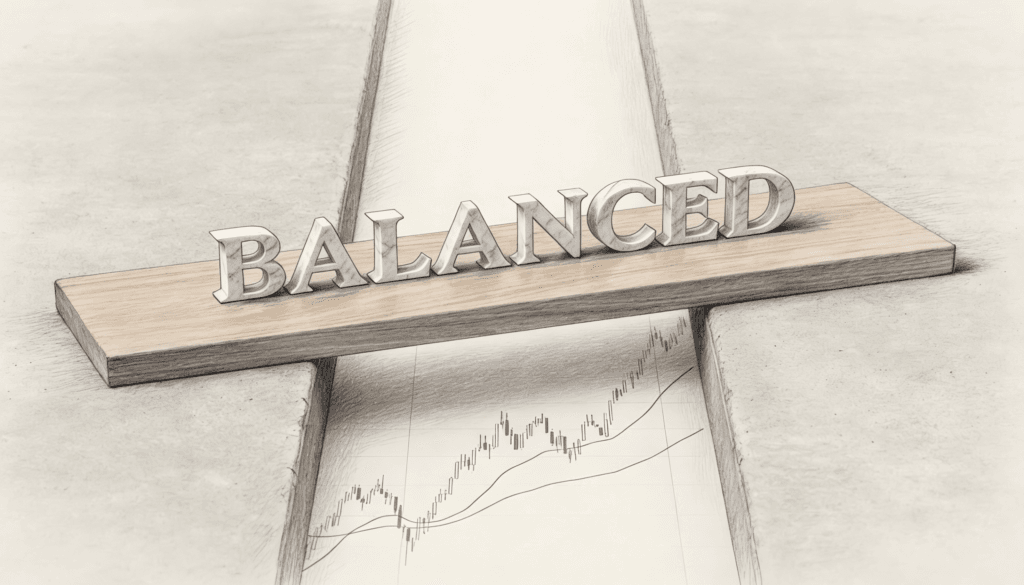
Every industry has its comfort words. Medicine has “stable.” Education has “well-rounded.” And finance has “balanced.”
The word shows up everywhere. Balanced portfolios. Balanced risk. Balanced approach. Financial advisors use it like a security blanket. Investors hear it and feel safer. But here’s the problem: balance in finance is not what you think it is. It’s not safety. It’s not wisdom. It’s often just expensive inertia wrapped in respectable language.
The most dangerous lies are the ones that sound reasonable.
The Myth of the Middle Ground
We’re taught from childhood that extremes are bad. Don’t eat too much or too little. Don’t work too hard or too little. The middle path sounds virtuous. Aristotle called it the golden mean. Your grandmother called it common sense.
But finance doesn’t work like your grandmother’s advice.
Markets are not reasonable. They don’t reward temperance. They reward being right about the future. And the future is never balanced. It’s always tilted somewhere. Technology dominates, then crashes. Real estate booms, then collapses. Bonds yield nothing, then suddenly everything.
When someone sells you a balanced portfolio, they’re really saying: “I don’t know what will happen, so let’s own a bit of everything.” That’s not strategy. That’s surrender dressed up in a suit.
The irony is thick. Because when you own everything, you’re guaranteed to own the wrong things. You’re just hoping the right things outweigh them.
Balance as a Marketing Tool
Walk into any bank and ask about investing. Within five minutes, someone will say “balanced approach.” It’s the industry’s favorite phrase because it sounds responsible without meaning anything specific.
What does a balanced portfolio even mean? Sixty percent stocks and forty percent bonds? Who decided that ratio? Why not fifty-fifty? Or seventy-thirty? The numbers change based on who’s selling them to you.
This is where finance borrows from art criticism. When art critics can’t explain why something is good, they call it “interesting” or “provocative.” When financial advisors can’t justify their choices, they call it “balanced.”
The word does important work for the industry. It shifts responsibility away from the advisor and onto an abstract principle. If your balanced portfolio loses money, well, that’s just how markets work. The balance wasn’t wrong. Reality was.
This matters because words shape how we think about risk. Calling something balanced makes it feel safer than it is. It’s like calling a tightrope walker “stable” because they haven’t fallen yet.
The Opportunity Cost Nobody Mentions
Every choice in finance has a cost. Not just the obvious costs like fees or taxes. The hidden cost is what you gave up by not choosing something else.
A balanced portfolio means you’re always partially wrong. If stocks soar, you wish you had more stocks. If bonds rally, you wish you had more bonds. You’re hedged against being completely right.
Think about this in human terms. Imagine a friend who tries to balance time between ten different hobbies. They’re okay at everything and great at nothing. Now imagine another friend who obsesses over one hobby. They might fail spectacularly. But they might also achieve something remarkable.
Finance celebrates the first friend. But wealth is usually created by the second.
The truly wealthy rarely got there through balance. They got there through concentration. They bet big on something they understood deeply. Then they won. Yes, many others bet big and lost. But “balanced” investors rarely win big either. They just win or lose slowly.
The Illusion of Control and Paralysis
Balance gives us the feeling we’re doing something smart. We’re not panicking. We’re not gambling. We’re being measured and thoughtful.
But sometimes panicking is correct. Sometimes gambling is correct. Not in the emotional sense, but in the strategic sense of going all in when you spot asymmetric opportunity.
The balanced investor confuses activity with progress. They rebalance their portfolio quarterly. They adjust their allocations. They feel in control. Meanwhile, the market does whatever it wants, completely indifferent to their careful calibrations.
Markets also evolved for extremes. They crash and boom. They panic and euphoria. Trying to stay balanced during these swings is like trying to surf by standing perfectly still on the board.
The really insidious part about balance is how it prevents decisions.
Should you invest more in growth stocks or value stocks? Balance says own both. Should you hold cash or be fully invested? Balance says hold some cash. Should you buy that rental property or keep your money liquid? Balance says do a little of everything.
Every time you choose balance, you avoid choosing. And in finance, not choosing is itself a choice. It’s usually the wrong one.
This connects to a broader truth about life. The people who achieve extraordinary things rarely have balanced lives. They’re obsessed. They neglect other areas. They go all in on what matters to them.
Steve Jobs wasn’t balanced. Einstein wasn’t balanced. Marie Curie wasn’t balanced. They were fanatics who happened to be right about what deserved their fanaticism.
Now, you’re not trying to invent the iPhone or discover relativity with your investment portfolio. But the principle holds. Meaningful returns require meaningful conviction. And conviction is the opposite of balance.
The Volatility Problem
Here’s a counterintuitive truth: sometimes more volatility is better than less.
A balanced portfolio is designed to reduce volatility. Your stocks zig while your bonds zag. You sleep better at night because your account value doesn’t jump around as much.
But volatility is not the same as risk. Real risk is permanent loss of capital. Volatility is just price movement.
If you’re investing for thirty years, do you care if your portfolio drops twenty percent next year? You should care about where it ends up in thirty years. But balanced portfolios train you to care about the wrong thing. They optimize for the appearance of stability rather than actual long term returns.
Think about a river. A calm, balanced river looks safe. But it might be shallow and going nowhere. A wild, volatile river looks dangerous. But it has the power to carve canyons and shape landscapes.
Young investors especially are sold balance when they should be seeking volatility. They have time to recover from crashes. They should want their money in the fastest, wildest rivers. Instead, they’re guided into calm ponds that barely move.
The False Precision of Asset Allocation
Financial advisors love charts showing optimal asset allocation. Sixty percent this, thirty percent that, ten percent something else. It all looks very scientific.
But these allocations are based on historical data. And history doesn’t repeat, does it?
Precise balance gives false comfort. It suggests someone has figured out the right proportions. But there is no right proportion. There’s only the proportion that happened to work in the past, which may or may not work in the future.
This is like those studies that find successful people drink exactly 2.3 cups of coffee per day. The precision is meaningless. Correlation isn’t causation. And trying to replicate someone else’s exact formula rarely works.
The Psychological Trap
Balance feels virtuous. It feels like the responsible adult thing to do.
This is exactly what makes it dangerous. We don’t question it. We don’t examine whether it actually serves our goals. We just accept it as financial wisdom.
But most financial wisdom is actually risk management for the financial industry, not for you. When your advisor recommends balance, they’re often protecting themselves from you suing them later for being too aggressive or too conservative. Balance is the legal defense built into the portfolio.
There’s nothing wrong with the advisor protecting themselves. But you should know that’s what’s happening. The balanced portfolio is designed to be defensible, not optimal.
What Actually Works
So if balance is dangerous, what should you do instead?
First, acknowledge what you actually believe. If you think technology will dominate the future, own technology stocks. Don’t dilute that conviction with equal parts of sectors you think will lag.
Second, accept concentration risk. The alternative to concentration risk is mediocrity. Would you rather have a small chance of losing big and a good chance of winning big, or a certain chance of treading water?
Third, separate safety money from growth money. Instead of a balanced portfolio, have unbalanced portfolios for different purposes. Money you need soon should be completely safe. Money you don’t need for decades should be completely aggressive. Mixing them together just makes both worse.
Fourth, recognize that your edge, if you have one, is probably in a specific area. You might understand technology or real estate or a particular industry. Lean into that knowledge instead of diversifying it away.
This doesn’t mean be reckless. It means be intentional. Know what you own and why. Have strong opinions, loosely held. Be willing to change your mind when conditions change.
Warren Buffett, he doubles down on his best ones. When something is working, he wants more of it, not less. The balanced investor following their allocation rules does the opposite. They’re forced to sell their winners to buy their losers, in the name of maintaining the sacred proportions.
The Real Danger
The most dangerous thing about “balanced” is not that it leads to bad returns. Mediocre returns are annoying but survivable.
The real danger is that it stops you from thinking clearly about what you’re trying to achieve and how to get there.
When you accept balance as the default answer, you stop asking better questions. You don’t ask whether you should have any bonds at all. You don’t ask whether international diversification still makes sense. You don’t ask if the old rules still apply.
Balance is intellectual surrender. It’s the investment equivalent of “everyone gets a trophy.” It sounds nice. It feels fair. But it doesn’t win.
Finance is one of the few areas where being average is actually below average, because fees and inflation eat into average returns. If you’re targeting average through balance, you’re actually targeting below average after costs.
The word “balanced” has done more damage to personal wealth than almost any other word in finance. Not because balance itself is always wrong, but because it stops people from thinking about whether it’s right for them, right now, given what they know and what they’re trying to accomplish.
Every time someone tells you to stay balanced, hear what they’re really saying: “I don’t know what will happen, so let’s hedge all our bets.” That might be honest. True strategy requires choosing. It requires saying this matters more than that. It requires being willing to be wrong in a specific way rather than vaguely wrong about everything.
Balance is the most dangerous word in finance because it sounds so safe. And the things that sound safe are usually where the real risk hides.