Table of Contents
We are obsessed with getting a good deal. Show someone two identical shirts, one marked down from $80 to $40 and another sitting at $40 with no markdown, and watch them gravitate toward the discounted one. Same shirt, same price, different story. The mind doesn’t care. It wants the feeling of winning.
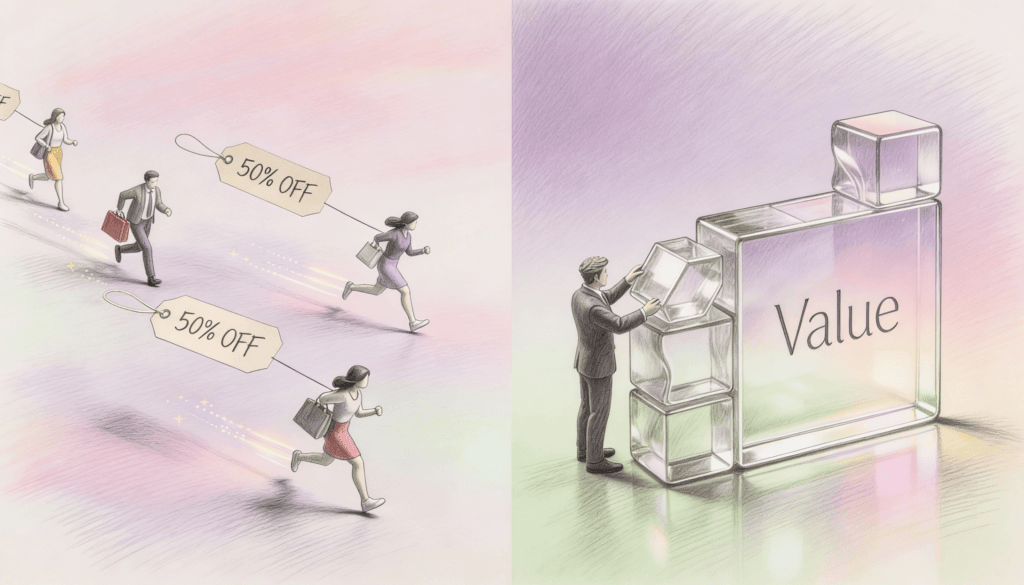
This peculiar tendency reveals something fundamental about how we think about money. We are hardwired to respond to price signals, yet the people who accumulate real wealth operate on an entirely different frequency. They think in terms of value. And the gap between these two concepts is where most financial decisions either flourish or fail.
The Dopamine Hit of a Bargain
There’s a reason clearance racks exist in the back of every store and flash sales dominate our inbox. Retailers understand that the human brain releases dopamine when it perceives a bargain. The same neurological reward system that lights up when we eat chocolate or hear a favorite song activates when we believe we’re paying less than something is worth.
But here’s the trick. The pleasure comes from the perception of saving, not from acquiring something valuable. You can feel fantastic about buying a designer jacket at 70% off and still end up with something you wear twice. The price made you feel smart. The value proposition was questionable from the start.
This explains why people will drive across town to save three dollars on groceries but won’t spend an afternoon learning about compound interest. One offers an immediate, tangible win. The other requires abstract thinking about future benefits that feel distant and uncertain. Our brains prefer the bird in hand, even when the two in the bush are worth exponentially more.
Value Hides in Plain Sight
Value doesn’t announce itself the way price does. Price is printed on a tag, displayed in bold numbers, impossible to miss. Value requires investigation. It demands that you ask uncomfortable questions about utility, longevity, opportunity cost, and what you’re actually trying to accomplish.
Consider the person who buys the cheapest laptop available because it costs $300 instead of $800. Seems reasonable on the surface. But if that laptop frustrates them daily, crashes during important moments, and needs replacing in eighteen months, while the $800 machine would have served them flawlessly for five years, which purchase demonstrated better judgment?
The $300 buyer won on price. The hypothetical $800 buyer would have won on value. But our brains struggle with this calculation because it requires projecting into an uncertain future and weighing intangibles like frustration, lost time, and opportunity.
This same dynamic plays out in every corner of financial life. The cheapest insurance until you need it. The budget lawyer who misses a crucial detail. The discount investment advisor who parks your money in high fee funds. Price is seductive because it’s simple. Value is invisible until it proves itself over time.
The Warren Buffett Paradox
Warren Buffett lives in a house he bought in 1958 for $31,500. He drives modest cars. He famously eats McDonald’s for breakfast and drinks multiple cans of Coca Cola daily. By conventional measures, one of the world’s richest people lives like someone decidedly middle class.
Yet this is precisely backwards from how most people think about wealth. We assume rich people should display their riches. Buffett’s approach reveals a different framework entirely. He spends money on things that provide genuine value to his life and ignores everything else, regardless of what society expects someone with his net worth to purchase.
The paradox is that his indifference to price tags on consumer goods exists alongside an obsessive focus on value when it comes to investments. He will analyze a company for months, read through decades of annual reports, and walk away from deals that seem cheap if he questions the underlying value. Price matters to him only in relation to value, never in isolation.
Most people invert this completely. They obsess over small price differences in everyday purchases while making massive financial decisions, buying homes or cars or taking jobs, based on superficial factors rather than deep value analysis. We will research a $50 toaster for two hours but accept a job offer in a dying industry because the salary number looked good.
Why Markets Reward Value Thinking
Stock markets provide perhaps the clearest laboratory for observing the price versus value dynamic. Over short periods, price dominates everything. Stocks swing based on headlines, rumors, momentum, and mass psychology. Price becomes untethered from underlying reality.
But extend the timeline and something remarkable happens. The market becomes a weighing machine rather than a voting machine, as Benjamin Graham observed. Companies with strong fundamentals, competitive advantages, and actual earnings power tend to appreciate. Hype stocks with compelling stories but no substance tend to crater.
The investors who build generational wealth aren’t the ones chasing the hottest stock or trying to time market swings. They’re the ones asking whether a company will matter in ten years. Whether its products solve real problems. Whether management allocates capital wisely. Whether the business model makes inherent sense.
These are value questions. They require thinking past the current price to what something is genuinely worth. And here’s the beautiful irony: by ignoring short term price movements and focusing on long term value, patient investors often end up buying at excellent prices anyway. Fear and impatience regularly create opportunities where price falls well below value.
The Education Premium Nobody Talks About
Education represents another arena where our confusion between price and value creates bizarre outcomes. Parents will pay extraordinary sums for elite university degrees, treating the credential as inherently valuable regardless of what their child studies or whether they engage with the material.
Meanwhile, someone can access world class lectures from Nobel Prize winners for free online, read the same textbooks for a fraction of bookstore prices, and build a portfolio of real work that demonstrates competence, all while spending virtually nothing. The price is radically different. But which path creates more value depends entirely on the individual, their goals, their discipline, and what they actually do with the resources available.
The expensive degree might provide tremendous value through networking, credentialing, and forced structure for someone who needs those elements. Or it might provide minimal value to someone who sleepwalks through four years and emerges with debt but no direction. The free education might be worthless to someone lacking self discipline or priceless to someone who treats it seriously and builds something meaningful.
Value emerges from the interaction between resource and person, not from price tags. Yet we persistently treat expensive things as automatically valuable and cheap things as automatically inferior, regardless of context.
Time as the Hidden Variable
Perhaps the deepest confusion between price and value involves time itself. Price is instantaneous. You see it, you pay it, transaction complete. Value unfolds across extended timelines, compounding in ways that are difficult to visualize when you’re making a decision.
This is why wealthy people think carefully about buying time. They’ll pay for services that free up hours for high value activities. They’ll invest in tools or systems that create leverage. They understand that time is the ultimate constraint and that optimizing for short term price savings often means squandering something far more precious.
Someone making $200 an hour who spends three hours comparison shopping to save $50 on a purchase hasn’t won. They’ve lost $600 in opportunity cost, even if their brain gives them a satisfaction hit for finding a good deal. The price conscious decision was the value destructive one.
The same principle applies to skill development, relationship building, and health maintenance. These investments often have unclear prices, certainly unclear immediate returns, but generate enormous value across years and decades. We underinvest in all of them because our minds struggle to weigh present costs against diffuse future benefits.
The Status Trap
Status goods introduce a fascinating wrinkle into the price versus value equation. A luxury handbag might cost fifty times what a functional equivalent costs, yet provide tremendous value to someone for whom it opens social or professional doors. Or it might provide zero value beyond a temporary ego boost.
The trouble is that we rarely think clearly about whether status purchases are actually moving us toward our goals or just feeding a psychological need that could be met more efficiently. The person buying a luxury car to impress neighbors they don’t like isn’t making a value based decision. They’re making an emotional decision and retrofitting a value narrative.
Real wealth tends to be quiet precisely because truly wealthy people stop needing external validation. They can afford anything, so they become free to buy only what they actually value. Meanwhile, people stretching to afford status symbols are trapped in a performance that costs more the longer it continues.
The irony is that the genuine confidence and security that come from building real financial stability are far more attractive than any branded accessory. But they take years to develop and don’t come in a shopping bag.
When Cheap Becomes Expensive
Some of the most expensive mistakes in life come from choosing the lowest price option. The cheap contractor who seems like a bargain until you’re living with structural problems. The budget medical procedure in a country with questionable standards. The discounted professional service that creates legal or financial complications requiring expensive fixes.
These aren’t hypothetical examples. They represent recurring patterns where the initial price savings multiply into far larger eventual costs. The value conscious person asks what could go wrong, what quality really means in this context, and whether saving money upfront is worth the tail risk.
This requires a different kind of thinking than price comparison. It requires imagination about failure modes, understanding of what expertise actually provides, and honest assessment of your own ability to evaluate quality. Most people skip these steps because they’re harder than looking at numbers.
Building the Value Muscle
The shift from price based to value based thinking isn’t a switch you flip. It’s a muscle you build through practice and reflection. It starts with asking better questions before purchases, large or small.
Not “what does this cost” but “what problem am I solving.” Not “is this a good deal” but “will I be glad I own this in a year.” Not “can I afford this” but “is this the best use of these resources given everything else I’m trying to accomplish.”
These questions feel awkward at first because they require confronting uncertainty and acknowledging tradeoffs. Price comparison feels scientific and objective. Value assessment feels squishy and subjective. But that subjective squishiness is where wisdom lives.
The people who build lasting wealth make thousands of small decisions through a value filter. They develop an intuition for distinguishing what matters from what doesn’t. They get comfortable walking away from deals that are cheap but pointless and paying premium prices for things that genuinely improve their lives or create opportunities.
The Long Game
In the end, the distinction between price and value is really a distinction between short term and long term thinking. Price optimization is a tactic. Value creation is a strategy. Tactics without strategy produce random results. Strategy executed through sound tactics compounds into something powerful.
The person who saves $30 on a restaurant meal by choosing the cheaper option gets to keep $30 today. The person who spends $30 having a meaningful conversation with a mentor over that meal might gain an insight worth $30,000. Both decisions involve $30. Only one of them involves thinking about value.
This is why wealth building looks boring from the outside. It’s consistent choices that don’t make for interesting stories. It’s passing on purchases that seem appealing to invest in assets that seem abstract. It’s delayed gratification compounded across decades. It’s thinking about what builds versus what impresses.
The love of price is human and understandable. Our brains evolved to notice immediate threats and opportunities, not to optimize across multi decade timelines. But understanding this tendency is the first step toward overriding it when it matters.
Wealth isn’t built by people who find the best deals. It’s built by people who make decisions based on value, even when that means paying more, waiting longer, or choosing options that look worse on spreadsheets but better in reality. The price tag tells you what you’ll pay today. The value proposition tells you what you’ll have tomorrow. And in that gap between payment and outcome, fortunes are made or squandered based on which question you learn to ask.