Table of Contents
Everyone knows the secret to investment success. Buy low, sell high. It’s so simple that a child could understand it. Yet somehow, this basic principle has bankrupted more investors than any complex financial instrument ever could.
The irony is almost perfect. The one thing everyone agrees on is the one thing almost nobody can do. When prices fall, wallets snap shut. When prices soar, money flows like water. We’re all aware of this pattern. We mock it in others. We swear we won’t repeat it ourselves. And then we do it anyway.
This isn’t stupidity. It’s not ignorance. It’s something far more interesting and far more difficult to overcome. The human brain, shaped by millions of years of evolution, simply wasn’t designed to excel at buying the dip.
The Mammalian Problem
Consider the gazelle watching a lion approach. Every instinct screams the same message: run. The gazelle that stops to consider whether the lion might be tired, whether the grass is greener here, whether this presents an opportunity for personal growth, becomes lunch. Evolution rewards creatures who treat danger as danger and flee accordingly.
Financial markets reverse this logic entirely. The moments that trigger our deepest survival instincts, when everything appears to be falling apart, when the herd is stampeding away, these are precisely the moments when staying put or moving closer offers the greatest reward. We’re being asked to act like that philosophical gazelle, the one who became extinct precisely because it spent too much time thinking.
The uncomfortable truth is that buying the dip requires you to suppress reactions that kept your ancestors alive. When markets crash, your amygdala doesn’t care about long term returns. It detects a threat to your resources and initiates a stress response identical to the one that helped humans survive famine, predators, and tribal warfare. Your body is doing exactly what it should do. It’s just that financial markets operate in a reality your body doesn’t recognize.
The Pain of Falling Knives
There’s a saying in trading: don’t try to catch a falling knife. The metaphor is visceral for a reason. Watching your investment drop feels like physical injury. Brain scans show that financial loss activates the same neural regions as physical pain. This isn’t mere analogy. Your brain genuinely cannot distinguish between losing money and losing blood.
Now imagine the pitch: “See that knife plummeting toward the ground? Stick your hand out.” This is what buying the dip asks of you. The rational mind knows that once the knife has landed, picking it up is safe and profitable. But the knife hasn’t landed yet. It’s still falling. And every day it falls further, your brain becomes more convinced that it will keep falling forever.
This is where the psychology becomes truly perverse. The better the opportunity becomes, the worse it feels. A stock that’s down 20% might be a decent value. Down 40%? Probably better. Down 60%? Could be excellent. But your emotional experience inverts this reality. At 60% down, you’re not thinking about opportunity. You’re thinking about the 40% more it could fall. You’re thinking about becoming one of those cautionary tales people tell at dinner parties.
The Social Proof Spiral
Humans are social creatures. We survived because we paid attention to what others were doing. If everyone in the tribe suddenly starts running, you run too. You don’t stop to analyze whether there’s actually a threat. The ones who stopped to analyze got left behind.
Markets crash in herds for this exact reason. The initial selling might start from rational concerns. But it accelerates because of social proof. If everyone else is selling, maybe they know something you don’t. This logic is usually sound in everyday life. The restaurant with no customers probably isn’t very good. The store having a closing sale is actually closing. The project everyone is abandoning probably has serious problems.
But in markets, social proof becomes social doom. The very mechanism that protects you in normal life destroys you in investing. Everyone selling creates the opportunity. But everyone selling also creates the overwhelming psychological signal that selling is the correct action. You’re not just fighting your own fear. You’re fighting the accumulated fear of millions of people, all of whom seem very certain that holding or buying would be insane.
The dip buyer must become a social contrarian. Not in a loud, performative way. But in the quiet certainty that the crowd, right now, in this moment, is wrong. This psychological position is nearly impossible to maintain. It feels like arrogance. It feels like delusion. And occasionally, it is both of those things. The crowd is sometimes right. Discerning when requires a level of emotional detachment that borders on the pathological.
The Narrative Addiction
Markets don’t just move. They move with stories attached. These stories explain why the move is happening and, more importantly, why it will continue. During a crash, the narratives are apocalyptic. The financial system is broken. The economy is doomed. This time really is different. Everything you thought you knew was wrong.
These stories are incredibly compelling because they’re often partially true. Markets usually crash for reasons. There usually is bad news. The narratives aren’t lies. They’re just incomplete. They focus on the present crisis and extrapolate it infinitely forward.
The human brain is a story processing machine. We don’t experience reality directly. We experience the stories we tell ourselves about reality. And during a market crash, the only story that makes sense is a story of continued decline. Buying the dip requires you to believe a story that has no evidence yet. You’re writing fiction while everyone else is reporting news.
This is why investors consistently buy the narrative instead of the asset. When a stock is soaring, the narrative is transformation, disruption, the future arriving ahead of schedule. When that same stock collapses, the narrative becomes obsolescence, fraud, the emperor has no clothes. The company might be essentially the same. But the story has changed, and humans trade stories far more readily than they trade balance sheets.
The Phantom of Perfect Timing
Many investors avoid buying the dip not because they don’t want to, but because they’re waiting for the bottom. They’ll buy low, but they want to buy lowest. This seems reasonable. Why buy today if it’ll be cheaper tomorrow?
This logic contains a hidden trap. The bottom is only visible in retrospect. While you’re living through it, any day could be the bottom or could be the middle of a much larger decline. Waiting for certainty means waiting until the bottom is past. And once the bottom is clearly past, prices are no longer low.
The quest for perfect timing is really a quest for comfort. If you can identify the exact bottom, you eliminate the risk of looking foolish. You eliminate the pain of watching your purchase immediately decline in value. But this comfort costs you the opportunity entirely. The market doesn’t reward patience in this scenario. It rewards tolerance for ambiguity.
There’s a deeper issue too. Even if you somehow bought at the exact bottom, you still wouldn’t feel good about it. At the actual bottom, the despair is at its maximum. The narratives are at their most convincing. The social proof is unanimous. Buying at the bottom means buying when it feels worst, when every signal screams that you’re making a catastrophic mistake. The emotional experience is identical whether you bought at the bottom or 20% above it. You suffer the same psychological torture either way.
The Commitment Problem
Buying the dip isn’t a single decision. It’s a decision you have to reaffirm every single day as your investment continues to decline. This is fundamentally different from holding an investment that rises. Rising investments validate your decision constantly. Falling investments challenge it constantly.
Every morning you wake up to your investment being worth less than when you went to sleep. Every check of your portfolio is a reminder that you were wrong. The market is telling you, in the clearest possible language, that your judgment was flawed. And it’s not telling you this once. It’s telling you this every hour of every day until the investment recovers.
The psychological term for this is commitment escalation. You’ve made a decision. That decision is proving costly. Do you admit error and exit, or do you commit further and buy more? Both options feel terrible. Exiting means accepting the loss and admitting you were wrong. Buying more means throwing good money after bad, the classic blunder every investor is warned against.
This is where the real psychological innovation of dip buying exists. It requires you to separate your judgment from the market’s judgment. The market says you’re wrong. You must somehow maintain the belief that you’re right while remaining intellectually honest enough to change your mind if the facts actually do change. This is an incredibly sophisticated mental operation. Most people can’t do it. They either become stubbornly committed regardless of evidence, or they fold at the first sign of trouble.
The Mirror and The Crowd
Here’s what makes buying the dip especially cruel. The people who can’t do it know they can’t do it. After every market recovery, the same investors who sold at the bottom swear they’ll behave differently next time. They study the charts. They see the pattern clearly. Buy when there’s blood in the streets. They’re completely convinced they’ve learned the lesson.
Then the next crash comes, and they do exactly the same thing. Because knowing what you should do and being able to do it are entirely different capabilities. You can understand intellectually that the crash is an opportunity while simultaneously experiencing it emotionally as a catastrophe. And emotions almost always win.
This creates a strange dynamic where investors are simultaneously aware of their own psychological limitations and completely unable to overcome them. It’s like watching yourself make a mistake in slow motion. You see it happening. You know what’s happening. You might even be able to articulate why it’s happening. And you do it anyway.
The few investors who succeed at buying the dip aren’t necessarily smarter. They’re psychologically different. Some are genuinely less sensitive to loss. Some have trained themselves through years of practice. Some simply have enough capital that individual positions don’t matter emotionally. But they’re outliers. For most people, the psychological barriers aren’t bugs to be fixed. They’re fundamental features of human cognition.
The Exit Nobody Talks About
Even if you successfully buy the dip, you face another psychological gauntlet: selling when you should. The same contrarian impulse that made you buy when others sold can make you hold too long on the recovery. You’ve proven the crowd wrong once. That success can make you overconfident about proving them wrong again.
Many successful dip buyers become unsuccessful dip holders. They rode the investment down and back up, and then watched it go back down again because they couldn’t bring themselves to take profits. The skill of buying low is useless without the separate skill of selling high. And selling high has its own psychological impossibilities. It requires you to exit while things feel good, while the story is compelling, while everyone else is buying.
The complete investor needs two contradictory personalities. One that buys during terror and one that sells during euphoria. Most people can’t even manage one of these. Having both is almost paradoxical. It’s not a skill set. It’s a psychological flexibility that runs counter to how human emotions normally operate.
The Reasonable Alternative
None of this means you should try to time markets or beat the professionals at their own game. The psychological impossibility of buying the dip is precisely why index investing works. You remove the decision entirely. When markets fall, you keep buying automatically through dollar cost averaging. You’re not making a brave contrarian call. You’re not fighting your instincts. You’re just following a mechanical process.
This is less heroic but far more effective for most people. The cult of the dip attracts people who want to prove something, either to themselves or to others. They want the story of how they were brave when others were fearful. But investment success isn’t about having a good story. It’s about ending up with more money than you started with.
The ultimate insight isn’t that you should learn to buy the dip. It’s that you should recognize if you’re psychologically capable of it. Most people aren’t, and that’s fine. The market doesn’t care about your courage. It doesn’t reward psychological sophistication directly. It rewards results. And for most investors, the results come from avoiding the psychological battle entirely rather than trying to win it.
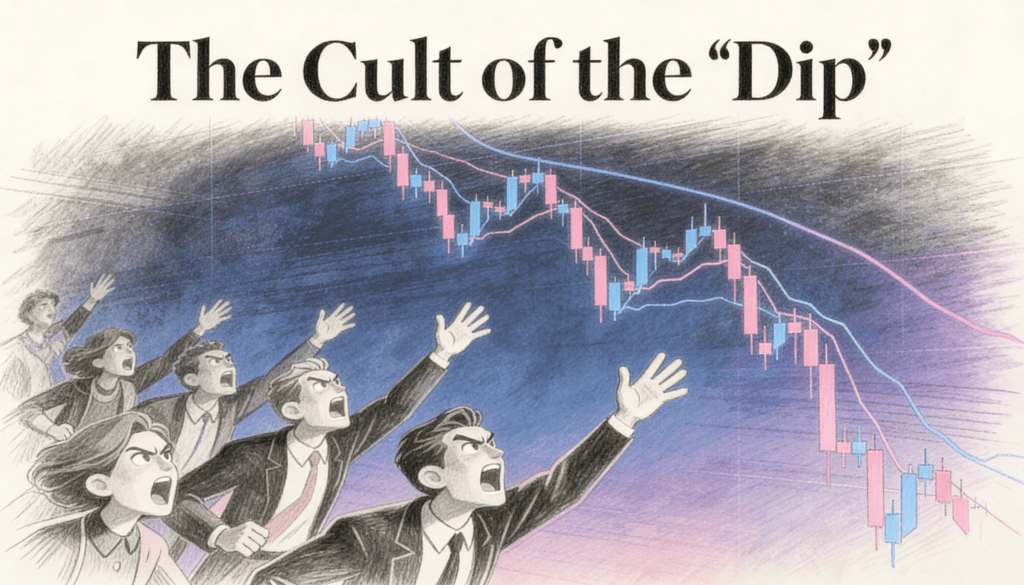
The dip will always be there, glittering like a mirage in the desert. And investors will always walk past it, convinced the next one will be different, convinced they’ll finally be able to do what everyone knows should be done. The pattern will repeat because the pattern isn’t about markets. It’s about minds. And minds change much more slowly than prices ever could.