Table of Contents
There’s a peculiar moment in every new investor’s journey when the market whispers sweet lies directly into their ear. It usually happens after a few successful trades, maybe a week or two of watching numbers tick upward. Suddenly, Warren Buffett seems like he’s been doing things the hard way. The investing books collecting dust on your shelf feel quaint, almost adorable in their caution. You’ve cracked the code, and it turns out the code was always quite simple.
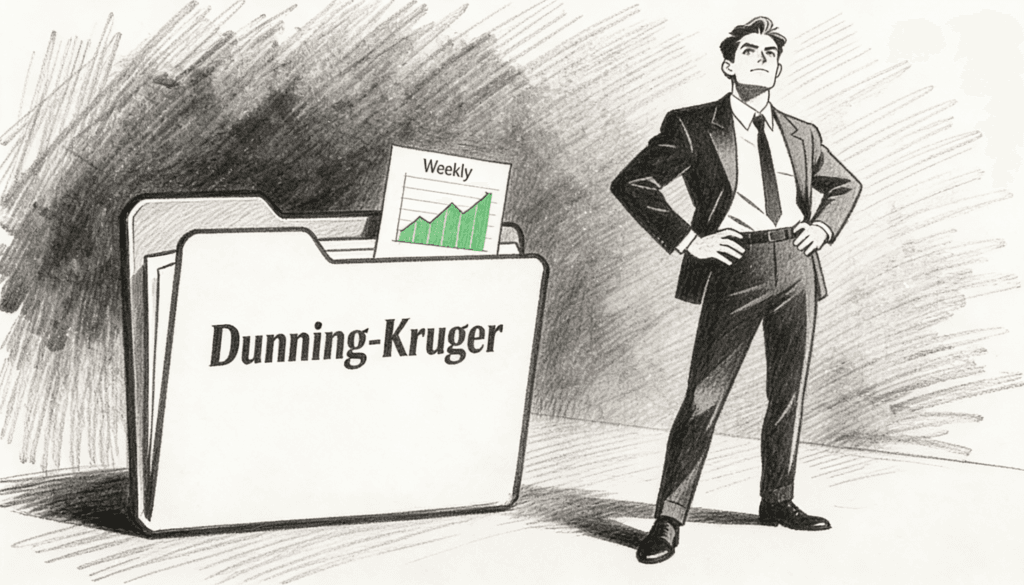
This is the Dunning-Kruger effect in full bloom, and it’s transforming your portfolio into a monument to misplaced confidence.
The Dunning-Kruger effect, for those mercifully unfamiliar, describes how people with limited knowledge in a domain consistently overestimate their competence. It’s not stupidity. It’s actually worse than that. It’s a cognitive blind spot. The cruel irony? The less you know, the more confident you feel. The more you actually learn, the more you realize how much you don’t know, and your confidence appropriately deflates.
In investing, this creates a predictable tragedy in three acts.
Act One: Beginner’s Luck Feels Like Genius
Let’s say you bought some tech stocks last month. Maybe you read a few articles, watched a YouTube video, absorbed some terminology. The stocks went up. Not slightly up. Meaningfully up. You made real money, the kind that makes you refresh your brokerage app at stoplights.
Your brain does something clever here, something it evolved to do over millions of years of pattern recognition. It connects your actions directly to the outcome. You researched, you bought, you profited. Cause and effect. The same neural pathway that helped your ancestors learn which berries were safe to eat now convinces you that you understand market dynamics.
But here’s what actually happened. You entered the market during a bullish phase. Or you bought companies that were already on everyone’s radar. Or you got lucky with timing. Or all three. The market was rising anyway, lifting your barely seaworthy raft along with the actual ships.
This distinction matters enormously, but it’s invisible to you. From inside your own experience, skill and luck are indistinguishable. They feel identical. They produce the same dopamine hit, the same sense of mastery, the same urge to tell people at dinner parties about your positions.
Consider how different this is from learning almost any other skill. When you first try to play guitar, the feedback is immediate and humbling. You sound terrible. There’s no confusion about whether you’ve mastered the instrument. When you attempt to speak a new language, native speakers politely pretend to understand you, but you know you’re fumbling. The gap between expert and novice is obvious.
Financial markets offer no such clarity. A complete amateur can outperform a seasoned professional for months, even years. This isn’t a bug in the market’s design. It’s a feature. Markets reward risk during bull runs without checking credentials. They hand out trophies to lucky and skilled alike, making no distinction in the short term.
Act Two: Complexity Disguised as Simplicity
After your initial success, you start developing theories. You notice that certain stocks move together. You spot patterns in charts. You develop rules: buy when this indicator crosses that line, sell when the news mentions these words, hold when you feel confident about the sector.
These theories feel sophisticated because they required effort to develop. You did research. You took notes. You ignored your family during dinner to check stock tickers. Surely this work produces insight.
But here’s the uncomfortable truth. The financial markets are among the most complex systems humans have ever created. They’re adaptive, reflexive, and influenced by millions of participants with different information, goals, and timelines. They respond to everything from interest rates and earnings reports to geopolitical events and viral tweets. They incorporate the collective predictions of people who have spent decades studying markets, people with advanced degrees, teams of analysts, and algorithms processing terabytes of data per second.
Your pattern, the one you spotted after studying charts for a few evenings, is almost certainly noise dressed up as signal. It’s a constellation you drew in random stars. The pattern feels real because humans are pattern-detection machines. We find faces in clouds and meaning in coincidence. This capacity helped us survive as a species. It’s also why we see trading strategies in random price movements.
The philosopher Nassim Taleb calls this “narrative fallacy,” our tendency to create stories that explain the past in ways that feel inevitable, even when randomness played the central role. After a stock rises, we construct reasons why it had to rise. The fundamentals were strong. The sector was hot. The CEO gave a compelling interview. We reverse-engineer causation from correlation, building a story that makes us feel we understand what happened.
The most dangerous moment isn’t when you’re wrong about the market. It’s when you’re right for the wrong reasons. That cements the faulty mental model. It convinces you that your theory works, that you’ve developed genuine insight, when really you’ve just experienced another round of luck.
Act Three: The Market Teaches Its Lesson
Eventually, the market turns. Not because it knows you’ve gotten cocky, though the timing always feels personal. It turns because markets turn. They cycle. They correct. They respond to factors you weren’t monitoring because you didn’t know they mattered.
Your positions start bleeding red. At first, you hold firm. This is just volatility. This is when weak hands fold and strong hands buy the dip. You’ve read about this. You’re prepared.
But it keeps dropping. Your unrealized gains evaporate, then your initial capital starts eroding. The stocks you researched, the ones with compelling stories and promising charts, now have equally compelling stories about why they’re declining. The same analysts who rated them “strong buy” now explain why the warning signs were always there.
This is when the learning actually begins, though it doesn’t feel like learning. It feels like betrayal. The market seemed to validate your intelligence, then snatched that validation away. But what’s really happening is reality reasserting itself. The noise is reverting to its mean. The luck is running out. The difference between your actual skill level and the results you were getting is becoming visible.
Some investors never recover from this phase. They decide markets are rigged or irrational. They retreat, bitter about a system that seemed to promise easy returns before revealing itself as treacherous. Others double down, convinced they just need to try harder, read more, trade faster. They’re still in denial about the gap between their competence and their confidence.
The investors who actually grow do something harder. They get humble.
The Valley of Despair and the Slope of Enlightenment
There’s a popular graph in learning theory that maps confidence against competence. It starts with the peak of inflated expectations, where beginners sit after early success. Then comes the trough of disillusionment, where reality hits. Eventually, if you persist, you climb the slope of enlightenment toward the plateau of sustainability.
The investing journey follows this arc with painful precision. The peak is that first green week. The trough is watching your portfolio crater while you realize you understood nothing. The slope is the years of actual learning that follow, if you stick with it.
What does real learning look like in investing? It’s less exciting than the beginner phase. You start understanding risk management. You develop genuine diversification strategies rather than just owning five tech stocks and calling it diversified. You learn that your goal isn’t to beat the market every quarter but to stay in the game long enough for compound interest to work its slow magic.
You also learn what you don’t know. You accept that you can’t predict short-term market movements with consistency. You recognize that the professionals with decades of experience and enormous resources also can’t predict short-term movements with consistency. You understand that investing well is less about brilliant stock picking and more about behavior management, fee minimization, and tax efficiency.
This knowledge feels less thrilling than those first wins. There’s no dopamine rush in rebalancing your portfolio or maxing out a retirement account. But this is where actual wealth gets built, in the boring accumulation of assets over decades, not in the exciting speculation over weeks.
Why Smart People Fall Hardest
Here’s a counterintuitive twist. The Dunning-Kruger effect often hits intelligent, successful people harder than others. If you’ve excelled in your career, if you’ve solved complex problems in other domains, you have evidence that you’re capable. This evidence is real. You are capable.
The trap is assuming that capability transfers across domains without adaptation. A brilliant surgeon can be a terrible investor. A talented engineer can lose money as reliably as someone who barely graduated high school. Intelligence helps, but it’s not sufficient. It might even hurt if it makes you confident enough to ignore the basics while attempting sophisticated strategies.
There’s a parallel here to chess. A smart person with no chess training will quickly beat other beginners. They’ll spot obvious tactics, avoid stupid blunders, think a few moves ahead. They’ll feel quite good about their chess ability. Then they’ll play someone who’s studied chess seriously for even a year, and they’ll get destroyed. The depth of chess mastery, the centuries of accumulated theory, the patterns that experts recognize automatically, all of this was invisible to them. They were good relative to other novices but nowhere near actual competence.
Markets work the same way. You can be smart enough to beat other confused beginners, skilled enough to profit during easy conditions, but still be miles away from genuine expertise. The difference is that in chess, you immediately know you’ve been beaten. In investing, you can lose while convincing yourself you’re actually winning, at least until you check your account balance.
The Social Amplification Effect
The Dunning-Kruger portfolio problem gets worse when you share your wins on social media. Every time you post about a successful trade, every time someone asks how you’re doing it, every time you explain your strategy to friends, you’re reinforcing the narrative of your own competence.
Social validation is a powerful drug. It’s why people trade more actively on platforms with social features, why trading apps gamify the experience, why investment message boards exist. We’re social creatures. We crave approval and status. A portfolio full of green numbers becomes not just personal success but social proof of intelligence.
This creates a toxic feedback loop. You make a lucky trade, you share it, people congratulate you, you feel more confident, you take bigger risks, you get lucky again, you share more, your audience grows. You’re becoming an influencer now, someone whose opinions on the market matter to others. Except your opinions are built on a foundation of luck misidentified as skill.
When the inevitable downturn comes, you face a new problem. You’ve publicly committed to your competence. You’ve built an identity around being good at this. Admitting you were wrong, that you got lucky, that you don’t actually know what you’re doing, means public humiliation. So instead, you double down. You explain why the market is wrong, why your thesis just needs more time, why the losses are temporary. You’re now trapped by your own narrative.
The Antidote: Structured Humility
So how do you avoid building a Dunning-Kruger portfolio? How do you separate luck from skill when both feel identical?
The answer isn’t to never trust yourself or to avoid investing entirely. It’s to build structured humility into your approach. This means creating systems that protect you from your own overconfidence.
Start by assuming you know less than you think. Not as a pose or false modesty, but as an accurate assessment. If you’ve been investing for less than a full market cycle, which usually means at least five to seven years including both bull and bear markets, you simply haven’t gathered enough data about your own abilities. You haven’t been tested by enough market conditions. Your track record, even if impressive, is incomplete.
Second, focus on process over outcomes. Good investors can lose money in the short term. Bad investors can make money in the short term. Judge yourself by whether you’re following a rational process, not by whether your portfolio happens to be green this month. Did you diversify appropriately for your risk tolerance? Did you avoid making emotional decisions? Did you stick to your strategy? These questions matter more than your returns over any brief period.
Third, study your failures more than your successes. When a trade goes well, you probably got something right, but you might have also gotten lucky. When a trade goes badly, you definitely got something wrong. That’s where the learning lives. Keep a trading journal. Record not just what you bought and sold, but why. When you’re wrong, force yourself to articulate what you misunderstood. This is painful. Do it anyway.
Fourth, embrace index funds and boring strategies. This isn’t admitting defeat. It’s acknowledging reality. The many of professional fund managers, people who do this for a living with teams and resources and decades of experience, fail to beat the market average over long periods. The odds that you’ll consistently beat it as a hobby investor are worse than the odds they face. Index funds aren’t exciting, but they work. They capture market returns with minimal fees and effort. They let you benefit from economic growth without pretending you can outsmart millions of other participants.
Finally, measure your competence against the right benchmark. If your portfolio is up fifteen percent and the overall market is up twenty percent, you didn’t win. You underperformed while taking on the risk and effort of active management. If your portfolio matches the market return, you’re doing fine, but you’re not demonstrating special skill. You’re just capturing the returns that any investor could capture with a simple index fund. Real outperformance, sustained over years and adjusted for risk, is exceptionally rare. If you think you’ve achieved it after one green week, you haven’t.
The Long Game
There’s something beautiful about genuinely understanding your own limitations. It’s freeing. Once you accept that you can’t predict short-term market movements, you stop trying. Once you recognize that most of your early success was luck, you stop building elaborate theories about your investment genius. Once you understand how complex markets really are, you develop appropriate respect for that complexity.
This doesn’t mean giving up on investing. It means investing wisely, which looks different than investing excitedly. It means building wealth slowly through consistent saving and broad diversification rather than chasing quick returns through concentrated bets. It means accepting smaller, more reliable gains over larger, more volatile swings. It means being boring.
The Dunning-Kruger effect tells us that confidence and competence follow different trajectories. In the beginning, your confidence outpaces your ability by a dangerous margin. With experience, if you’re learning correctly, your competence grows while your confidence moderates. Eventually, you might reach actual expertise, and your confidence will be calibrated appropriately.
But here’s the final irony. By the time you really understand investing, by the time you’ve studied for years and weathered multiple market cycles and developed genuine insight, you’ll probably conclude that simple strategies work best for most people. You’ll have traveled through complexity to arrive back at simplicity, but now you’ll understand why simple works.
That first green week wasn’t showing you that investing is easy. It was showing you how seductive it feels when luck masquerades as skill. The market wasn’t validating your intelligence. It was setting up a lesson about humility, though you wouldn’t recognize the lesson until much later.
The question isn’t whether you’ll build a Dunning-Kruger portfolio. Most investors do at some point. The question is whether you’ll recognize it for what it is, learn from the experience, and develop the structured humility that separates sustainable investors from those who flame out spectacularly.
Because the market will eventually teach you this lesson. You can learn it the easy way, by accepting your limitations early and investing accordingly. Or you can learn it the hard way, by losing money you couldn’t afford to lose while convinced you knew what you were doing. Either way, the market is patient. It has time. The only question is how much of your capital will survive the education.