Table of Contents
In biology, there is a concept called apoptosis. It is the programmed death of a cell. The cell receives a signal, and it quietly dismantles itself from within. No drama. No inflammation. Just an orderly exit so the organism can keep functioning. It is one of the most elegant processes in nature, and it happens billions of times a day inside your body without you ever noticing.
Markets are supposed to have their own version of apoptosis. Companies that no longer serve a purpose, that burn through capital without creating value, that exist only because someone keeps feeding them money, are supposed to die. Capital is supposed to flow away from waste and toward productivity. That is the theory, anyway. In practice, the story is far messier. Some companies refuse to die. Others eat themselves alive trying to look healthy. And a small group of investors has built entire careers around identifying both types and betting against them.
This is the world of long short equity, and specifically the dark art of shorting companies that probably should not exist. It sits at the intersection of financial analysis, corporate psychology, and something close to forensic investigation. To understand it well, you need to think less like a trader and more like a field biologist studying an ecosystem where the predators and the prey sometimes wear the same disguise.
The Cannibal: When Companies Eat Themselves
Start with the cannibal. In finance, a share buyback is often described as a company “eating its own shares.” When done well, it is a sign of confidence. Management believes the stock is undervalued, so they use excess cash to buy shares back from the market, reducing the total number outstanding and increasing the value of each remaining share. Warren Buffett has long praised this as a disciplined use of capital.
But here is where things get interesting. A buyback can also be a mask. When a company has no good ideas for growth, no promising projects, no reason for its cash to exist inside the business, it can buy back shares and create the illusion of progress. Earnings per share go up. Not because earnings grew, but because the denominator shrank. It is the financial equivalent of making a pizza look bigger by cutting it into fewer slices.
The cannibal, in this metaphor, is a company that has turned buybacks into its primary strategy. It is not investing in research. It is not expanding into new markets. It is not building anything. It is simply consuming itself, piece by piece, and reporting the result as growth. For a while, this works beautifully. The stock rises. Analysts applaud the “shareholder friendly” capital allocation. Everyone is happy.
Until the company runs out of itself to eat.
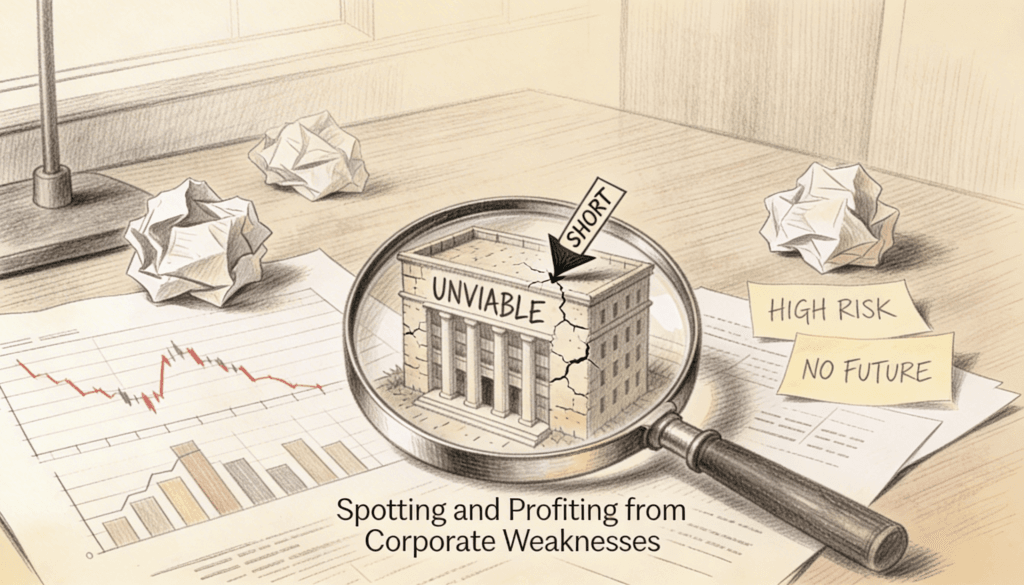
This is where the short seller enters the picture. A skilled short seller looks at a cannibal company and asks a deceptively simple question: what happens when the buybacks stop? If the answer is that revenue is flat, margins are shrinking, and the core business is slowly decaying, then the buyback program is not a strategy. It is a countdown. The short seller is not betting against the company so much as betting on the clock.
There is an irony here that is worth sitting with. The very mechanism that is supposed to signal strength, returning capital to shareholders, becomes the clearest signal of weakness when it is the only thing a company knows how to do. The cannibal looks healthy right up until it has consumed its last limb.
The Zombie: Dead but Still Walking
If the cannibal is a company eating itself, the zombie is a company that has already died but forgotten to fall down. The term “zombie company” entered mainstream financial vocabulary after the 2008 financial crisis, but the concept is much older. Japan’s “lost decade” in the 1990s was partly a story of zombie banks and zombie corporations propped up by cheap credit and a government unwilling to let them fail.
A zombie company, in its simplest definition, is one that cannot cover its debt with its profits. It survives only because interest rates are low enough, or lenders are patient enough, or new investors are naive enough to keep the lights on. It creates no value or not enough of value. It produces no real innovation. It simply occupies space in the economy that could be used by something alive.
Think of it like an ecology. In a healthy forest, dead trees fall and decompose. The nutrients return to the soil. New growth emerges. In a forest full of zombies, the dead trees remain standing. They block the sunlight. They take up root space. The forest looks dense and full from a distance, but nothing is actually growing.
When central banks hold interest rates near zero for extended periods, they are essentially keeping the dead trees standing. Companies that would have failed in a normal interest rate environment are able to roll over their debt indefinitely. They hire employees. They lease office space. They generate revenue. But they never generate enough profit to justify their existence on their own terms.
For a short seller, zombie companies present a particular kind of opportunity and a particular kind of trap. The opportunity is obvious: the company is fundamentally broken, and eventually gravity will win. The trap is timing. A zombie can walk for years. Sometimes decades. As John Maynard Keynes supposedly said, the market can remain irrational longer than you can remain solvent. Shorting a zombie is like betting that a bad movie will eventually end. You are probably right. But you might go broke waiting for the credits to roll.
This is why the best short sellers rarely short a zombie based purely on its zombie status. They look for a catalyst. A debt maturity wall approaching with no refinancing options. A key customer walking away. A regulatory change that removes the one subsidy keeping the company alive. Without a catalyst, a zombie short is just a thesis without a timeline, and in the short selling business, being right without a timeline is the same as being wrong.
The Ecosystem of Deception
There is a broader pattern here that connects cannibals and zombies, and it has to do with the stories companies tell about themselves. Every public company is, among other things, a narrative. It is a story told to investors, employees, customers, and regulators. The narrative says: we are growing, we are innovative, we are essential. And in many cases, the narrative is true.
But some companies become better at telling the story than at living it. They master the art of looking alive. They use financial engineering to smooth out earnings. They use acquisitions to obscure declining organic growth. They use debt to fund dividends that make them look like cash machines. They build elaborate structures of complexity that make it genuinely difficult for any outsider to tell the difference between real health and cosmetic health.
This is where short selling starts to resemble investigative journalism more than traditional investing. The best short sellers are often the people who read the footnotes. Not the headline earnings, not the press release, not the CEO’s confident tone on the conference call. The footnotes. Because that is where companies bury the things they do not want you to see. Changes in accounting methods. Related party transactions. Off balance sheet obligations. The slow bleed of quality masked by the loud performance of confidence.
In evolutionary biology, there is a concept called Batesian mimicry. A harmless species evolves to look like a dangerous one in order to avoid being eaten. A perfectly edible butterfly develops wing patterns identical to a toxic species. It works as long as predators cannot tell the difference.
Zombie and cannibal companies practice a corporate form of Batesian mimicry. They adopt the appearance of healthy, growing businesses. They mimic the signals: buybacks, dividends, acquisitions, confident guidance. And the mimicry works as long as the market cannot tell the difference. The short seller, in this framing, is the predator who has learned to see through the disguise.
Why the Market Keeps These Companies Alive
If these companies are so obviously broken, why do they persist? This is the question that separates casual observers from people who actually understand market structure.
The answer has several layers. The first is incentives. Asset managers are often benchmarked against indices. If a zombie company is in the index, the asset manager owns it regardless of its quality. Passive investing, for all its democratic virtues, is indifferent to whether a company deserves to exist. It buys everything in the index by definition. This creates a floor of demand for even the most questionable businesses.
The second layer is the agency problem. Corporate managers are not always aligned with shareholders. A CEO whose compensation is tied to revenue growth has every incentive to keep the company alive and growing in nominal terms, even if that growth destroys value. Acquisitions that make no strategic sense suddenly make perfect sense when you realize they increase the CEO’s empire and the size of the bonus pool. The company is not being run for the benefit of its owners. It is being run for the benefit of its operators. The organism serves the parasite.
The third layer is the most uncomfortable one: collective delusion. Markets are social systems. Beliefs spread through networks. If enough analysts cover a company favorably, enough funds own it, and enough media outlets write about it positively, the narrative becomes self reinforcing. The company is good because everyone says it is good. And everyone says it is good because the stock keeps going up. And the stock keeps going up because everyone keeps buying it.
The Mechanics of the Short
So how does one actually profit from identifying a company that should not exist? The mechanics of short selling are straightforward in concept but punishing in practice.
You borrow shares from someone who owns them. You sell those borrowed shares in the open market. You wait for the price to drop. You buy the shares back at the lower price and return them to the lender. The difference is your profit.
Simple enough. Except for all the ways it can go wrong.
When you buy a stock, the most you can lose is what you paid. If you buy a share for fifty dollars, you can lose fifty dollars. That is the floor. But when you short a stock, your potential loss is theoretically infinite. If you short a share at fifty dollars and it goes to five hundred dollars, you have lost four hundred and fifty dollars per share. There is no ceiling on how wrong you can be.
This asymmetry is the defining feature of short selling. It means that even when you are absolutely right about a company being worthless, you can still be destroyed by a temporary move against you. This is why short sellers tend to be a specific breed: part analyst, part risk manager, part stoic philosopher. You need the intellectual conviction to see through a false narrative, the technical skill to size your position correctly, and the emotional discipline to hold on while the market tells you that you are an idiot.
There is something almost Darwinian about the selection process for successful short sellers. The ones who survive tend to be obsessively detail oriented, naturally skeptical, comfortable with being disliked, and pathologically honest with themselves about what they do and do not know. These traits are not rewarded in most professional environments. In short selling, they are essential.
The Social Cost of Zombie Preservation
Here is a perspective that does not get enough attention: keeping zombie companies alive has a real cost, and it is not just financial.
When a bad company occupies market space that a good company could use, the economy loses something invisible but important. It loses dynamism. Talented employees work at companies going nowhere instead of companies that might change something. Capital sits in businesses that generate no return instead of flowing to entrepreneurs with better ideas. Real estate is occupied by offices that produce nothing of value.
Economists call this “capital misallocation,” but that term is too clinical. What it really means is wasted potential. Every dollar propping up a zombie is a dollar not building something new. Every engineer maintaining a dying product line is an engineer not inventing the next breakthrough. The cost is not measured in financial statements. It is measured in the things that never got built.
This is why short selling, for all its negative reputation, plays an essential role in market health. Short sellers are the immune system of the capital markets. They identify the cells that are not functioning properly and help accelerate their removal. Without them, the system becomes congested with waste. The forest fills with dead trees. The economy loses its ability to adapt and renew.
It is deeply counterintuitive. The people who profit from corporate failure are, in a meaningful sense, contributing to collective economic health. The person who identifies a fraud and shorts the stock is doing the market a service. The person who spots a zombie and bets against it is helping capital flow to where it belongs. The profit motive and the public good, in this specific case, point in the same direction.
The Moral Dimension
There is a persistent moral discomfort with short selling that is worth addressing directly. Profiting from someone else’s failure feels unseemly. When a short seller makes money, it often means employees lost their jobs, shareholders lost their savings, and communities lost an employer. The short seller did not cause these things, but they did benefit from them.
And yet. Consider the alternative. If no one is allowed to bet against bad companies, then bad companies persist longer. Frauds go undetected. Capital continues flowing to the wrong places. The eventual reckoning, when it comes, is larger and more painful than it needed to be. Enron was not exposed by regulators. It was exposed largely by short sellers and journalists who bothered to read the financial statements closely.
The harm is already happening inside the zombie or the cannibal. The short seller is not creating the disease. They are diagnosing it.
This does not mean all short selling is noble. There are predatory short sellers who spread false information to drive prices down. There are campaigns designed to destroy healthy companies through manufactured fear. These practices are harmful, and they are also illegal, though enforcement is inconsistent.
What Comes Next
The game evolves, but the underlying dynamics remain. There will always be companies that should not exist. There will always be mechanisms that keep them alive longer than they should be. And there will always be investors who look past the narrative, past the mimicry, past the shared fiction, and bet on reality.
The forest needs its fires. The body needs its apoptosis. And the market, whether it wants to admit it or not, needs its short sellers. Not because they are heroes. But because the alternative, a world where nothing is allowed to die, is far worse than the discomfort of letting nature take its course.