Table of Contents
You have read the books. You have watched the interviews. You have nodded along to every piece of advice about staying calm when markets drop. You have told yourself, with great confidence, that you are a long term investor who does not panic.
Then your portfolio drops 15% in a week and you become someone else entirely.
This is not a failure of character. It is not a failure of education. It is biology doing exactly what it was designed to do, at the worst possible time, in the worst possible context. Understanding what happens inside your skull during a market crash is not just interesting. It is, arguably, the most profitable thing you will ever learn about investing.
The Alarm System You Did Not Subscribe To
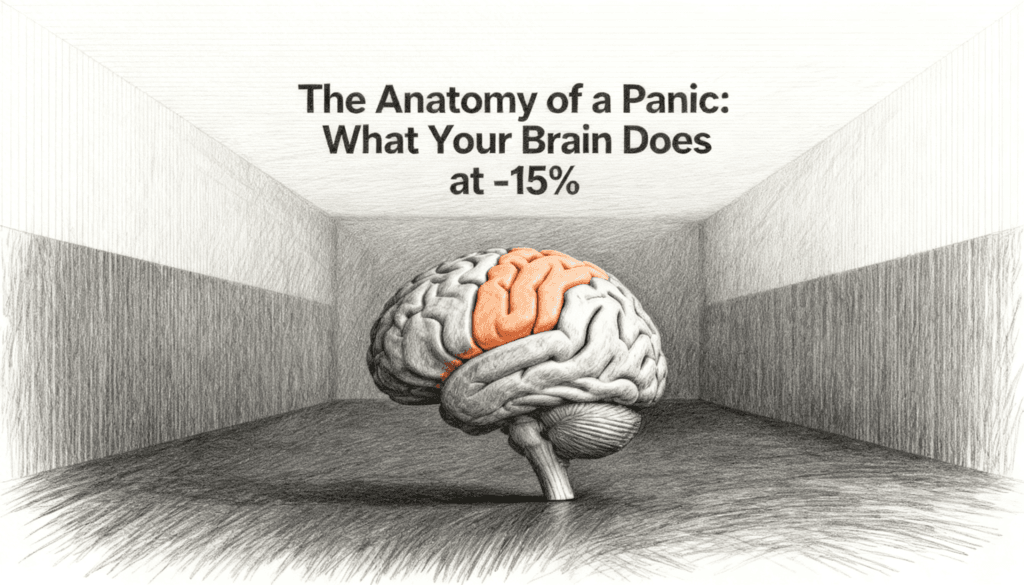
Deep inside your brain sits a small, almond shaped structure called the amygdala. It has one job and it does that job with terrifying efficiency. The amygdala is your threat detection center. It evolved to keep you alive on the savanna, where the cost of ignoring a rustling bush was death, and the cost of overreacting was just a little wasted energy.
Here is the problem. The amygdala does not know what a stock market is. It does not understand percentages. It cannot distinguish between a lion in the grass and a red number on a screen. What it can do, with remarkable speed, is detect that something important to your survival is disappearing. And when your portfolio falls 15%, your brain registers that as your resources vanishing. Your food supply shrinking. Your shelter becoming less secure.
The amygdala processes this threat faster than your conscious mind can intervene. We are talking seconds. Before you have finished reading the headline about why markets are falling, your body is already in fight or flight mode. Your heart rate is up. Your palms are sweating. Cortisol is flooding your bloodstream. You are, in every physiological sense, preparing to run from a predator.
The predator, of course, is a number on a screen. But your body does not care about that distinction.
The Hostile Takeover of Your Prefrontal Cortex
Under normal conditions, your prefrontal cortex is the adult in the room. It handles planning, reasoning, and impulse control. It is the part of your brain that looks at a 15% decline and says, “Well, historically, markets recover from this, and my time horizon is 20 years, so perhaps I should do nothing.”
That is excellent advice. The problem is that during a panic, the prefrontal cortex gets essentially overruled. Neuroscientists call this an amygdala hijack, a term coined by psychologist Daniel Goleman, and it describes a process where your emotional brain takes command and your rational brain gets demoted to spectator.
Think of it like a boardroom coup. The CEO who makes careful, evidence based decisions has just been shoved aside by the head of security, who is now screaming that the building is on fire. The head of security does not care about quarterly projections. He does not care about long term strategy. He cares about one thing: getting out alive.
This is why intelligent, educated, experienced investors sell at the bottom. It is not because they do not know better. It is because knowing better requires access to a part of the brain that has been temporarily taken offline.
Pain, Pleasure, and the Strange Math of Losing
In the 1970s, psychologists Daniel Kahneman and Amos Tversky discovered something that would reshape our understanding of economic behavior. They found that the pain of losing is roughly twice as powerful as the pleasure of gaining. Lose a hundred dollars and the emotional impact is about twice as intense as finding a hundred dollars.
This asymmetry, known as loss aversion, is not a quirk. It is a deep feature of human psychology, likely hardwired through millions of years of evolution. On the savanna, losing your food meant death. Finding extra food meant a nice afternoon. The stakes were not symmetrical, so our emotional responses are not symmetrical either.
Now apply this to a 15% portfolio drop. If you have a million dollars invested, you are looking at a $150,000 loss on paper. Your brain processes this with twice the emotional intensity it would use for a $150,000 gain. But it gets worse. The pain is not linear. As losses accumulate, each additional percentage point feels heavier than the last. The drop from minus 10% to minus 15% feels worse than the drop from zero to minus 5%, even though the arithmetic is the same.
This is why market crashes feel like they accelerate even when they do not. Your perception of pain is warping time and proportion. You are not experiencing the market as it is. You are experiencing it through a lens that was calibrated for a world where losses could kill you.
The Herd Was Smart Once
There is a popular narrative in investing circles that herd behavior is foolish. That following the crowd is what unsophisticated investors do. But this framing misses something important.
For most of human history, the herd was right. If everyone in your tribe started running in one direction, the correct move was to run with them and ask questions later. The individuals who stopped to independently analyze the situation were, statistically, more likely to get eaten. Natural selection did not favor the contrarian thinker on the savanna. It favored the fast follower.
This is the cruel irony of market panics. The very instinct that kept your ancestors alive is the one that destroys portfolio value. When you see everyone selling, when the headlines are apocalyptic, when your colleague mentions moving everything to cash, your brain interprets all of this as tribal knowledge about an approaching threat. The urge to join them is not stupidity. It is one of the most successful survival strategies in human history, ruthlessly misapplied.
What makes investing uniquely difficult is that it requires you to do something that no other domain of human life regularly demands: act against the consensus of your peers while experiencing genuine fear. That is not a natural behavior. That is a trained one.
Your Memory Is Not Helping
During a panic, your brain does something else that is both fascinating and unhelpful. It starts pulling up memories of previous losses. Not just investment losses. All losses. That time you trusted someone and got burned. That business venture that failed. That moment you should have acted but did not, or acted when you should not have.
This is your hippocampus working in concert with the amygdala, trying to be helpful. It is pattern matching. It is saying, “You have been in situations where things went wrong before. Here is how they felt. Here is what happened.” The intention is protective. The effect is paralyzing.
This is why second and third market crashes feel psychologically worse than the first, even if they are smaller in magnitude. You are not just processing the current loss. You are reliving every previous one simultaneously. Your brain has created a highlight reel of failure and it is playing on a loop at the exact moment you need clarity.
The Illusion of Action
Here is one of the most counterintuitive aspects of panic: doing nothing feels reckless. Selling feels responsible. This is backward, but it makes perfect sense from a neurological standpoint.
Your brain evolved in an environment where threats required physical response. See a snake, move away. Hear a growl, climb a tree. The idea that the optimal response to danger is to sit perfectly still and do absolutely nothing is, from an evolutionary perspective, absurd. Organisms that responded to threats with inaction did not tend to pass on their genes.
So when your portfolio is plummeting, your brain creates an almost unbearable urge to do something. Anything. Sell a position. Rebalance. Move to bonds. Call your advisor. The specific action almost does not matter. What matters, to your brain, is that you are not just sitting there while your resources disappear.
This is why many investors who sell during a crash describe feeling an immediate sense of relief, even though they have just locked in their losses. The relief is real. It is neurochemical. Cortisol levels drop when you take action against a perceived threat. Your brain rewards you for doing the exact wrong thing.
Meanwhile, the investor who does nothing, who sits with the discomfort, who lets the unrealized loss exist without responding, gets no neurochemical reward. They feel terrible the entire time. They are, in a very real sense, fighting their own biology every single minute. And they are usually the ones who come out ahead.
The 72 Hour Window
This has a practical implication that is almost too simple to feel meaningful: if you can survive three days without making a major financial decision during a panic, you will almost certainly make a better decision on day four than on day one. Not a perfect decision. Not a decision free from emotion. But a decision made with at least partial access to the part of your brain that can think about time horizons and historical precedent and probability.
The best investors in history have described, in various ways, this same basic practice. They create systems that prevent them from acting during the acute phase of a panic. Some use rules. Some use advisors as gatekeepers. Some, famously, simply turn off the screen and go do something else.
They are not doing this because they are braver than everyone else. They are doing it because they understand that they are, for about 72 hours, neurologically incapable of making good decisions. That is not weakness. That is self awareness operating at a very high level.
The Expensive Paradox
Here is the part that should bother you. The investors who feel the worst during a crash are usually the ones doing the right thing. And the investors who feel relief are usually the ones locking in damage.
Let that sit for a moment.
The entire reward structure of your brain is inverted when it comes to investing during a downturn. Comfort is expensive. Discomfort is profitable. The action that makes you feel safe is the one that harms you. The inaction that feels reckless is the one that protects you.
This is genuinely unusual. In most areas of life, your instincts are at least somewhat useful. In social situations, your gut feeling about a person is often right. In physical danger, your fear response is appropriate. Even in business, your intuition, built from experience, frequently points in a reasonable direction.
But in a market panic, your instincts are not just unhelpful. They are almost perfectly wrong. Every signal your brain sends you is the inverse of what would actually serve your interests. It is as if evolution designed a system specifically to make you a terrible investor, which, in a sense, it did. Evolution designed you to survive on a savanna. It did not design you to hold index funds through a correction.
What Knowing This Actually Buys You
Understanding the neuroscience of panic does not make you immune to it. You will still feel the fear. Your heart will still race. The urge to sell will still feel urgent and rational and completely justified.
But knowledge creates a small gap between stimulus and response. It is the difference between thinking “I need to sell everything right now” and thinking “My amygdala wants me to sell everything right now.” That second framing does not eliminate the emotion. But it gives you just enough distance to not act on it. Just enough room to wait for the 72 hours to pass. Just enough perspective to recognize that the voice in your head screaming about danger is the same voice that once screamed about rustling bushes.
Your brain at minus 15% is not broken. It is ancient. It is running software that was last updated about 200,000 years ago, in a world that looked nothing like this one. The panic you feel is a fossil, perfectly preserved, utterly convinced that your life is in danger.
Your job is not to silence it. Your job is to hear it, understand where it comes from, and then, with full respect for its evolutionary wisdom, do absolutely nothing.
That is the hardest thing in investing. It is also, over a lifetime, the most valuable.