Table of Contents
The Stock Picker and the Landlord Are the Same Person in Different Clothes
There is a specific kind of person who gets excited about a stock trading below its book value. There is another specific kind of person who gets excited about a triplex in a neighborhood nobody wants to drive through yet. These two people rarely end up at the same dinner party, and when they do, they usually discover something uncomfortable halfway through the second drink: they are the same person wearing different hats.
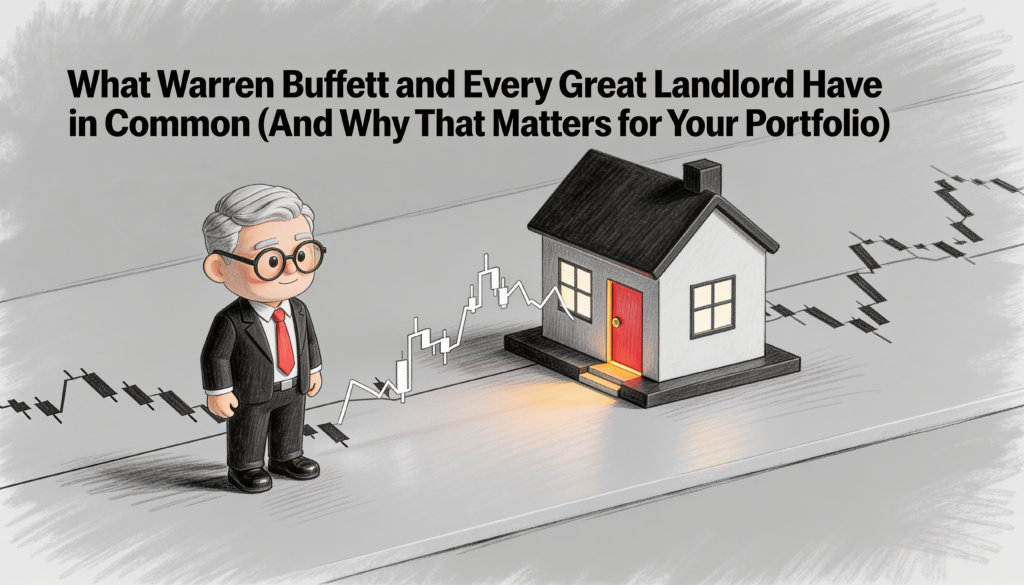
This is the quiet truth that connects Warren Buffett and every great landlord who has ever screened a tenant. Value investing and real estate investing are treated as separate religions. One belongs to the quiet men reading annual reports. The other belongs to the louder men in trucks inspecting basements. Strip away the costumes, though, and the underlying philosophy is almost identical. Buy something worth more than you paid for it. Wait. Try very hard not to do anything stupid in the meantime.
Buffett himself has made this connection explicit more than once. He likes to remind people that he thinks of stocks as fractional ownership of real businesses, the same way a landlord thinks of a building as a thing that produces rent. So why do these two groups still act like strangers who happen to share an elevator? The answer says something useful about how your own portfolio should be built.
The Same Instinct Playing on Two Different Fields
Benjamin Graham, the man who taught Buffett everything that mattered, instructed a generation of investors to look for dollars trading for fifty cents. He called it a margin of safety. The idea was that if you bought something cheap enough, the market could be wrong about it for a long time and you would still come out fine. Graham was not interested in predicting the future. He was interested in paying so little for the present that the future barely mattered.
Real estate investors figured out the same thing, just with walls. The oldest saying in property circles is that you make your money when you buy, not when you sell. That is Graham in work boots. It is the same discipline wearing different clothes.
You make your money when you buy, not when you sell. That single sentence is value investing translated into the language of brick and mortar.
Both Camps Are Comfortable Being Ignored
Both groups share a temperament that is genuinely rare in finance. They are comfortable being ignored. A value investor who finds a forgotten industrial company in Ohio and a real estate investor who finds a forgotten duplex in the same town are doing exactly the same thing. They are looking where nobody else is looking, because that is the only place where the prices still make sense. Popularity and bargains almost never share a zip code.
Buffett built his entire fortune on this idea. He bought See’s Candies, he bought a furniture store, he bought insurance companies, and he did it the way a careful landlord buys a building: by asking what the thing actually produces and refusing to pay more than that production is worth. The great landlord does the same calculation, just with rent rolls instead of earnings reports.
The Hidden Difference That Changes Everything
Here is where the two paths quietly split, and this difference matters more for your portfolio than almost anything else you will read about asset allocation.
A stock sits in a brokerage account. You can sell it on a Tuesday afternoon while eating a sandwich. A building sits on a street. You cannot sell it on a Tuesday afternoon under any circumstances. You can barely sell it in a month. Sometimes it takes a year. This is usually framed as a disadvantage of real estate. It is actually the secret weapon.
The value investor who buys a cheap stock has to watch it stay cheap, sometimes for years. Every morning the market opens and tells them they were wrong. Every evening some newsletter explains why the company is doomed. This is psychologically brutal, and most people cannot handle it. They sell too early, usually right before the thing finally works. The graveyard of value investing is full of people who had the right idea and the wrong stomach.
The Building Enforces the Patience You Lack
The real estate investor who buys a cheap building does not have this problem. Nobody tells them every morning that their building is worth less than they thought. There is no ticker. There is no red number flashing during lunch. The building just sits there, collecting rent, being a building. The investor is protected from their own worst instincts by the simple fact that they cannot easily act on them.
Patience is not a virtue you bring to real estate. It is a feature the asset enforces for you. The building does the discipline so your nerves do not have to.
This is one of the least appreciated ideas in all of finance. The same person can make money in real estate and lose money in stocks, not because they are smarter about buildings than about businesses, but because buildings do not give them the option to panic on a schedule. Buffett solved this same problem a different way. He treats his publicly traded stocks as if they were illiquid private businesses, refusing to check prices and pretending the market is closed for years at a time. He is, in his own words, behaving like a landlord who cannot sell the property even when he wants to.
The Cardigan and the Tool Belt Are Doing the Same Job
There is a stereotype that value investors are cerebral and real estate investors are practical. The cerebral ones read ten thousand page annual reports. The practical ones crawl under houses looking for termites. This is mostly true and mostly irrelevant.
What matters is that both jobs eventually come down to the same question. Is this thing going to produce more cash over time than I am paying for it right now? A stock is a claim on future earnings. A building is a claim on future rent. Both are just boxes that spit out money, one slowly and predictably, the other slowly and predictably with occasional plumbing emergencies.
What Each Side Refuses to Admit About the Other
The cardigan crowd tends to think the tool belt crowd is unsophisticated. The tool belt crowd tends to think the cardigan crowd lives in a fantasy. Both are partially right in ways that would annoy them if they admitted it.
Value investors underestimate how much real estate rewards operational competence. A stock does not care whether you are a good manager. A building cares enormously. The same property can be a great investment in one person’s hands and a disaster in another’s, depending on whether they know how to screen tenants, handle repairs, and say no to contractors who smell weakness. There is a craft to it that never shows up in a spreadsheet.
Real estate investors, meanwhile, underestimate how much stock investing rewards doing absolutely nothing. A great business compounds whether you pay attention to it or not. You do not have to unclog anything. You do not have to evict anyone. The work lives in the thinking rather than the doing, and the reward for thinking correctly one single time can stretch across decades. This is precisely why Buffett has held some positions for thirty years and counting. For the right business, the optimal activity level is almost zero.
The Ironic Overlap With Farming
Here is a connection that might seem strange but turns out to be the deepest one of all. The oldest form of value investing on earth is farming.
A farmer buys land that is underpriced for what it can grow. They improve it. They wait for the seasons. They collect what the land produces. They are not trying to outsmart anyone. They are trying to own a productive thing at a reasonable price and let nature do the compounding. Buffett, fittingly, often uses a farm as his favorite analogy for owning stocks. He bought a farm in Nebraska, never looked at its daily quoted price because there was none, and simply collected what it produced year after year.
Value investing is farming a business. Real estate is farming a building. Both are ancient ideas wrapped in modern packaging, and the only people surprised by this are the ones who were told that finance is complicated.
Finance is mostly not complicated. It is marketed that way by people who get paid the moment you believe it is. This matters because it reframes the entire debate. The question was never whether stocks or buildings are better. The real question is what kind of farmer you want to be. Some people are happier tending rows of businesses they will never physically visit. Some people are happier walking the property themselves on a Saturday morning. Neither choice is wrong. They are simply suited to different temperaments, and a thoughtful portfolio often holds room for both.
The One Place These Two Worlds Genuinely Disagree
If value investors and real estate investors agree on almost everything, there is exactly one battlefield where they draw their swords. That battlefield is debt, and understanding the disagreement protects you from the single most common way investors blow themselves up.
Value investors, trained by Graham and reinforced by Buffett, tend to treat debt as poison. A company carrying too much of it is fragile. A portfolio purchased with too much of it is a tragedy waiting for a date on the calendar. Buffett famously keeps mountains of cash and uses very little borrowed money, because he never wants to be a forced seller at the worst possible moment.
Why the Landlord Sees Debt as a Tool
Real estate investors see debt differently. They see it as a tool, frequently the main tool. The entire business model of small scale real estate often depends on using other people’s money to buy the building while the tenant slowly pays it off. That is not a flaw in the strategy. That is the strategy itself.
This is a real and meaningful difference, and it deserves to be sat with rather than dismissed. Neither side is wrong. They are solving different problems. A stock investor using heavy leverage is usually trying to amplify an opinion. A real estate investor using a mortgage is trying to buy a cash producing asset they otherwise could not afford, where the rental cash flow itself services the debt. The mechanics look similar. The logic could not be more different.
There is a lesson here for anyone who reads finance advice from either camp. Context matters more than rules. A principle that is wise in one asset class can be reckless in another. The investors who eventually get into trouble are almost always the ones who took a rule that worked beautifully in their home discipline and dragged it somewhere it never belonged.
The Quiet Truth Underneath Both Disciplines
If you listen carefully to value investors and real estate investors over a long enough stretch of years, you start to notice that they say the same things using different vocabularies.
- Do not overpay for anything, ever.
- Do not chase what everyone else is already chasing.
- Focus relentlessly on the cash a thing produces.
- Ignore the noise, the newsletters, and the neighbor with the hot tip.
- Be patient, and be willing to look foolish for an uncomfortably long time.
- Know exactly what you own and exactly why you own it.
These are not clever insights. They are the opposite of clever. They are obvious in the same way that sleeping enough and eating vegetables are obvious. The entire industry around both disciplines exists because obvious advice turns out to be nearly impossible to follow without a community reminding you of it constantly.
What This Means for Your Own Portfolio
Maybe that is the real lesson of watching these two groups argue across a room they should probably be sharing. The disciplines that actually work in finance are all variations of the same small set of unglamorous habits. The packaging changes. The deals change. The assets change. But the person who wins at value investing and the person who wins at real estate investing are, underneath the costume, doing the same patient and slightly boring thing.
For your portfolio, the practical takeaway is twofold. First, stop treating stocks and property as rival faiths and start treating them as two expressions of one principle: own productive assets bought at sensible prices and let time do the compounding. Second, choose the wrapper that matches your temperament. If you cannot stop yourself from selling during a crash, the illiquidity of a building may save you from your own hands. If you have no interest in midnight calls about a broken furnace, the silence of a quality business in a brokerage account may suit you far better. The asset you can hold calmly through a decade will always beat the asset you cannot.
The stock investor calls it a margin of safety. The property investor calls it buying right. The farmer calls it knowing the land. The grandmother who paid off her house and never once considered selling it calls it common sense. They are all telling exactly the same story. It is simply that only one of them is trying to sell you a course about it.