Table of Contents
There is a particular kind of investor who checks his portfolio at red lights. He knows the closing price of oil, the yield on the ten year treasury, and the exact percentage his net worth dropped during lunch. What he does not know is why his shoulders have been tight for three years, or why his wife stopped asking how the markets did.
He is winning, technically. The numbers are up. He is also losing something that does not appear on any brokerage statement, and that loss compounds quietly in the background, the way termites work.
We have built an entire culture around measuring wealth in figures that can be screenshotted. Returns, yields, multiples, ratios. The financial industry sells certainty in decimal points because decimal points are easy to print on a glossy report. But the most valuable asset a person can hold is almost impossible to quantify, which is probably why nobody talks about it. Peace of mind does not have a ticker symbol.
The Asset Nobody Lists on Their Balance Sheet
Consider what financial stress actually does to a human being. It does not politely wait until market hours to make its presence felt. It wakes you at three in the morning. It sits in the passenger seat during family dinners. It rewrites your personality in small ways you do not notice until your friends do.
Doctors have known for decades that chronic stress is linked to heart disease, weakened immunity, poor sleep, digestive problems, and a long list of other conditions that eventually require expensive medical attention. So here is the irony that the financial planning industry rarely brings up. The pursuit of more money, when done anxiously, can directly produce the medical bills, lost productivity, and shortened lifespan that erase the gains you were chasing in the first place.
You can earn fifteen percent a year and still go bankrupt in the ways that matter most.
What Warren Buffett Forgot to Mention
There is a famous line from Buffett about sleeping well at night being worth more than making an extra few percentage points. People nod when they hear it, then immediately go back to optimizing their portfolios for maximum return. The advice gets framed as folksy wisdom, something charming an old man says, rather than what it actually is, which is one of the most important financial principles ever spoken aloud.
Sleep is not a metaphor here. It is the literal thing. The hours you spend unconscious are when your body repairs itself, when your brain consolidates memory, when your hormones rebalance. A person who sacrifices sleep for returns is selling biological infrastructure for paper gains. The market does not know you exist. It will not send flowers when your back gives out.
The Borrowed Calm of Index Funds
Here is something contrarian, but only mildly. The rise of passive investing was not really a financial revolution. It was a mental health intervention disguised as a strategy.
When millions of people stopped trying to beat the market and started just owning it, they did not only get better returns on average. They got their evenings back. They stopped reading earnings reports. They stopped having opinions about the Federal Reserve at dinner parties. The genius of the index fund was not the math. The math had been understood for decades. The genius was that it gave permission to stop caring so much, and that permission turned out to be worth more than alpha.
This is what the industry will never put on a billboard. One of the best financial product of the last fifty years succeeded largely because it freed people from financial products.
Lifestyle Inflation as a Stress Subscription
Most people understand lifestyle inflation as a math problem. You make more, you spend more, you save the same percentage, you end up no further ahead. True enough. But the deeper cost is psychological.
Each upgrade to your life arrives with a small invisible tax. The bigger house has a bigger mortgage, which means a bigger fear of losing the income that services it. The nicer car comes with insurance premiums and the low grade anxiety of parking it anywhere unfamiliar. The private school for the kids becomes a non negotiable line item that quietly shapes every career decision you make for the next decade.
You did not just buy things. You bought a subscription to a particular kind of stress, and the renewal is automatic.
The people I have observed who seem genuinely at peace with their finances are rarely the richest in their circle. They are the ones whose lifestyle costs significantly less than what they earn, and who have arranged their lives so that a bad year would be inconvenient rather than catastrophic. That gap between income and lifestyle is the silent dividend. It pays out every single day in the form of choices you do not have to agonize over.
The Stoics Saw This Coming
The ancient Stoics, who knew nothing about ETFs, understood the core principle better than most modern advisors. Seneca, who was extraordinarily wealthy, wrote constantly about the importance of practicing voluntary discomfort and imagining the loss of everything you owned. The point was not self punishment. The point was to inoculate yourself against the fear of losing what you had, because that fear was the thing actually running your life.
Translate that to a portfolio context and it sounds almost radical. Instead of asking what your investments will return, ask what would happen to your daily mood if they returned nothing for five years. If the answer is that you would be devastated, you are not really an investor. You are a hostage with a brokerage account.
The Stoic insight applies cleanly here. Wealth that controls your emotional state is not wealth. It is a sophisticated form of servitude, and the chains are made of numbers that update every fifteen seconds.
Here is something therapists notice that financial advisors generally miss. People who are deeply anxious about money at a net worth of fifty thousand dollars are usually still anxious about money at five million. The numbers change. The feeling does not.
This suggests something uncomfortable, which is that financial stress is frequently a psychological pattern wearing a financial costume. It is a way the mind has learned to express a more general sense of insecurity, and pouring more money into it is like trying to fill a bucket with a hole in the bottom. You can do it. You just have to keep pouring forever.
What the Silent Dividend Actually Pays
If you accept that peace of mind is a real asset, the question becomes how to accumulate it. The answer is unglamorous and will not sell any books.
Spend less than you earn by a comfortable margin. Avoid debt that is not buying you a genuinely appreciating asset. Keep your fixed costs low enough that you could absorb a serious income disruption without panic. Invest in things boring enough that you do not need to monitor them. Insure against the risks that would actually ruin you and ignore the ones that would only inconvenience you. Resist the social pressure to upgrade your life every time your income rises.
None of this is clever. None of it will impress anyone. It will, however, quietly produce a person who sleeps through the night, who is pleasant to be around, who can take a two week vacation without checking email, and who has the rarest luxury available in the modern economy, which is the absence of low grade financial dread.
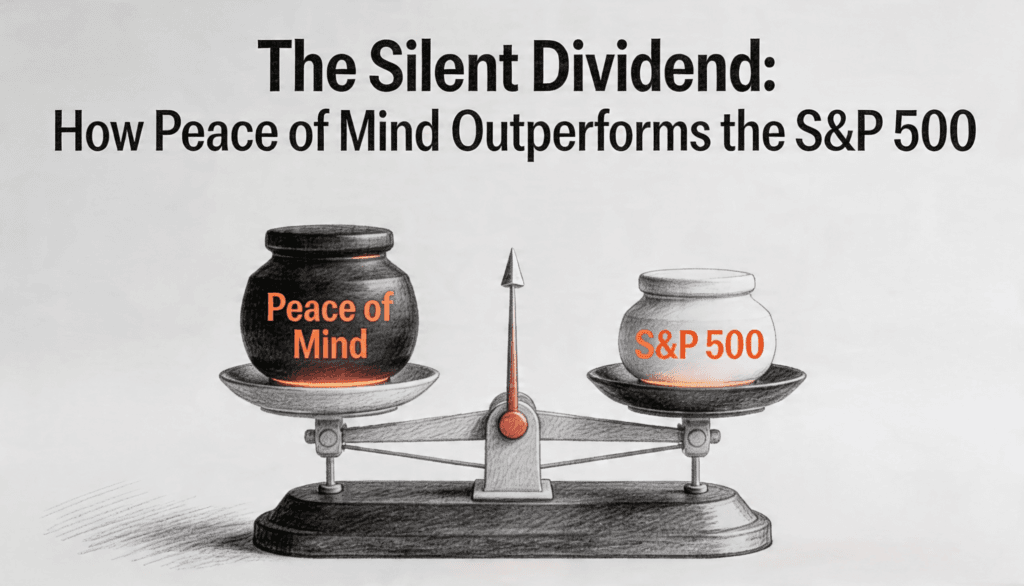
That absence is the dividend. It pays out in better health, better relationships, better work, and better decisions across every domain of life. Compounded over forty years, it almost certainly outperforms the S&P 500 in every measure that matters when you are old enough to look back honestly.
The Final Trade
There is a trade available to almost everyone, and very few people take it. You can exchange a portion of your potential financial returns for a substantial improvement in the quality of your daily experience. The market for this trade is wide open because it has terrible marketing. Nobody profits from selling you peace of mind. There is no fund that charges fees on it. No advisor earns a commission for recommending you simply want less.
This is probably why the wisest financial move most people could make is one that no professional has any incentive to suggest. Earn enough. Spend less than that. Invest the rest in something dull. Then go live your actual life, the one happening right now, while you still have the nervous system to enjoy it.
The silent dividend does not show up in your brokerage statement. It shows up in the fact that you forgot to check it.