Table of Contents
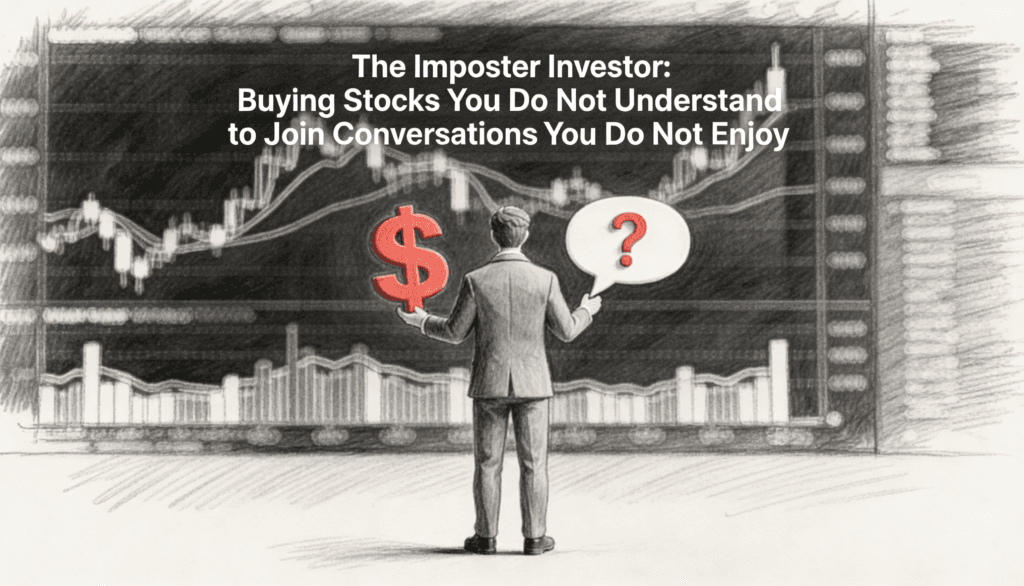
There is a specific kind of loneliness that only exists at dinner parties. It shows up when someone mentions they just rotated out of semiconductors and everyone nods like they understood the sentence. You nod too. You have no idea what rotating out of semiconductors means. You picture a washing machine full of microchips. But the conversation keeps moving, and now you are three drinks deep into a discussion about small cap value, and somewhere between the appetizer and the main course, you pull out your phone and buy something. Anything. Just so next time, you will have something to say.
This is how some people become investors. Not through curiosity. Not through careful reading. Through social pressure so quiet it barely registers as pressure at all.
The Portfolio as Costume
Clothes tell people who you are before you open your mouth. A portfolio does the same thing, except the audience is smaller and the costume is invisible to everyone except the wearer. You know what you own. You know it says something about you. And you know that admitting you own the wrong things feels like showing up to a black tie event in cargo shorts.
So people buy stocks the way they buy certain books. Not to read them, but to have them on the shelf. The Bitcoin was the first costume piece for a lot of people. Then came the AI stocks, which arrived with their own vocabulary kit. Now there is always a new one. The specific tickers change. The impulse does not.
Here is the part that almost nobody talks about. Owning a thing you do not understand is not financially neutral. It is actively expensive, because you cannot tell the difference between a temporary drop and a permanent problem. When the price falls, you have no frame of reference. You did not buy it for reasons, so you cannot evaluate whether the reasons still hold. You just watch the number and feel things. That is not investing. That is a slot machine that happens to be legal and tax advantaged.
The Social Cost of Not Knowing
There is a concept in psychology called pluralistic ignorance. It describes the situation where everyone in a room privately disagrees with something, but each person assumes the others agree, so nobody speaks up. The classroom where the professor asks if anyone has questions and nobody raises a hand. Half the room is lost. All of them think they are the only one.
Finance runs on pluralistic ignorance like a car runs on gasoline. When someone at the table mentions a position they took in some obscure biotech, the table nods. Half of them do not know what the company does. A quarter do not know what biotech means in any specific sense. But nobody wants to be the person who asks, because asking is the one thing more expensive than pretending. Asking reveals you do not belong. And belonging, for most people, is worth more than being right.
The result is a strange market where confidence circulates faster than information. People repeat things they have half heard. Those things get repeated again, slightly more confidently, by someone who heard them from the first person. By the time it reaches you, it sounds like consensus. It is not consensus.
The Hobby That Does Not Love You Back
Real hobbies have a feedback loop. You garden, the tomatoes grow or do not. You play guitar, you can hear yourself improving. You cook, the dinner is good or it is not. The feedback is fast, honest, and mostly private. Nobody watches you fail at a tomato.
Investing as a performance hobby breaks this loop in two places. First, the feedback is slow. You might be wrong for years before the market tells you. Second, the feedback is public, or at least semi public, because the whole reason you started was to have something to say at the dinner party. So when you are wrong, you are wrong in front of the audience you were performing for. And when you are right, you cannot tell if it was skill or luck, because you never understood the thing well enough to know which forces were actually at play.
Compare this to someone who genuinely finds companies interesting. They read the quarterly reports because they want to. They talk about the business rather than the ticker. When the stock drops, they either get more interested or they sell, and in both cases they can tell you why in plain language. They are not performing. They are paying attention. The distinction sounds small but it changes everything downstream.
The Quiet Violence of Jargon
Every profession develops specialized language for two reasons. One is useful. Precise words let you describe precise things faster. The other is defensive. Specialized language keeps outsiders out, and makes insiders feel like insiders.
Finance has an unusually high ratio of the second kind. Much of what gets said on television could be said in ordinary English without losing any meaning. It is not said that way because ordinary English would reveal how simple most of the claims are, and how shaky most of the reasoning is. If someone says the yield curve is signaling a regime change in the macro environment, you could ask them to say it without the jargon, and most of the time they cannot. Not because they are hiding anything. Because they never translated it for themselves in the first place.
This matters because you, sitting at the dinner party, are absorbing that jargon as evidence that somebody knows something. The jargon is the proof. But the jargon is often the whole product. When you buy stocks to participate in conversations structured around this vocabulary, you are not buying into knowledge. You are buying into the feeling that knowledge exists somewhere nearby.
A Detour Through Restaurants
There is a useful comparison in the restaurant industry. Food critics and chefs have noticed for decades that customers often cannot tell the difference between a great meal and a confidently presented mediocre one. Plating, lighting, the server’s tone, the menu’s vocabulary, the price. These things shape the experience more than the actual flavor does for most diners. A bad dish described as a deconstructed heritage interpretation with foraged elements will get better reviews than a perfect version of the same dish called lunch.
The stock market works the same way, except the stakes are your retirement instead of your Saturday night. The same underlying asset, described confidently in the right vocabulary, feels different than it would if described plainly. This is why a boring index fund feels boring, even though for most people it will quietly outperform the exciting stock picks they got at dinner. The excitement is part of the product. It is also part of the cost.
What Imposter Investing Actually Costs You
The financial cost is the obvious part. Buying things you do not understand, at prices you did not evaluate, for reasons you did not examine, is a reliable way to lose money over time. Not always. Sometimes you get lucky. But luck is not a strategy. Luck is just variance pretending to be skill until the sample size grows.
The deeper cost is attentional. Every stock you own that you do not understand is a small process running in the background of your life. It consumes a little worry. It pulls your phone out of your pocket a few extra times a day. It gives you a reason to check things that do not need checking. Multiply that across a dozen holdings and you have built yourself a low grade anxiety subscription. You pay for it in the only currency that does not refund. Which is attention.
The third cost is the most subtle. When you pretend to understand things, you lose the ability to learn them. Pretending is the opposite of curiosity. You cannot ask the beginner questions that would actually teach you something, because asking would reveal you have been pretending. So you stay stuck, year after year, in the same position. Nodding at dinner parties. Buying the next thing. Knowing slightly less than you appear to know, which is the exact shape of the trap.
The Cure Is Smaller Than You Think
The fix is not becoming a financial expert. Most successful long term investors are not experts in any deep sense. They have simply made peace with not needing to sound smart. This is the counterintuitive part. The people who do best often know the least, because they picked one boring strategy they actually understand and stuck with it while everyone around them kept costuming up for the next conversation.
The fix looks like this. You are allowed to not have opinions about stocks. You are allowed to say you do not know. You are allowed to own three things, or one thing, or nothing, and let the rest of the table perform for each other while you enjoy the food. The dinner party is not actually judging you as hard as you think. Most of them are too busy worrying about whether you are judging them.
And if they are judging you, consider what they are judging you with. A portfolio they assembled the same way you assembled yours. From overheard comments and half understood headlines. From the desire to sound like someone who belongs. These are not the people whose approval is worth buying. And it turns out the approval was not actually for sale anyway. They were not impressed. They were just relieved you were nodding too.
The Point
The imposter investor is not a financial type. It is a social type that happens to express itself through money. The real problem is not the stock picks. The real problem is using the market as a vocabulary test for belonging.
The market does not care about your vocabulary. It does not care about your dinner party. It does not know you exist. It will take your money whether you bought in with deep conviction or with panicked Googling under the table. And it will return your money, or not, based on things that have nothing to do with how you sounded while you waited.
There is a quiet dignity in admitting you do not know what semiconductors are doing this quarter. In saying, when asked, that you have not thought about it. In buying the boring thing, or nothing, and spending the freed up attention on something that actually loves you back. A book. A walk. A conversation where you do not have to perform.
The real flex, if you need one, is no longer needing to have one.