Table of Contents
Every couple, every friendship, every family has one. The person who sees a paycheck as a starting gun and the person who sees it as a sandbag. One wants to live. The other wants to prepare for living. And somehow, despite sharing a roof, a bank account, or a bloodline, they occupy completely different financial universes.
This is not a budgeting problem. Budgets are just spreadsheets, and spreadsheets do not argue at dinner. This is an identity problem. And identity problems do not get solved with a pie chart.
The Real Disagreement Has Nothing to Do With Money
Here is what most financial advice gets wrong from the start. It assumes the spender and the saver disagree about dollars. They do not. They disagree about time.
The saver operates on a long timeline. Every dollar today is a proxy for safety tomorrow. Saving is not about accumulation. It is about buying distance from catastrophe. The saver looks at a savings account the way a medieval town looked at its walls. Not exciting. Not beautiful. But you will be glad they are there when trouble arrives.
The spender operates on a short timeline. Not because they are reckless or stupid, but because they have made a different philosophical bet. The spender suspects, sometimes correctly, that tomorrow is not guaranteed. That the dinner you skip today to save forty dollars is a dinner that never happens. That life is not a rehearsal for some future, better life.
Both positions are entirely rational. That is what makes the conflict so vicious. You are not fighting against someone who is wrong. You are fighting against someone who is right in a way you find threatening.
The Psychology Nobody Talks About
Behavioral economists have spent decades studying why people make the financial choices they do. But there is a layer beneath the psychology that rarely gets discussed. It is not just about dopamine hits from purchases or anxiety from watching a balance drop. It is about narrative.
Every person carries a story about what money means. And that story was usually written before they were old enough to question it.
The kid who watched a parent lose a job and scramble to cover rent does not grow up to be a casual spender. The kid who watched a parent hoard every penny while refusing to enjoy anything does not grow up to admire frugality. These are not financial strategies. They are emotional scar tissue dressed up as common sense.
So when a saver says “we need to be responsible,” what they often mean is “I need to feel safe.” And when a spender says “you only live once,” what they often mean is “I refuse to live the way I watched someone else live.”
Neither person is having a conversation about money. They are having a conversation about fear. And fear, unlike a credit card balance, does not respond well to logic.
The Scoreboard Illusion
There is a seductive trap in this dynamic. Both sides keep score, and both sides believe they are losing.
The saver sees every unnecessary purchase as evidence that the spender does not care about the future. The spender sees every denied experience as evidence that the saver does not care about the present. Each side accumulates grievances like frequent flyer miles, except these miles do not get you anywhere pleasant.
Here is the counterintuitive part. In most relationships where this tension exists, the total amount in dispute is shockingly small. Couples who fight about money are rarely fighting about the mortgage or the car payment. They are fighting about the third streaming subscription. The extra appetizer. The gym membership that gets used twice.
The war is enormous. The territory being fought over is tiny. This should tell you something. The money is a stage. The play being performed on it is about something else entirely.
What Game Theory Teaches Us About Couples and Cash
There is a concept in game theory called the infinite game. Finite games have clear winners and losers. Infinite games have players who keep playing. The goal is not to win. The goal is to keep the game going.
Most spender and saver conflicts are being played as finite games. Someone has to be right. Someone has to give in. Someone has to admit that their entire philosophy of money was flawed from the beginning. This framing guarantees that every conversation ends in resentment, because whoever “loses” today will fight harder tomorrow.
The shift happens when both players recognize they are in an infinite game. You are not trying to defeat your partner. You are trying to keep the partnership functioning across decades. That requires something more sophisticated than compromise. It requires what game theorists call a mixed strategy. Sometimes you play one way. Sometimes you play the other. The pattern is not random, but it is not rigid either.
In practical terms, this means the saver occasionally spends without guilt and the spender occasionally saves without resentment. Not as a concession. As a strategy. Because a system that never flexes eventually snaps.
The Margin of Safety Is Not What You Think
Investors use the term “margin of safety” to describe the buffer between what something is worth and what you pay for it. Buy an asset for less than its value, and you have room for error. The concept is usually applied to stocks. But it works just as well for relationships.
The margin of safety in a spender and saver relationship is not the emergency fund. It is the emotional space between the two people. When that space is wide, disagreements are manageable. When it narrows, every receipt becomes a referendum.
Most couples try to fix this by tightening the rules. More categories in the budget. More approvals required for purchases over a certain amount. This is like trying to fix a marriage by adding more surveillance cameras. Technically it provides information. Practically it destroys trust.
The better approach is to widen the margin. And the way you widen it is not by controlling more. It is by agreeing on less.
Decide on the three or four things that actually matter. The savings rate, roughly. The debt limit, firmly. The non negotiable expenses, clearly. Everything else becomes discretionary in the truest sense. Each person gets genuine autonomy over a portion of money that is theirs to use without explanation or apology.
This is not “allowance.” This is sovereignty. A small country within the larger nation of your shared finances. You do not need to approve of what happens there. You just need to respect the border.
Why the Spender Is Sometimes the Wiser One
Financial culture has a bias. It celebrates the saver and pathologizes the spender. Frugality gets blog posts. Spending gets interventions.
But there is a version of saving that is genuinely destructive. The person who will not spend on healthcare because the copay feels wasteful. The person who refuses to travel in their healthy years so they can travel in their retirement years, which may never come, or may come with a body that can no longer climb stairs. The person who has six figures in a brokerage account and will not replace a mattress that ruins their sleep every night.
This is not discipline. It is dysfunction wearing a sensible outfit.
The spender, at their best, understands something the saver forgets. Money is a tool. Tools are meant to be used. A hammer that never touches a nail is not a well preserved hammer. It is a paperweight.
The best financial lives are not the ones with the highest net worth at death. They are the ones where money was converted into experience, security, and generosity at the right times and in the right proportions. That requires knowing when to save and when to spend. It does not require choosing a permanent side.
The Conversation That Actually Works
If you have read this far hoping for a script, here is something close to one. But it is not a script for talking about money. It is a script for talking about what money represents.
Start by asking each other a question that has nothing to do with budgets. Ask: what are you most afraid of? Not financially. Just in general. Because the answer to that question will explain almost everything about how the other person handles money.
The person afraid of being trapped will spend freely. Movement is their antidote to fear. The person afraid of being vulnerable will save aggressively. Reserves are their antidote to fear. Once you see the fear, the financial behavior stops being irritating and starts being human.
Then ask a second question. What would “enough” look like? Not a number. A feeling. What would your life feel like if money stopped being a source of stress? The saver might describe a particular account balance. The spender might describe a particular kind of Tuesday afternoon. Both answers are valid. Both answers reveal what the person is actually optimizing for.
From there, the conversation changes. You are no longer negotiating over line items. You are building something together. And building together is fundamentally different from compromising. Compromise means everyone loses a little. Building means everyone contributes something.
The Paradox at the Center of It All
Here is the strangest truth about the spender and saver conflict. Each side needs the other more than they will admit.
The saver without the spender becomes a miser. Not in the cartoonish sense. In the quiet, corrosive sense. Their life gets smaller every year. Their world shrinks to fit inside a spreadsheet. They optimize so completely that they forget what they were optimizing for.
The spender without the saver becomes fragile. Not broke, necessarily. Fragile. One unexpected expense, one job loss, one medical bill, and the entire structure collapses. Because there was no structure. There was only momentum.
Together, they create something neither could build alone. The saver provides the foundation. The spender provides the reason to build on it. The tension between them is not a flaw. It is the architecture.
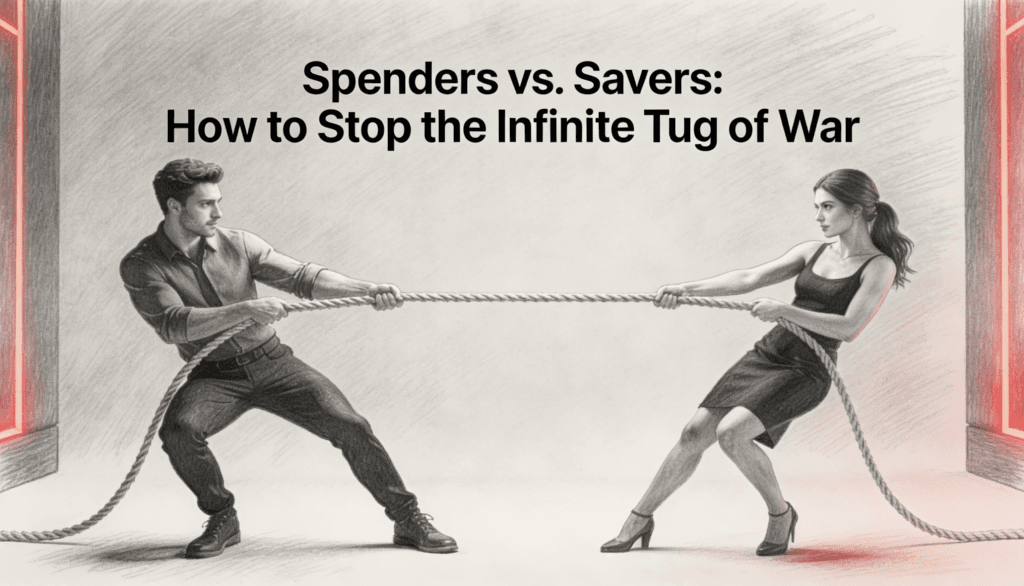
The goal was never to eliminate the tug of war. It was to stop pretending that one side should win.