Table of Contents
Every corporation worth its stock price has a board of directors. A group of people who show up quarterly, ask uncomfortable questions, and prevent the CEO from doing something catastrophic like acquiring a failing company because it “felt right.”
Your marriage, which is arguably a more complex merger than anything on Wall Street, probably has no such structure. Instead, it has your mother in law offering unsolicited opinions about your mortgage and your college roommate who still thinks crypto is a retirement plan.
This is a problem.
The Merger Nobody Audits
When two companies merge, teams of lawyers and accountants spend months on due diligence. They examine every asset, every liability, every pending lawsuit. When two people merge their financial lives through marriage, the due diligence usually amounts to a vague conversation at a restaurant where one person admits they have “some student loans” while the other nods and changes the subject to the wedding playlist.
Marriage is the only merger where the parties involved actively avoid looking at the balance sheet before signing.
And yet the financial stakes are enormous. Not because of any single transaction, but because marriage creates a decades long compounding machine. Every financial decision feeds into the next one. Where you live determines what you spend on housing, which determines how much you save, which determines when you retire, which determines the entire shape of your life. One bad assumption in year two echoes for thirty years.
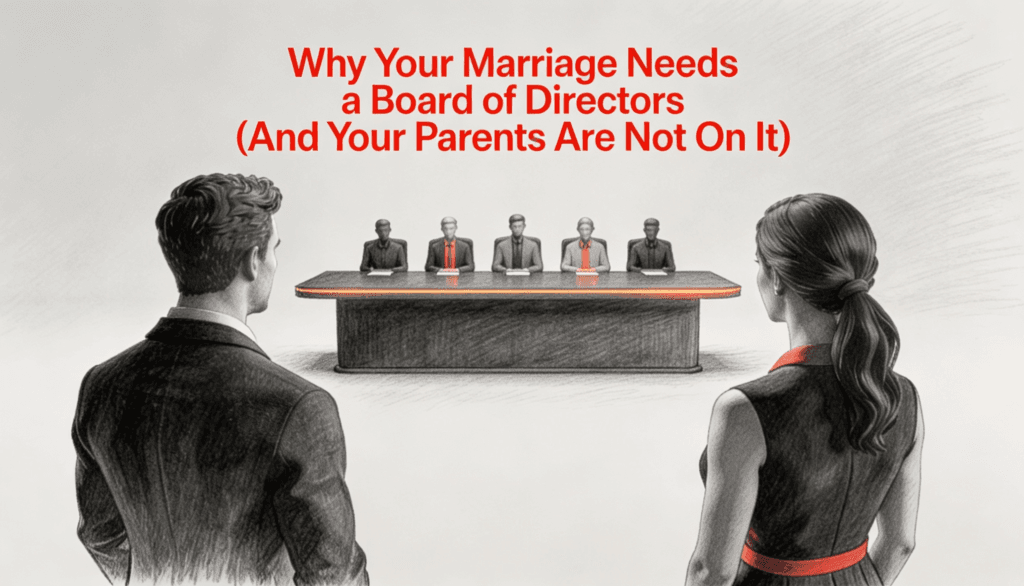
This is why you need a board. Not a formal one with Robert’s Rules of Order and quarterly earnings calls. But a small, deliberately chosen group of people who can see your financial blind spots before those blind spots drive you off a cliff.
Why Your Parents Are Disqualified
Here is where it gets uncomfortable. The people who love you most are often the worst possible financial advisors for your marriage. Not because they are stupid or malicious, but because they are compromised.
Your parents have what any good corporate governance expert would call a conflict of interest. They are not neutral parties. They are deeply, emotionally invested in one side of the merger. When your mother says you should not have to give up your spending habits, she is not offering financial counsel. She is protecting her child. When your father says your spouse is being irresponsible, he is not analyzing cash flow. He is running a loyalty program.
There is also the problem of generational context. Your parents built their financial lives in a completely different economy. The playbook that worked in 1985, buy a house immediately, stay at one company forever, pensions exist, is not just outdated. In many cases, following it precisely today would be financially destructive.
This does not mean your parents are wrong about everything. It means they are structurally unable to be objective about your marriage’s finances. They are like a board member who also happens to own 51% of one of the merging companies. Their advice is not worthless, but it is not impartial.
What a Real Board Looks Like
A good board of directors for your marriage has three to five people. Not twelve. Not your entire extended family group chat. A small group, chosen with the same care you would use to pick a surgeon. Here is what the composition should look like.
The person who is ahead of you. This is a couple, ideally five to ten years further into marriage than you are, who has navigated the financial stages you have not reached yet. They have already fought about whether to renovate the kitchen. They have already had the brutal conversation about one partner earning significantly more than the other. They have scar tissue, and scar tissue is the most undervalued asset in financial planning.
The person who disagrees with you. This is counterintuitive, but the most valuable board member is the one who does not share your financial philosophy. If you are a saver, you need someone who understands the argument for strategic spending. If you are an aggressive investor, you need someone who can articulate why capital preservation matters without sounding like a coward. Echo chambers feel comfortable. They are also where bad financial decisions go to get validated.
The professional who does not care about your feelings. A fee only financial advisor, a CPA, or an estate planning attorney. Someone who gets paid for accuracy, not for making you feel good. The distinction between fee only and commission based matters here. A commission based advisor is not on your board. They are a vendor with a sales quota. A fee only professional has one incentive: being right.
Notice who is not on this list. Your best friend who “is really into investing.” Your sibling who just went through a divorce and has strong opinions about joint accounts. Your coworker who will not stop talking about index funds. Enthusiasm is not a qualification. Objectivity and relevant experience are qualifications.
The Meeting You Are Not Having
Here is what most married couples do when a major financial decision appears. One person has an opinion. The other person has a different opinion. They argue, sometimes for twenty minutes, sometimes for three months. Eventually one person gives in, or they compromise in a way that satisfies nobody, or they just avoid the decision entirely and let inertia choose for them.
Inertia, by the way, is the most powerful financial advisor in most marriages. Not because it is wise, but because conflict avoidance is a powerful drug.
A board structure changes this dynamic entirely. Instead of two people trapped in their own perspectives arguing in circles, you bring the question to people who can see it from the outside. Should we buy this house or keep renting? Should one of us leave a stable job to start a business? Should we fund private school or invest that money instead?
These are not questions with objectively correct answers. They are questions where the right answer depends on factors that the two people inside the marriage are often too close to evaluate clearly. You are inside the jar. You cannot read the label.
There is a concept in behavioral economics called the planning fallacy. People consistently underestimate how long things will take and how much they will cost. Couples are especially vulnerable to this because optimism is basically a prerequisite for getting married in the first place. You looked at another human being with all their flaws and thought, yes, I want to merge my entire financial future with this person. That level of optimism is beautiful. It is also a terrible foundation for forecasting your renovation budget.
A board corrects for this. Not by being pessimistic, but by being calibrated.
The Transparency Problem
One reason people resist this idea is that it requires financial transparency with people outside the marriage. And most people would rather discuss their medical history than their net worth.
This discomfort is worth examining. If you cannot tell a trusted advisor how much debt you carry, that is not a privacy issue. That is a shame issue. And shame around money is one of the most expensive emotions a marriage can carry, because it prevents you from getting help exactly when you need it most.
Think of it this way. You would not hide a tumor from your doctor because you felt embarrassed about it. But people routinely hide financial problems from everyone, including their spouse, because money carries a moral weight that health problems do not. Being sick is bad luck. Being broke feels like a character flaw. This is irrational, but irrationality does not stop being powerful just because you can identify it.
A board normalizes financial transparency. When you regularly discuss money with a small group of trusted people, the stigma fades. Money becomes what it actually is: a tool, a resource, a set of decisions. Not a referendum on your worth as a human being.
The Governance Model Nobody Teaches You
There is a reason business schools teach corporate governance and nobody teaches marital financial governance. Corporations are legally required to have oversight structures. Marriages are not. And we tend to build systems only where the law demands them.
But the marriages that handle money best tend to develop informal governance structures on their own. They have regular financial check ins. They consult advisors before major decisions. They create decision making frameworks, like agreeing that any purchase over a certain threshold requires a conversation before someone clicks buy.
These are not romantic. Nobody puts “established a joint financial review process” in their wedding vows. But these structures do something romance alone cannot do. They prevent the slow accumulation of financial resentment that kills more marriages than any affair ever could.
Divorce attorneys will tell you something interesting if you ask them. The fights that end marriages are rarely about the big, obvious financial disasters. They are about the years of small misalignments that never got addressed. One person quietly resentful about how the other spends. One person making investment decisions without consultation. One person carrying the entire cognitive load of household finances while the other remains blissfully ignorant. These are governance failures, not love failures.
How to Actually Build This
Start with a conversation with your spouse. Not about who should be on the board, but about the concept itself. The idea that your marriage would benefit from outside financial perspective. If this conversation goes badly, that is actually useful information. Resistance to outside input on finances is often a sign that someone knows the current situation would not survive scrutiny.
Then identify your candidates. Think about the people in your life who are financially thoughtful, emotionally stable, and capable of telling you things you do not want to hear. That last quality matters most. A board that only validates your existing decisions is not a board. It is an audience.
Set a frequency. Twice a year is enough for most couples. Once before any major financial decision. This is not a weekly therapy session. It is a strategic review.
And finally, establish one rule that makes the whole thing work: both partners have to be present, and both partners have to be honest. A board that only hears one side of the story is worse than no board at all. That is not governance. That is lobbying.
The Return on Investment
The best financial decision most people will ever make is not a stock pick or a real estate play. It is building a system that prevents them from making the worst decision of their lives. A board of directors for your marriage is that system.
It will not make you rich. It will not eliminate financial conflict. What it will do is give you a fighting chance of making important decisions with clear eyes instead of clouded ones. And over the course of a thirty or forty year marriage, the compound interest on better decisions is worth more than any portfolio optimization strategy ever invented.
Your parents love you. Your friends mean well. But love and good intentions are not governance.
Build the board.