Table of Contents
You want your partner to save more money. You also want your partner to still like you by Friday. These two goals are in more tension than most personal finance advice will admit.
The internet is full of cheerful suggestions about “having the money talk” and “getting on the same page financially.” What it rarely acknowledges is that trying to change someone else’s financial behavior is one of the fastest ways to build resentment in a relationship. You are not their manager. You are not their parent. And yet, if you share a life with someone, their savings habits are absolutely your business.
So how do you influence without controlling? How do you nudge without nagging? The answer is not another budgeting app. It is something borrowed from behavioral economics and game design: incentive mapping.
The Problem With Just Talking About It
Let us start with why the standard advice fails.
“Sit down and have an honest conversation about money.” Great. You did that. You laid out the numbers, explained compound interest, maybe even showed a retirement calculator. Your partner nodded, agreed it was important, and then bought a espresso machine the following Tuesday.
This is not because your partner is irresponsible. It is because information does not change behavior. If it did, no doctor would smoke and no financial advisor would carry credit card debt. Humans are not spreadsheets. We do not update our actions every time we receive new data.
The disconnect here is what psychologists call the intention gap. People genuinely intend to save more. They mean it when they say it. But intention lives in one part of the brain, and spending decisions live in another. The grocery store does not care about your five year plan.
So if conversation alone does not work, what does?
What Game Designers Already Know
The video game industry solved a version of this problem decades ago. They needed people to do repetitive, often tedious tasks for hours on end. Mining virtual ore. Walking across digital landscapes. Grinding through levels. The tasks themselves are not fun. What makes them compelling is the incentive architecture built around them.
Game designers learned that people will do almost anything if you give them three things: clear progress signals, meaningful milestones, and the right ratio of effort to reward.
This is not manipulation. Or rather, it is, but so is every menu design, every store layout, every salary structure. The question is not whether you are shaping behavior. The question is whether you are doing it in a way that respects the other person.
Here is where it gets interesting for couples and money.
Incentive Mapping, Explained Simply
Incentive mapping is the process of designing a reward structure around a behavior you want to encourage. In a corporate context, this is just compensation design. In game design, it is progression systems. In a relationship, it is something more delicate: creating conditions where saving feels genuinely rewarding rather than punitive.
Most people experience saving as loss. You had money. Now you have less money. Yes, technically it is in an account somewhere, but your brain does not process a number on a screen the same way it processes a dinner out or a new jacket. Saving is choosing a future abstraction over a present pleasure. You can do it, but you will not enjoy it.
The trick is making the present moment more rewarding, not less. And doing it in a way that does not make your partner feel like a lab rat.
The Architecture of a Good System
Here is a framework that borrows from game design, behavioral economics, and the hard earned wisdom of couples who have actually made this work.
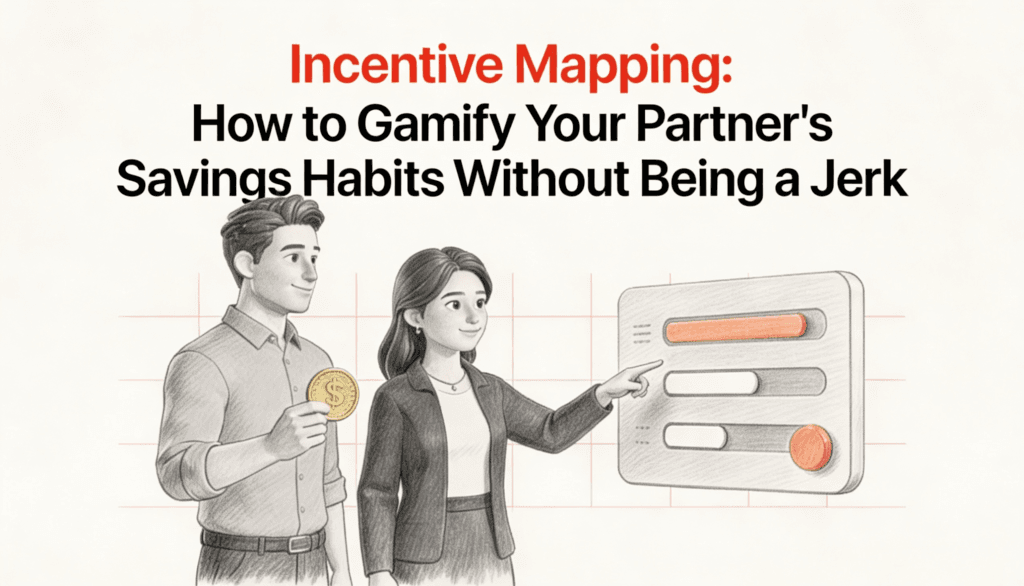
Make it visible. One of the most powerful findings in behavioral research is that people save more when they can see their progress. Not in an app they check once a month. Visibly. A chart on the fridge. A thermometer graphic. A jar filling up. There is a reason fundraising campaigns use those giant thermometer posters. They work because progress that you can see becomes progress that feels real.
For couples, this means creating a shared visual tracker for a specific savings goal. Not “retirement” because that is too abstract. Something concrete. A trip. A house down payment. A renovation. Something you both actually want.
Make it mutual. This is where most people wreck the whole project. If you set up a savings system that only tracks your partner’s behavior, you have built a surveillance tool, not a game. Both people need to be playing. Both people need to be measured. If you are the one who already saves well, great. Find a stretch goal for yourself too. The dynamic should be teammates, not coach and player.
Make the rewards immediate and small. Behavioral economics has shown repeatedly that small, frequent rewards drive more behavior change than large, distant ones. This is counterintuitive. You would think a big payoff would be more motivating. But humans discount the future so aggressively that a cookie today genuinely competes with a thousand dollars in ten years, at least in terms of motivational pull.
So build in small wins. Hit a weekly savings target? You both get to pick a meal out. Reach a monthly milestone? A small splurge on something fun. The paradox is that spending a little to celebrate saving actually increases total savings over time. It keeps the game alive.
Make the milestones uneven. This is a direct steal from game design. The best progression systems do not space their rewards evenly. They front load them. Your first few levels come fast. Then the gaps widen gradually. This creates early momentum and a sense of investment that carries people through the harder middle stretch.
Apply this to savings. Set your first milestone low. Absurdly low. First $500 saved together? Celebrate. Next one at $1,500. Then $3,000. Then $5,000. The increasing gaps feel natural because you have already built the habit and the identity of someone who saves.
The Jerk Spectrum
Now, let us talk about the part everyone avoids. There is a line between gamifying and patronizing, and it is thinner than you think.
You cross it when the system is something you designed for them rather than with them. You cross it when the rewards are things you approve of rather than things they actually enjoy. You cross it when “encouragement” starts sounding like scorekeeping.
The whole framework collapses if your partner feels managed. And here is the uncomfortable truth: if you are the person who came up with this idea, you probably are the more financially disciplined partner. Which means you are already operating from a position of perceived superiority, whether you intend to or not.
The antidote is genuine vulnerability. Share your own financial anxieties. Admit the goals you have failed at. Make it clear that this system exists because saving is hard for humans in general, not because your partner specifically has a problem. The framing matters more than the mechanics.
What Poker Teaches About Financial Partnerships
There is a concept in poker called “playing your opponent’s hand.” The best players do not just think about their own cards. They model what the other person is likely holding, what they are likely to feel, and what they are likely to do in response to pressure.
Financial partnerships require the same skill. You need to understand your partner’s relationship with money, which is almost never purely rational. Money is identity. Money is safety. Money is freedom. For some people, spending is how they feel alive. For others, saving is how they feel safe. Neither is wrong. They are different survival strategies shaped by different experiences.
When you design an incentive system, you are not just building a savings plan. You are negotiating between two different emotional relationships with money. If your partner grew up in a household where money was scarce, saving might trigger anxiety rather than security. If they grew up in a household where money was used for control, any system you propose might feel like a trap.
This is why the “without being a jerk” part of the title is not a joke. It is the entire challenge.
A Practical Starting Point
If you have read this far and want to actually try it, here is a minimal starting point.
Pick one shared savings goal that excites both of you. Not an obligation. Not “we should.” Something you both genuinely want. Set a target amount and a rough timeline. Create a visual tracker that lives somewhere you both see daily. Set three or four milestones, front loaded so the first one comes quickly. Attach a small shared reward to each milestone. Check in weekly, but keep it brief and keep it positive. If either person misses a week, the system does not punish. It just continues.
That is it. No apps. No complex spreadsheets. No lectures about compound interest.
The Bigger Picture
What makes this approach work is not the gamification. It is the respect embedded in the design. You are treating your partner as a capable adult who responds to good incentive design, just like every human does. You are not fixing them. You are building something together.
The best financial partnerships are not the ones where both people happen to have identical money habits. Those are just lucky. The best ones are where two people with different instincts figure out how to channel those differences into a system that works for both of them.
And if the system involves a chart on the fridge and a celebratory dinner every time you hit a milestone, that is not childish. That is just good behavioral design dressed up as a relationship.
Which, if you think about it, is what all the best relationships are anyway.