Table of Contents
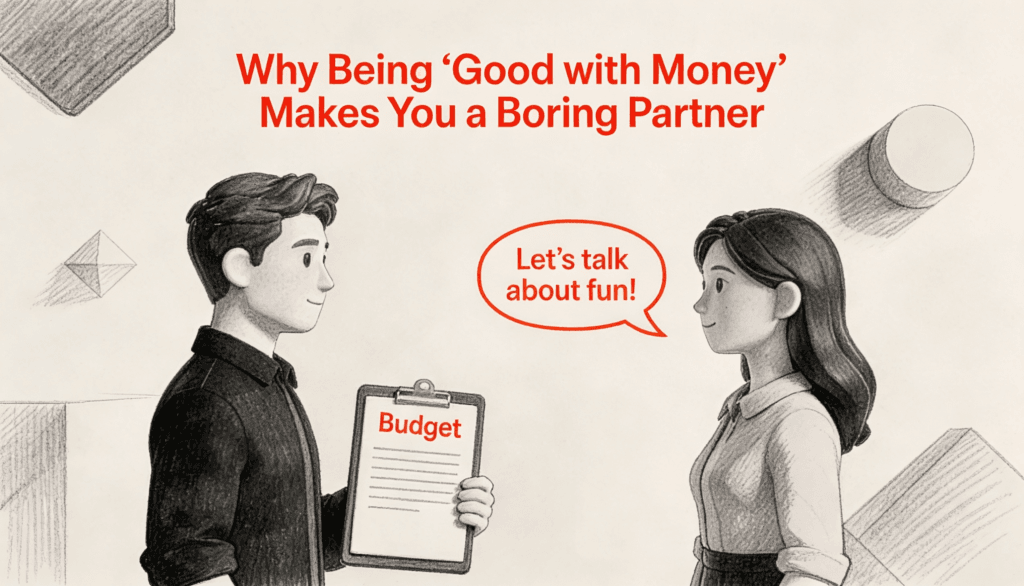
There is a particular kind of person who knows exactly how much they spent on groceries last Tuesday. They can tell you their net worth to the decimal. They have a spreadsheet for date nights.
On paper, this person is winning. In practice, they are often eating dinner alone.
The financially responsible partner is one of the great paradoxes of modern relationships. Everyone says they want someone who is good with money. Nobody says they want someone who checks the restaurant menu prices before checking whether their partner is having a good time.
So what happens when the trait that makes you responsible also makes you insufferable?
The Spreadsheet That Killed the Romance
Let us start with an uncomfortable truth. Financial discipline is, at its core, an exercise in control. You control spending. You control impulses. You control the future by sacrificing the present. This is admirable in a vacuum. In a relationship, it can become something else entirely.
Because relationships are not spreadsheets. They are not optimizable. The person sitting across from you at dinner does not want to be a line item in your monthly budget review. They want to feel like the reason you might occasionally do something irrational.
Think about the most romantic gestures you have ever witnessed or experienced. Almost none of them were fiscally responsible. Nobody tells the story of how their partner once surprised them with a moderately priced gift that was well within the quarterly discretionary spending allocation.
The problem is not money management itself. The problem is when the logic of money management starts colonizing every other part of your life. When you start optimizing relationships the same way you optimize a portfolio, you have already lost something important. You just cannot see it yet because it does not show up on a balance sheet.
The Psychology of Tightness (It Is Not Really About Money)
Here is where it gets interesting. People who are extremely controlled with money often exhibit the same patterns across all emotional domains. The person who cannot let go of ten dollars often cannot let go of an argument either. The person who needs to know exactly where every cent went also needs to know exactly where you were last night, and not always in a romantic way.
This is not a coincidence. Financial rigidity and emotional rigidity tend to share the same root system. Both come from a deep discomfort with uncertainty. And relationships, if they are worth anything at all, are fundamentally uncertain. You cannot hedge against heartbreak. There is no stop loss order for love.
The irony is thick here. The person who is best prepared for financial emergencies is often the least prepared for emotional ones. They have six months of expenses saved but cannot handle six minutes of not knowing where the relationship is heading.
The Generosity Problem
There is a difference between being generous and being strategic about generosity. Most financially savvy people know this distinction well because they live on the wrong side of it.
Strategic generosity looks like this: buying flowers because you read an article about how small gestures improve relationship satisfaction metrics. Real generosity looks like this: buying flowers because you walked past them and thought of someone.
The financially disciplined mind has a hard time with the second version. It wants a reason. A return on investment. A justification. But the whole point of generosity in relationships is that it is not supposed to make sense. The wastefulness is the message. You are saying, in effect, that this person is worth being slightly irrational for.
This connects to something the anthropologist David Graeber wrote about in his work on debt and social relationships. The thing is that perfectly balanced exchanges are actually the hallmark of relationships between strangers or enemies. When you insist on splitting everything exactly fifty fifty, you are essentially treating your partner like someone you owe nothing to. The slight imbalance, the messiness of who paid for what, is actually what creates intimacy. You stay entangled. You stay connected.
The person who Venmo requests their partner for half of a shared appetizer is not being fair. They are being distant.
When Frugality Becomes a Personality
There is a moment in every financially responsible person’s journey where something shifts. Saving money stops being something they do and starts being something they are. Their identity fuses with their bank account. Every purchase becomes a moral question. Every expense is weighed not just against their budget but against their self concept.
This is where it gets dangerous for relationships. Because when frugality becomes your identity, your partner’s spending becomes a personal attack. Their coffee habit is not just expensive. It is an attack to who you are. Their desire to go on a vacation is not just a preference. It is evidence that they do not share your values.
And suddenly you are not arguing about money anymore. You are arguing about identity. Which is much harder to resolve because nobody wants to be told that who they are is the problem.
The philosopher Alain de Botton has made the observation that we tend to fall in love with people who are slightly different from us precisely because they offer something we lack. The saver is drawn to the spender. The planner is drawn to the spontaneous one. This is not a design flaw. It is the whole point. But instead of learning from the difference, the financially disciplined partner often spends the entire relationship trying to convert the other person. And nobody has ever been seduced by a budget proposal.
The Opportunity Cost of Being Too Careful
Finance people love the concept of opportunity cost. The value of what you give up when you choose one option over another. They apply it to investments, career decisions, major purchases.
They almost never apply it to their own caution.
What is the opportunity cost of saying no to the spontaneous weekend trip? It is not just the money saved. It is the memory that was never made. The inside joke that never happened. The version of your relationship that would have existed if you had said yes.
What is the opportunity cost of always choosing the cheaper option? It is not poverty. It is a slow, creeping sense that life with you is a series of small compromises downward.
The truly expensive thing is not the occasional splurge. It is the cumulative effect of always choosing safety over experience. Over years, this does not build wealth. It builds resentment.
How to Fix It (Without Going Broke)
Now for the part you actually came here for. How do you stay financially responsible without becoming the human equivalent of a terms and conditions page?
Stop narrating your financial decisions. Your partner does not need a running commentary on how much things cost. When you say “that is expensive” at a restaurant, you are not sharing information. You are creating an atmosphere. And it is not a good one.
Create a category in your budget called “irrational.” Seriously. Give yourself permission to spend money on things that do not make sense. Things that only make sense because they make someone smile. The budget is not violated. Your identity is intact. But now there is room for surprise.
Practice saying yes before calculating. Not always. Not recklessly. But occasionally, when your partner suggests something, try agreeing before your brain finishes computing the cost per unit of enjoyment. You can do the math later. The moment only happens once.
Separate your money identity from your actual identity. You are not your savings rate. You are not your credit score. These are tools, not characteristics. The moment you start introducing yourself at parties by mentioning your investment strategy, you have gone too far. Nobody has ever done this and been invited back.
Understand that financial security is a means, not an end. The entire point of having money is to live well. And living well, for most humans throughout most of history, has meant sharing generously with people you care about. If your financial security comes at the cost of your relationships, you have not secured anything. You have just rearranged which parts of your life are bankrupt.
The Real Bottom Line
Being good with money is a skill. Knowing when to stop being good with money is wisdom.
The difference between the two is usually the difference between eating dinner alone and eating it with someone who is genuinely glad to be there. Not because you split the check perfectly, but because you made them feel like some things are more important than the check.
That feeling, for what it is worth, has an extraordinary rate of return.