Table of Contents
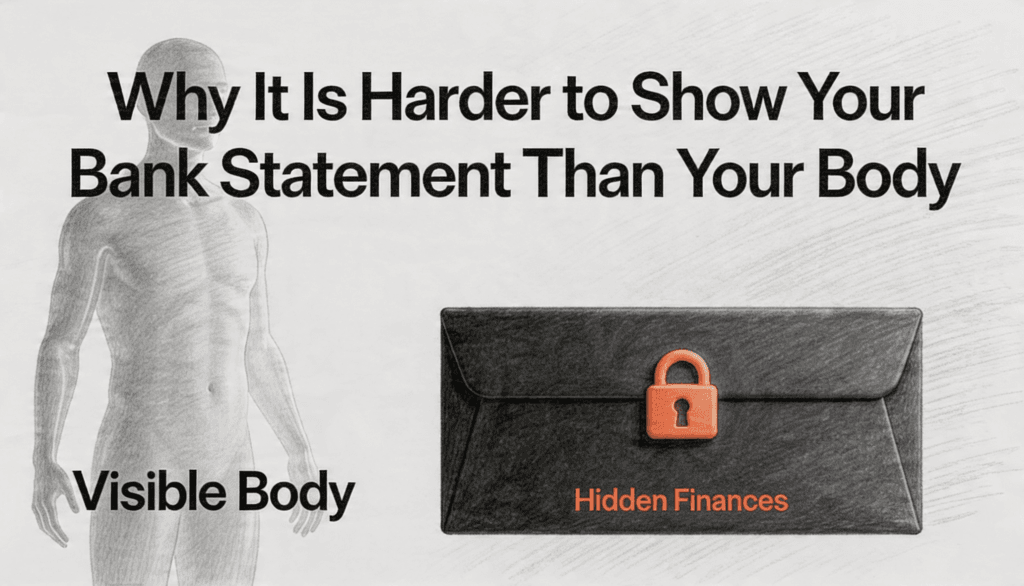
There is a strange arithmetic to modern intimacy. A person will undress in front of someone they have known for three weeks. The same person will guard their bank balance from someone they have known for three years.
Think about that for a moment. We live in an era where you can watch a stranger eat breakfast on a livestream, where people post their heart rate data and sleep scores for anyone to see. Bodies are out there. Emotions are out there. Financial statements? Those stay in the vault.
This is not an accident. It reveals something deep about what money actually represents in relationships and why we treat it as the last frontier of vulnerability.
The Body Is Easy Because the Stakes Are Clear
When you take off your clothes, the worst case scenario is rejection. That stings. But physical vulnerability operates on a known scale. Someone sees you. They like what they see or they do not. Either way, the judgment is about one dimension of who you are. You can recover from it. People do, every weekend, across every city on the planet.
Financial exposure is different. When someone sees your bank statement, they are not looking at one dimension. They are looking at a document that tells a story about your discipline, your ambition, your past mistakes, your family background, your addictions, your priorities. A bank statement is an autobiography that nobody sat down to write.
Your body says something about genetics and how often you go to the gym. Your bank statement says something about every choice you have made since your first paycheck.
That is why it is harder.
Money as Identity
Psychologists have a concept called financial self worth. It is exactly what it sounds like. People merge their sense of identity with their financial standing to a degree that would be considered unhealthy if we did it with anything else.
Nobody says “I am my cholesterol numbers.” But plenty of people quietly believe they are their net worth.
This creates an impossible situation inside relationships. If your money is your identity, then showing someone your bank statement is not like showing them your body. It is like showing them your soul and then asking them to still love you after they have seen the overdraft fees.
The irony is sharp. We tell people to be vulnerable. We celebrate emotional openness. But the moment someone suggests splitting finances or discussing savings goals with a partner, the room gets tense. Emotional vulnerability is trendy. Financial vulnerability is terrifying.
Why Shame Attaches to Money Differently
Here is something worth sitting with. Body shame, as real and damaging as it is, has a cultural counter movement. Body positivity has entered the mainstream. People share unfiltered photos. There are campaigns and hashtags and entire industries built around the idea that your body is acceptable as it is.
Where is the equivalent for money?
There is no financial positivity movement. Nobody is posting their credit card debt with the caption “this is real and this is okay.” Nobody is sharing their savings account with two hundred dollars in it and getting encouragement from strangers. The conversation around money shame is almost nonexistent because the shame itself prevents the conversation from starting. It is a perfect closed loop.
And this silence has consequences in relationships. Couples who cannot talk about money are essentially building a house while refusing to discuss the foundation. Research consistently shows that financial disagreements are among the strongest predictors of relationship breakdown. Not because money is inherently divisive, but because the inability to talk about it honestly creates a slow poison.
The Hierarchy of Disclosure
Relationships tend to follow a predictable sequence of disclosure. You share your name, then your interests, then your past, then your fears, then your body, then maybe, eventually, your finances.
Notice where money falls. It is after sex. It is after trauma. It is after almost everything.
This hierarchy is not rational. It is cultural. And it is reinforced every day by the unspoken rules of dating and partnership. Ask someone on a third date what they earn and watch their face. You have just committed a social crime worse than most things you could say about their appearance.
There is a comparison to be made here with how societies handle health information. Medical records are protected by law. Financial records are also protected by law. But in personal relationships, people will casually mention a health condition far sooner than they will mention a financial one. “I have anxiety” is an acceptable early disclosure. “I have twenty thousand dollars in student loans” is not.
Both are facts about a person. Both affect the relationship. But one carries a stigma the other does not.
The Power Dynamic Problem
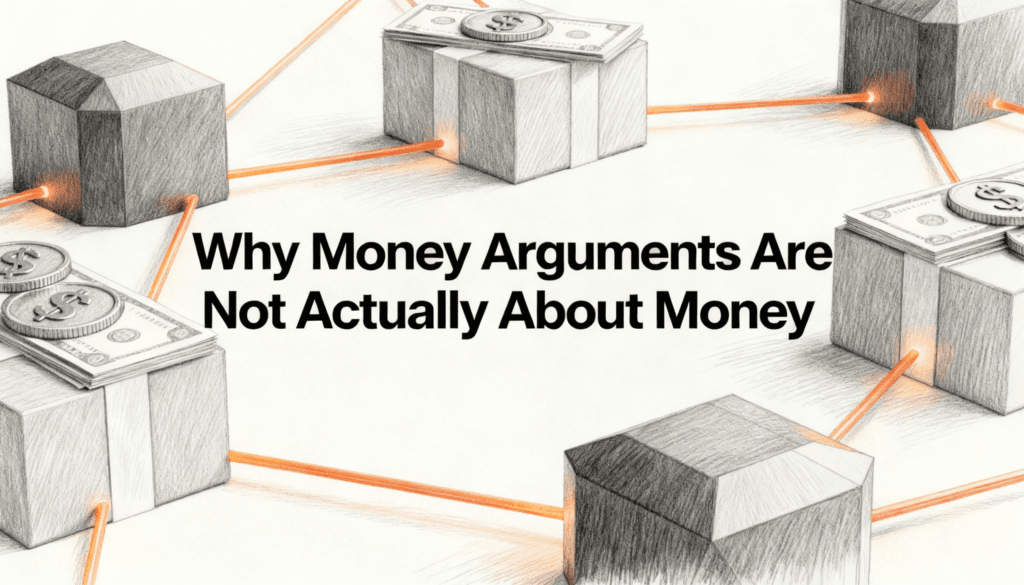
Money in relationships is never just money. It is power. And power is the thing we are least equipped to discuss honestly.
When two people share their financial situations, they are not just exchanging information. They are establishing a dynamic. The person who earns more gains leverage they did not ask for. The person who earns less feels a vulnerability they cannot easily articulate. Even in the most egalitarian partnerships, the numbers create a gravity that pulls the relationship in directions neither person chose.
This is why people hide their finances even from people they love. It is not always about shame. Sometimes it is about protection. If I do not show you my bank statement, you cannot use it as evidence in an argument. You cannot judge my spending. You cannot quietly recalculate my worth as a partner based on a number.
The counter intuitive truth is that financial secrecy in relationships is often an act of self preservation disguised as privacy. People frame it as “my money is my business” when what they actually mean is “my money is my vulnerability and I am not ready to hand you that weapon.”
What Evolutionary Psychology Might Say
There is an interesting lens here from evolutionary psychology, and it connects to something unexpected: status signaling.
In most social species, status is displayed. Peacocks fan their tails. Gorillas beat their chests. Humans buy watches.
But the display is always selective. You show strength, not weakness. You signal abundance, not scarcity. The entire luxury goods industry is built on this principle. You will happily show someone your new car. You will not show them the loan you took out to buy it.
Relationships complicate this because they require the one thing that status signaling forbids: honesty about your actual position. A peacock never has to admit that half its tail feathers are fake. But a partner eventually needs to know the truth.
This creates a fundamental tension. The instinct to signal competence conflicts with the relationship need for transparency. And because financial competence is one of the deepest status markers in modern life, the conflict hits hardest right there.
The Digital Paradox
Something peculiar has happened in the last decade. People share more about themselves online than any generation in human history. Daily routines, workout splits, relationship struggles, mental health journeys. All of it is broadcast to audiences of hundreds or thousands.
But financial transparency? Still almost nonexistent.
There are a few creators who share their income reports or investment portfolios. They are treated like daredevils. The audience watches with the same fascination they would bring to someone walking a tightrope. It is entertainment precisely because it feels dangerous.
This is revealing. In an age where oversharing is the norm, money remains the thing people will not share. It has outlasted every other taboo. It survived the death of privacy. It survived the confessional culture of social media. It sits there, untouched, while everything else has been laid bare.
What Couples Can Actually Do
The practical question matters, so here it is. If financial transparency is difficult but necessary, how do couples get there without detonating the relationship?
The answer is not a dramatic reveal. Nobody needs a cinematic moment where two people slide their bank statements across the table like poker players showing their hands.
The better approach is gradual and low stakes. Start with values before numbers. Talk about what money means to each of you before you talk about how much of it you have. Discuss spending philosophies. Talk about what financial security looks like in your mind. These conversations build the trust infrastructure that makes the actual numbers less frightening when they eventually come out.
There is a principle in negotiation theory that applies perfectly here. People resist positions but respond to interests. “I have thirty thousand in savings” is a position. “Financial security matters to me because I grew up watching my parents fight about bills” is an interest. Lead with interests.
The goal is not to audit each other. The goal is to build a shared language around money so that when the numbers do come up, they land on soft ground instead of concrete.
Here is the thing nobody says out loud. Showing someone your bank statement is harder than showing them your body because your body is something that happens to you. Your finances are something you did.
Bodies are inherited, influenced by genetics, shaped by forces partly outside your control. Nobody looks at a body and says “this tells me every decision you have ever made.” But a financial statement does exactly that. Every impulse purchase, every investment, every month you did or did not save. It is all there, and it is all yours.
That is the real vulnerability. Not the number itself, but the narrative the number tells. People can forgive a body for being imperfect because they understand that bodies are imperfect by nature. Forgiving a bank statement requires forgiving the person for the choices they have made. That asks something much harder of a partner.
The Uncomfortable Bottom Line
We have built a culture that celebrates vulnerability but exempts the one area where vulnerability matters most for long term partnership. We will cry in front of our partners. We will share our deepest fears. We will undress physically and emotionally. But the bank statement stays hidden.
The uncomfortable truth is that financial intimacy is the real intimacy. Everything else is just a warm up. And until we treat it that way, we will keep having relationships that look strong on the surface and crack along the fault lines that nobody was willing to examine.
Your bank statement is not your worth. But your willingness to share it might say more about your capacity for partnership than anything else you could offer.