Table of Contents
Most things in economics follow a simple rule. When the price goes up, people buy less. When the price drops, people buy more. This is the law of demand, and it is so foundational that questioning it feels almost rude. Like asking if gravity takes weekends off.
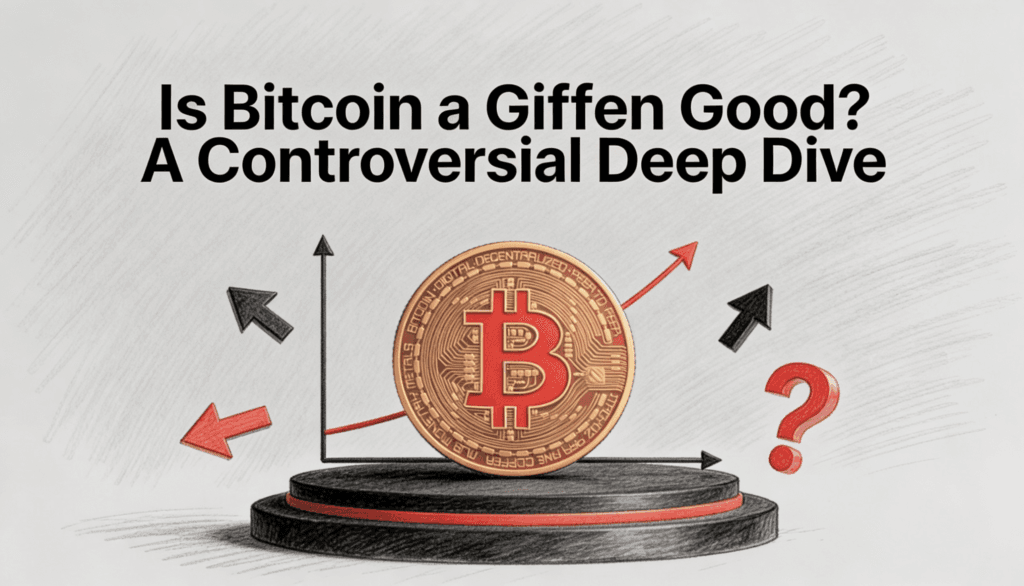
But there is a strange exception buried in economic theory. It is called a Giffen good. And increasingly we could be asking whether Bitcoin might be one.
The short answer is no. The longer answer is far more interesting.
What Is a Giffen Good, Really?
A Giffen good is a product where demand actually increases as the price rises. Not because people suddenly love it more, but because they have no choice. The classic example involves bread in Victorian England. When bread prices went up, the poorest workers could no longer afford meat. So they bought even more bread to fill their stomachs. The price increase made the cheap staple more necessary, not less.
The key detail here is desperation. A Giffen good only works when people are so constrained that a price increase in one thing reshuffles their entire budget toward that very thing. It is a survival mechanism, not a preference.
Now look at Bitcoin. Nobody is buying Bitcoin to survive. Nobody is reallocating their grocery budget toward satoshis because steak got expensive. The motivations are entirely different. Speculation, ideology, portfolio diversification, fear of missing out. None of these are the economic conditions that produce a Giffen good.
So why does the comparison keep coming up?
The Behavioral Illusion
Here is where it gets interesting. Bitcoin does something that looks, on the surface, remarkably similar to Giffen behavior. When its price rises, demand often rises too. When it crashes, many holders panic sell rather than buy the dip. This is the opposite of what normal goods do. And if you squint hard enough, it mimics the Giffen pattern.
But mimicry is not identity. A parrot can say “I love you” without understanding marriage.
What is actually happening with Bitcoin is closer to what economists call a Veblen effect. Veblen goods are things people want more precisely because they are expensive. Luxury handbags. Rare watches. Status symbols where the price tag is part of the product. The higher the cost, the greater the signal of wealth or sophistication.
Bitcoin occupies a weird middle ground. It is not a luxury good in the traditional sense. You cannot wear it to a dinner party. But its rising price generates attention, media coverage, social proof, and a feeling that something important is happening. That feeling drives more buying. The price becomes its own marketing campaign.
This is not Giffen economics. This is reflexivity, a concept George Soros wrote about extensively. The price influences the fundamentals, which influence the price, which influences the fundamentals. It is a feedback loop that feeds on itself until it does not.
The Giffen Framework Still Teaches Us Something
Even though Bitcoin is not technically a Giffen good, applying the framework reveals something valuable about how people relate to money itself.
In the original Giffen model, the good in question is inferior. Bread was not what Victorian workers wanted. They wanted meat. But bread was what they could afford. When circumstances worsened, they moved down the hierarchy.
Now consider the global financial system from the perspective of someone in a country with a collapsing currency. Argentina. Turkey. Nigeria. For these people, their local currency is becoming less useful by the day. Inflation is eating their savings. Capital controls prevent them from holding dollars easily.
In this context, Bitcoin starts to resemble something structurally adjacent to a Giffen dynamic. Not in the textbook sense, but in the lived experience sense. As the “price” of maintaining purchasing power goes up (because inflation is accelerating), the demand for Bitcoin as an escape hatch increases. The worse things get, the more they need it.
This is not a perfect analogy. But it is a useful one. It suggests that Bitcoin’s demand curve in unstable economies might behave in ways that classical models do not anticipate. The deterioration of alternatives drives adoption, not the attractiveness of the asset itself.
Demand Curves Are Lying to You
One of the more underappreciated problems with applying traditional economic models to Bitcoin is that these models assume rational, well informed agents making marginal decisions. That is a polite fiction even for grocery shopping. For speculative digital assets, it is practically fantasy.
Bitcoin buyers are not reading supply and demand charts before making purchases. They are reading tweets. They are watching YouTube videos with thumbnails of people pointing at exponential curves with their mouths open. They are responding to narratives, not price signals in the way an economist would model them.
This matters because the Giffen question assumes that demand responds to price in a mechanical way, even if that response is unusual. But Bitcoin demand responds to stories. The price is just one input into a much more complex emotional calculation that includes identity, community belonging, distrust of institutions, and the very human desire to be early to something big.
Behavioral economics has a term for this. It is called narrative economics, popularized by Robert Shiller. The stories we tell about an asset shape its demand more than its fundamental characteristics. And Bitcoin has one of the most powerful narratives in modern finance. Digital gold. A hedge against the system. Freedom from central banks. Whether these stories are accurate is almost beside the point. They are effective.
The Substitution Problem
Another reason Bitcoin cannot be a Giffen good is the substitution issue. Giffen goods work because there are no viable substitutes at that price level. Victorian workers could not switch to a cheaper bread. There was nothing below bread.
Bitcoin has thousands of substitutes. Ethereum. Stablecoins. Gold. Index funds. Real estate. Treasury bonds. If Bitcoin gets too expensive or too volatile, capital can and does flow into alternatives. The crypto market itself is proof of this. Every cycle produces a new set of competitors promising to be the better version.
Now, Bitcoin maximalists will argue that none of these are true substitutes. That Bitcoin is uniquely scarce, uniquely decentralized, uniquely secure. And they have a point, at least partially. But the existence of alternatives, even imperfect ones, disqualifies the Giffen framework. Giffen goods require a closed system with no exit. Bitcoin exists in one of the most open and fluid markets ever created.
A More Honest Framework
If we are being honest about what Bitcoin actually is in economic terms, the best description might be something no textbook has a clean name for yet.
It is a speculative store of value with reflexive demand characteristics, driven primarily by narrative momentum and network effects, exhibiting occasional Veblen like behavior during bull markets and panic liquidation during bear markets.
That does not fit on a flashcard. But it is closer to the truth than calling it a Giffen good.
The fascination with applying the Giffen label to Bitcoin says more about us than about Bitcoin. We want a framework. We want a model that explains why this strange asset defies the normal rules. And Giffen goods are one of the few models where “price goes up, demand goes up” is theoretically permitted. So we reach for it, even when the underlying mechanism does not match.
It is like diagnosing someone with a rare tropical disease because they sneezed. The symptom overlaps. The cause does not.
What This Means for Investors
The practical takeaway here is not about labels. It is about understanding what drives the demand for what you own.
If you hold Bitcoin because you believe its rising price will continue to attract more buyers, you are making a reflexivity bet. That is fine. But you should know that reflexive dynamics work in both directions. The same mechanism that drives parabolic rallies drives catastrophic crashes. The feedback loop does not have a loyalty clause.
If you hold Bitcoin because you see it as an escape from a broken monetary system, you are making a structural bet. That is also fine. But you should recognize that this thesis depends on continued institutional failure, which is a dark thing to invest in.
And if you hold Bitcoin because someone told you it is a Giffen good and therefore the price can only go up, you should probably reconsider your information sources.
The Bigger Picture
The real value of this question is not the answer. It is the thinking it forces.
Asking whether Bitcoin is a Giffen good requires you to understand what drives demand, what role price plays in perception, how substitution works, and why economic models have edges and boundaries. These are useful muscles for any investor to develop, regardless of whether they ever buy a single satoshi.
Economics is not a set of laws like physics. It is a set of lenses. And sometimes the most valuable thing a lens can do is show you clearly what something is not.
Bitcoin is not a Giffen good. But the reasons why teach you more about both Bitcoin and economics than a simple yes ever could.