Table of Contents
You have never made a truly rational financial decision in your life. Neither have I. Neither has anyone walking the floor of the New York Stock Exchange or quietly managing a sovereign wealth fund in Oslo. This is not an insult. It is a design feature.
The human brain did not evolve to maximize portfolio returns. It evolved to survive savannas, avoid predators, and make sense of a chaotic world where a rustling bush could mean lunch or death. The tool it developed for all of this was not a spreadsheet. It was narrative. Story. The ability to take scattered, confusing inputs and weave them into something that feels coherent.
And that same tool is running your financial life whether you know it or not.
The Brain Is Not a Calculator. It Is a Storyteller.
Neuroscience has made this uncomfortably clear. When people evaluate investments, the regions of the brain that light up are not the ones associated with mathematical reasoning. They are the ones tied to emotion, identity, and pattern recognition. The same neural machinery you use to follow a movie plot is the machinery you use to decide whether Tesla is overvalued.
This is why a company with no earnings can trade at absurd multiples while a boring, profitable industrial firm gets ignored. The first one has a story. The second one has a balance sheet. And your brain, given the choice, will pick the story every single time.
Think about it. When someone pitches you a stock, they do not hand you a discounted cash flow model. They tell you a narrative. “This company is going to disrupt healthcare.” “This founder is the next Steve Jobs.” “This sector is about to explode.” You nod along not because you ran the numbers, but because the story resonates with something inside you. It clicks. It feels right.
That feeling is not analysis. It is your brain doing what it has done for a hundred thousand years. Finding a pattern, building a narrative, and rewarding you with a small hit of dopamine for making sense of the chaos.
Why Narratives Beat Numbers (Even When They Should Not)
Here is the uncomfortable part. Stories are often more persuasive than facts, even when the facts directly contradict the story. Psychologists call this “narrative transportation.” Once you are inside a good story, your critical thinking does not just weaken. It essentially takes a nap.
Robert Shiller, the economist who predicted both the dot com bubble and the housing crisis, built much of his later career around this exact idea. He argued that economic events are driven less by fundamentals and more by the viral spread of narratives. A story about housing prices never going down. A story about a new economy where traditional valuation does not apply. A story about crypto replacing the entire financial system.
These narratives do not need to be true. They need to be compelling. And there is a meaningful difference.
Consider the meme stock phenomenon. GameStop in early 2021 was not a story about a company with strong fundamentals pivoting to digital retail. It was a David versus Goliath narrative. Small investors versus hedge funds. The little guy fighting back. The actual business was almost irrelevant. People were not buying a stock. They were buying a chapter in a story where they got to be the hero.
And it worked. Not because the thesis was sound, but because humans will sacrifice money to be part of a good story. They always have. Medieval crusaders did not do a cost benefit analysis before marching to Jerusalem.
The Narrative Trap: When Stories Become Prisons
If stories were only a source of irrational exuberance, they would be easy enough to manage. But the real danger is more subtle. Stories do not just drive you into bad trades. They keep you in them.
Once you have committed to a narrative, your brain treats contradictory evidence not as useful information but as a threat. This is the endowment effect applied to ideas. You own this story now. It is yours. And your brain will work overtime to protect it.
This is why investors hold losing positions for years, adding to them on every dip, insisting the market “just does not understand yet.” The market understands fine. But the investor has confused their story with reality, and abandoning the story would mean admitting they were wrong. For most human brains, losing money is preferable to losing the narrative.
It is also why market bubbles last so much longer than any rational model would predict. A bubble is not just an overpriced market. It is a shared story that an entire community has invested in emotionally. Popping the bubble does not just destroy wealth. It destroys meaning. And people will go to extraordinary lengths to avoid that.
The Sunk Cost of Identity
Here is where it gets really interesting. Financial decisions are not just about money. They are about who you think you are.
If you tell everyone at dinner parties that you are a value investor in the tradition of Benjamin Graham, you are not going to pivot to momentum trading on a Thursday afternoon. Not because momentum does not work. It often does. But because switching strategies would require you to become a different person, and identity change is one of the most psychologically expensive things a human being can do.
This is the hidden cost that never shows up in any brokerage statement. The sunk cost of identity. You are not just holding a position. You are holding a version of yourself. And selling means letting that version go.
Fund managers suffer from this acutely. A fund built around a specific thesis, say that emerging markets will outperform, cannot easily pivot when the thesis breaks down. The fund’s identity, its marketing, its investor base, its manager’s reputation, all of it is built around the story. Changing the story is existential. So they hold. And they underperform. And they write quarterly letters explaining why they are actually still right and the market is temporarily insane.
The market is many things. Temporarily insane is rarely one of them.
So What Do You Actually Do With This?
The answer is not to stop telling yourself stories. You cannot. It would be like trying to stop your heart from beating through sheer willpower. Narrative is not a bug in human cognition. It is the operating system.
The answer is to become aware of the stories you are telling yourself and to hold them loosely. To recognize the difference between “I have analyzed this company and believe it is undervalued” and “I have fallen in love with a narrative and am now rationalizing my position.”
One practical approach is to write down your investment thesis before you enter a position. Not vaguely, not in your head, but on paper. Be specific about what you expect to happen and what would prove you wrong. Then revisit it regularly. If the story has changed and your position has not, that is a signal. Not a signal from the market. A signal from your own psychology.
Another is to deliberately seek out the counter narrative. If you are bullish on something, go read the best bear case you can find. Not to change your mind necessarily, but to stress test whether your conviction is based on analysis or on the simple pleasure of having a good story to believe in.
The investors who outperform over long periods are not the ones with the best stories. They are the ones who can separate the story from the signal. Who can appreciate a narrative without marrying it. Who can change their mind without feeling like they are losing themselves.
This is extraordinarily difficult. It goes against everything your brain wants to do. Which is precisely why so few people manage it, and why the ones who do tend to be rewarded disproportionately.
The Final Irony
There is a deep irony at the center of all this. The financial industry sells itself as the domain of pure rationality. Numbers, models, algorithms, efficiency. But the entire machine runs on stories. Central bankers tell stories about forward guidance and market participants rearrange trillions of dollars based on subtle changes in tone. CEOs tell stories on earnings calls and stock prices move before anyone has read the actual filing. Financial media exists almost entirely to convert data into narrative, because nobody would watch a channel that just read numbers aloud for eight hours.
The market is not a machine for pricing assets. It is a machine for pricing stories. The assets are almost incidental.
Once you see this, you cannot unsee it. Every rally has a narrative engine. Every crash has a story that broke. Every bubble is a story that too many people believed for too long, and every recovery is a new story taking its place.
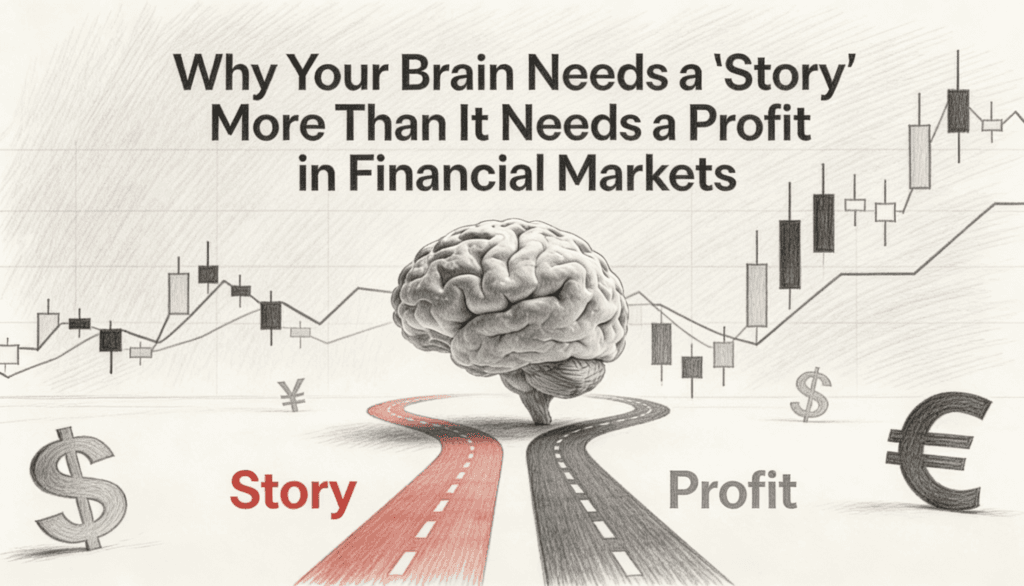
Your brain needs a story more than it needs a profit because, at the deepest level, it does not actually understand what a profit is. A profit is an abstraction. A number on a screen. But a story? A story is survival. A story is meaning. A story is the thing your brain was literally built to chase.
The trick is not to stop chasing. It is to notice when the chase is doing the thinking for you.