Table of Contents
Most people assume central banks were born from economic theory. That some group of brilliant minds sat in a quiet room, debated monetary policy, and designed institutions to manage the money supply for the good of the people.
That is a nice story. It is also mostly wrong.
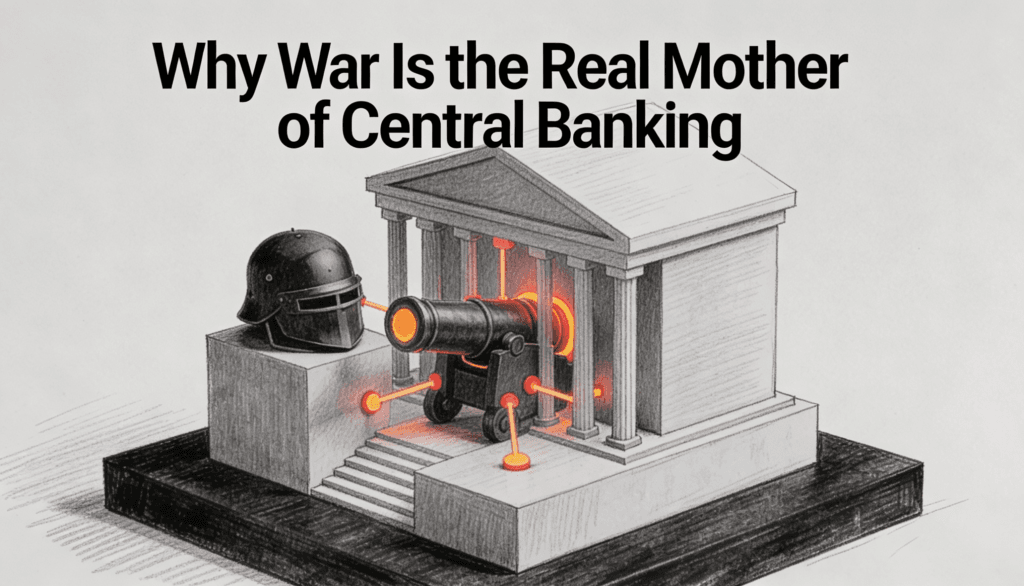
The real origin of central banking is not economics. It is war. Specifically, the desperate, bankrupt, backs against the wall reality of governments that needed to fund armies they could not afford. Central banks were not created to stabilize economies. They were created to win wars. The stability part came later, almost as an afterthought.
Understanding this changes how you think about money, government debt, and the financial system you live inside today.
England Had a Problem and It Was Not Inflation
The year was 1694. England was locked in an expensive war against France. King William III needed ships, soldiers, and weapons. What he did not have was cash. The English crown had a terrible credit reputation. It had defaulted before, seized assets from lenders, and generally behaved the way you would expect a medieval government to behave when it owed people money.
No one wanted to lend to the king. Not at reasonable rates, anyway.
So a deal was struck. A group of wealthy merchants would lend the government 1.2 million pounds. In return, they received the right to incorporate as a bank and issue notes. The Bank of England was born. Not from some grand economic vision. From a financing problem during wartime.
The merchants got a profitable institution. The king got his war funds. And the public got a central bank, whether they asked for one or not.
This pattern would repeat across the world for the next three centuries.
The Template That Kept Showing Up
Once you see the pattern, you cannot unsee it. A country faces a military crisis. The government runs out of money. A new financial institution is created to bridge the gap. That institution gradually becomes the central bank.
Sweden actually beat England to it. The Riksbank, often cited as the world oldest central bank, was established in 1668 partly to manage the financial chaos left behind by Sweden military adventures across Northern Europe. The country had been punching well above its weight in continental wars and needed a way to organize what was left of its finances.
France tried its own version under John Law in the early 1700s, attempting to monetize government war debts through a bank that also managed colonial speculation. That experiment ended in one of history most spectacular financial collapses. But the impulse was the same. War debt needed managing, and a central institution seemed like the answer.
Napoleon later created the Banque de France in 1800 for exactly the reason you would guess. He needed a reliable mechanism to finance his campaigns. The man who reshaped the map of Europe also reshaped French finance, and not because he cared about price stability.
America Fought About It for a Century
The United States provides the most entertaining case study because Americans managed to create, destroy, and recreate central banking institutions multiple times before finally settling on the Federal Reserve in 1913.
Alexander Hamilton pushed for the First Bank of the United States in 1791. His argument was partly about economic management, but the real catalyst was Revolutionary War debt. The new country owed money it could not easily repay, and Hamilton needed a financial institution to help restructure and manage those obligations. The war for independence had been won on the battlefield but was still being fought on the balance sheet.
That bank was allowed to expire in 1811. Then the War of 1812 happened, and suddenly the government found itself once again unable to finance a military conflict efficiently. The Second Bank of the United States was chartered in 1816. War debt, again, was the midwife.
Andrew Jackson killed the Second Bank in the 1830s, and the country went without a central bank for nearly 80 years. It was a fascinating experiment. It also meant that during the Civil War, the Union had to get creative with financing. The National Banking Acts of 1863 and 1864 created a national banking system partly to fund the war effort against the Confederacy. Lincoln needed money for armies. Financial innovation followed.
The Federal Reserve itself was created in response to financial panics rather than a specific war. But even here, it took less than four years for World War I to transform the Fed from a relatively modest institution into the government primary mechanism for war finance. The Fed was born in peacetime but grew up in wartime. Its adolescence was defined entirely by the need to fund the largest military conflict the world had ever seen.
Why This Matters More Than You Think
Here is where it gets interesting for anyone who cares about money and investing today.
If central banks were designed primarily to fund wars, then their DNA is not really about managing inflation or maximizing employment. Those missions were bolted on later. The original code, the thing that sits at the deepest layer of these institutions, is about ensuring the government can always borrow. Everything else is secondary.
This explains behaviors that otherwise seem puzzling. Why do central banks tend to err on the side of loose monetary policy? Why is the bias almost always toward more liquidity rather than less? Why do governments and central banks, despite their supposed independence, always seem to end up on the same page during a crisis?
Because the original function was to make sure the state could fund itself, especially when survival was on the line. That function has never really gone away. It has just been dressed up in more sophisticated language.
Think of it like a building that was originally constructed as a fortress and later converted into a hospital. The hospital function is real and important. But the walls are still three feet thick, the windows are still narrow, and the whole structure sits on top of a hill for defensive reasons. The original purpose shapes the building long after the purpose has officially changed.
The Quiet Revolution Nobody Voted For
There is something deeply ironic about the history of central banking. These institutions, which now sit at the center of every major economy and affect the life of every person who uses money, were never really chosen by the public. They were created in moments of crisis, usually by elites making deals with governments that needed cash for military purposes.
Nobody held a referendum on the Bank of England. No popular vote established the Federal Reserve. These institutions emerged from backroom negotiations between states that needed money and financiers who wanted privilege. The public was the last to know and the last to be consulted.
This is not a conspiracy theory. It is just how institutions get built during emergencies. When a government is fighting a war or recovering from one, democratic deliberation is not the priority. Speed is. And the people who can provide money quickly get to set the terms.
Over time, these institutions proved useful for peacetime purposes too. They became lenders of last resort during financial panics. They developed tools for managing interest rates and money supply. They hired economists who built theoretical frameworks justifying their existence on grounds that had nothing to do with warfare.
But the foundation was always military finance. The economists came after. The theories came after. The peacetime justifications came after.
The Investor Takeaway That Nobody Talks About
If you invest or manage money, this history is not just academic trivia. It is a lens that helps you predict institutional behavior.
Central banks will almost always choose to preserve the government ability to borrow over other objectives. When forced to choose between fighting inflation and ensuring the state can finance itself, the historical record is clear. The state wins. It may take time. There may be periods where inflation fighting appears to be the top priority. But when the situation gets serious enough, the original mission reasserts itself.
This does not mean central banks are villains. It means they are institutions shaped by the circumstances of their birth. Like all institutions, they carry their history in their structure, their culture, and their decision making, even when the people running them are not consciously aware of it.
The next time you watch a central bank press conference and hear language about price stability, maximum employment, and data dependent decisions, remember what those institutions were actually built for. Remember the merchants lending money to William III. Remember Hamilton trying to manage war debts. Remember Napoleon needing a bank to fund his armies.
The economics is real. But the history underneath it is more real. And the history says these are institutions of state power first and economic management second.