Table of Contents
Did Harry Markowitz Really Invent Diversification?
In 1952, a 25 year old graduate student named Harry Markowitz published a 15 page paper in the Journal of Finance titled “Portfolio Selection.” It earned him a Nobel Prize in 1990 and a permanent place in every finance textbook as the father of modern portfolio theory. The story we tell ourselves is clean and flattering: a brilliant young economist sat down with some equations and discovered that you should not put all your eggs in one basket. The science of portfolio diversification was born, fully formed, in a university library.
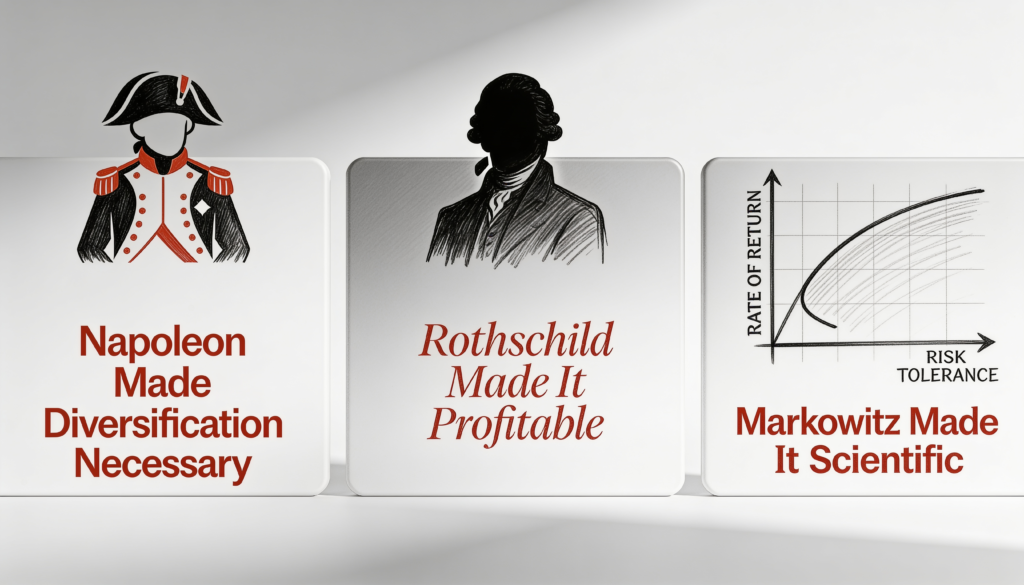
That story is incomplete. Markowitz did not discover diversification. He formalized something that wealthy Europeans had already learned the hard way, through fire and bankruptcy, more than a century earlier. The truth is stranger and more useful than the textbook version. Napoleon Bonaparte made diversification necessary by teaching an entire continent what concentrated risk feels like when everything collapses at once. The Rothschild family made it profitable by building the first network that proved spreading capital across borders actually worked. And only then, generations later, did Markowitz arrive to make it scientific. This is the real history of portfolio diversification, and it begins not with mathematics but with a man on horseback trying to conquer Europe.
A Timeline of How Diversification Became Science
- 1803 – The Napoleonic Wars begin. Across Europe, concentrated fortunes start to evaporate simultaneously.
- 1815 – The wars end at Waterloo. A generation of survivors rebuilds with a permanent fear of putting everything in one place.
- 1952 – Harry Markowitz publishes “Portfolio Selection,” turning intuition into equations.
- 1990 – Markowitz receives the Nobel Prize in Economic Sciences for that work.
Did Diversification Exist Before Markowitz?
Yes, and to understand how completely it existed, you need to understand the world of money before the wars. In the late 1700s, investing was not really investing in any sense we would recognize. It was gambling with a top hat on. Wealthy Europeans would sink their entire fortunes into a single venture, a single ship, a single colonial enterprise, and either become spectacularly rich or spectacularly ruined. There was very little in between.
The Amsterdam Stock Exchange had been operating since 1602. London had its own exchange. But these were not the broad, liquid markets we know today. They traded a handful of securities, mostly government debt and shares in monopoly trading companies such as the Dutch East India Company. If you were an investor in 1790, your portfolio looked less like a balanced allocation and more like a prayer.
The concept of spreading risk existed in theory. Merchants had been dividing cargo across multiple ships for centuries to avoid losing everything to a single storm. But as a financial principle, as something you did deliberately with your money across different types of assets, diversification was not yet a discipline. It was an instinct some people had and most people ignored.
Diversification did not arrive as a theory waiting to be discovered. It arrived as a survival trait, the financial equivalent of an immune response, forged by people watching their neighbors lose everything.
Then Napoleon showed up, and the instinct that most people ignored became a lesson that no survivor could afford to forget.
What Did the Napoleonic Wars Have to Do With Investing?
The Napoleonic Wars lasted from 1803 to 1815, though the chaos began earlier with the French Revolutionary Wars in the 1790s. For more than two decades, Europe was a continent on fire. And fire, it turns out, is an excellent teacher.
The wars did something no textbook could do. They showed an entire generation of wealthy Europeans, in real time, what concentrated risk actually looks like when everything goes wrong simultaneously. This was the laboratory in which the history of portfolio diversification was written. Every type of asset, in every country, took its turn being obliterated. Government bonds collapsed when governments fell. Land lost value when armies marched across it. Trade dried up when ports were blockaded. Currency became unreliable when nations printed money to fund their campaigns.
No single asset class survived the wars unscathed. That lesson, brutal as it was, became the foundation of modern portfolio thinking. To see why, it helps to stop talking in abstractions and look at exactly what happened to real investors on the day the war began.
What Happens If You Do Not Diversify? Three Investors in 1803
Imagine three wealthy men in the spring of 1803, each confident that his fortune is secure. Each holds a respectable, sensible, even conservative position. Within a few years, all three watch their wealth evaporate, and the cruel detail is that each one is destroyed for a completely different reason at roughly the same time. This is the worked example that no theory can match, because it is not theory. It happened.
The British consol holder. Our first investor keeps his fortune in British government consols, the perpetual bonds issued by the Crown. In 1803, this is considered the safest asset on earth. The British government does not default. Then the war drags on, and on, and on. To fund two decades of conflict, Britain issues an avalanche of new debt. The national debt swells from roughly 571 million pounds toward 865 million pounds. Inflation eats into fixed coupon payments. Consol prices sag under the weight of endless new issuance. The safest asset in the world does not go to zero, but it bleeds real value year after year while its owner can do nothing but watch. Safety, he learns, is not the same as preservation.
The Dutch colonial trader. Our second investor holds his wealth in colonial commerce, the trade routes that built the Dutch golden age. His fortune is tied to ships, cargo, and the East India trade. Then Napoleon imposes the Continental System, his blockade designed to strangle British commerce. The blockade does not only hurt Britain. It throttles the very trade routes Dutch fortunes depend on. Ports close. Cargoes are seized. The Royal Navy intercepts what the French do not. Wealth that seemed as permanent as the sea turns out to be one policy decision away from worthless. His ships still float. The trade beneath them simply ceases to exist.
The French landowner. Our third investor owns land, the oldest and most tangible store of wealth in human history. You cannot blockade a field. You cannot inflate away an acre. And yet armies march directly across his estates. Crops are requisitioned to feed soldiers. Conscription strips the countryside of the labor needed to work the soil. Political upheaval throws property rights into doubt as regimes rise and fall. The land remains exactly where it always was. Its value, however, collapses, because land is only worth something when there is peace, labor, and a stable government to enforce the deed.
Three men, three “safe” assets, three completely unrelated reasons for ruin, all arriving at the same historical moment. This is the entire case for diversification compressed into a single decade of European history.
Here is the lesson that no equation delivers as forcefully as these three men do. They were not destroyed by a single risk. They were destroyed by the assumption that their chosen risk was the only one that mattered. The bond holder feared default and met inflation. The trader feared storms and met blockade. The landowner feared nothing and met an army. An investor who had held all three positions, spread across consols, trade, and land, would still have suffered. But he would not have been wiped out, because no single catastrophe could reach every part of his wealth at once. That gap, the distance between a painful year and total ruin, is the whole point.
How Did the Rothschilds Make Diversification Profitable?
If the Napoleonic Wars were the classroom, the Rothschild family were the students who actually took notes and turned the lesson into a fortune.
The story of Nathan Rothschild and the Battle of Waterloo is famous and mostly exaggerated. The popular version says he learned of Napoleon’s defeat before anyone else and used that information to make a killing on the London Stock Exchange. The reality is more nuanced and, frankly, more interesting. What the Rothschilds actually pioneered was not insider trading. It was the first truly international financial network.
The five Rothschild brothers positioned themselves in five different European capitals: London, Paris, Frankfurt, Vienna, and Naples. They did not merely communicate across borders. They moved capital across borders. This was diversification in its most literal and most powerful form. The family did not keep all its wealth in one country, one currency, or one type of asset. They spread it across nations, across instruments, across political regimes that were frequently at war with one another.
When France stumbled, their London operations thrived. When British consols wobbled, their continental positions held. The Rothschilds did not invent diversification because they read a paper about it. They invented its profitable, institutional form because they watched what happened to families who did not diversify. Those families do not have biographies written about them. The Rothschilds turned the survival trait of the post war generation into a deliberate strategy, and that strategy made them the most powerful financial dynasty of the 19th century.
The Accidental Machinery of Modern Markets
Here is where the story becomes genuinely strange. The wars did not only teach people to diversify. They accidentally built the infrastructure that made diversification possible in the first place.
To fund the fighting, governments across Europe issued unprecedented amounts of debt. Britain alone saw its national debt to over 850 million pounds during the conflict. This explosion of government bonds created, almost by accident, the first deep and liquid bond markets. Before the wars, bond markets were shallow pools where a few wealthy individuals traded with each other. After the wars, they were oceans. There were simply so many bonds in circulation that a real market had to develop to handle them. Trading became more frequent. Pricing became more transparent. New financial intermediaries emerged to match buyers and sellers.
The wars also accelerated the development of insurance markets. Lloyd’s of London, which had been insuring ships since the 1680s, became enormously sophisticated during the Napoleonic era. When your ships might be captured by French privateers, sunk by the Royal Navy, or seized under the Continental System depending on which flag they flew, you develop a very detailed understanding of how to price risk.
And then there was currency. The wars forced Europeans to think about exchange rate risk in ways they never had before. When Napoleon redrew the map of Europe every few years, currencies rose and fell with borders. Investors who survived learned to hold assets in multiple currencies, not out of sophistication but out of self defense. The machinery of modern diversification, namely deep bond markets, sophisticated insurance, currency hedging, and cross border capital flows, was never designed by a committee. It was forged in the panic of trying to preserve wealth while the world burned.
How Did Markowitz Turn Survival Into Science?
When the wars ended in 1815, Europe did something remarkable. It did not simply rebuild. It rebuilt with memory.
The Congress of Vienna brought political stability, but the financial innovations born of wartime desperation did not disappear. They accelerated. The London Stock Exchange, which had grown enormously during the war years to handle government debt issuance, became the center of global finance. New types of securities emerged. Railroad stocks in the 1830s and 1840s gave investors something genuinely new to buy, an asset class that was neither government debt nor colonial speculation.
The generation of investors who came of age during or just after the wars carried a specific trauma. They had watched concentrated bets destroy families. They had seen how war could make any single asset, no matter how safe it appeared, fall to zero. And they built their financial lives accordingly. This is, when you think about it, exactly how evolution works. Not the survival of the smartest or the strongest, but the survival of whoever happened to be doing the thing that worked when the catastrophe hit. The investors who diversified did not do so because they held a theory. They did so because the ones who did not diversify were eliminated from the gene pool of wealth.
What remained was a population of wealthy Europeans who, through sheer survival, believed in spreading risk. They had the conviction. What they lacked was the mathematics.
By the time Harry Markowitz arrived, the world had already spent more than a century proving his thesis with real money and real ruin. He gave the proof its equations. The Napoleonic generation gave it its scars.
That is precisely what Markowitz contributed in 1952. He demonstrated, with formal mathematics, that you can reduce risk without proportionally reducing returns by combining assets that do not move in lockstep. He introduced the idea of an efficient frontier, the set of portfolios that deliver the most return for a given level of risk. He proved that the correlation between assets, not just their individual riskiness, is what determines the safety of the whole. Our three investors from 1803 would have understood this instantly. Consols, colonial trade, and farmland were dangerous separately, which is the very property that would have saved a diversified holder. Markowitz simply wrote down the rule that the survivors had been living by for 137 years. The 1990 Nobel Prize honored the formalization, not the discovery.
What Can Napoleon Teach You About Your Portfolio Today?
The temptation today is to believe we have moved beyond the crude lessons of the early 1800s. We have index funds. We have modern portfolio theory. We have algorithms that rebalance our holdings while we sleep. But the core insight has not changed at all, and it did not originate in a textbook. It came from watching real people lose real fortunes because they believed the thing that had always worked would always work.
Every generation relearns this lesson from scratch. The investors of 1929 learned it. The investors who went all in on technology stocks in 2000 learned it. The investors of 2008 learned it. The lesson is always identical, and it is always learned the hard way, because the easy way never seems to stick.
It is also worth being precise about what diversification can and cannot do. It is not a guarantee against loss. The investors who spread their wealth during the Napoleonic Wars still lost money. What they avoided was losing everything. That difference, between a bad year and total ruin, is the entire purpose. Diversification is not really about winning. It is about surviving long enough to keep playing the game.
There is a beautiful irony at the heart of all this. Napoleon’s lifelong goal was concentration. He wanted one empire, one legal code, one system of weights and measures, one Continental System of trade. He was the ultimate advocate of putting everything in a single basket. And the lasting financial legacy of his ambition turned out to be the exact opposite: a continent that learned, through pain, that the only sane response to an unpredictable world is to never put everything in one place.
So when you build a portfolio across stocks, bonds, real estate, and currencies, you are not following a piece of academic theory invented in 1952. You are obeying a survival instinct that a continent paid for in blood and bankruptcy two centuries ago. Napoleon would probably hate knowing that his greatest lasting gift to civilization was not the Napoleonic Code and not the metric system. It was teaching people to spread their money around. Do not put all your wealth in one empire, especially if that empire is run by a man who believes invading Russia in winter is a good idea.