Table of Contents
The Stock Market History No One Teaches You: 400 Years of Identical Human Mistakes
The stock market did not begin with screens and ticker symbols. It began with ships, spices, and a gamble so large that no single merchant in Amsterdam could afford to lose. The history of the stock market spans more than four centuries, and the single most uncomfortable truth running through all of it is this: the technology keeps upgrading, but the humans never do.
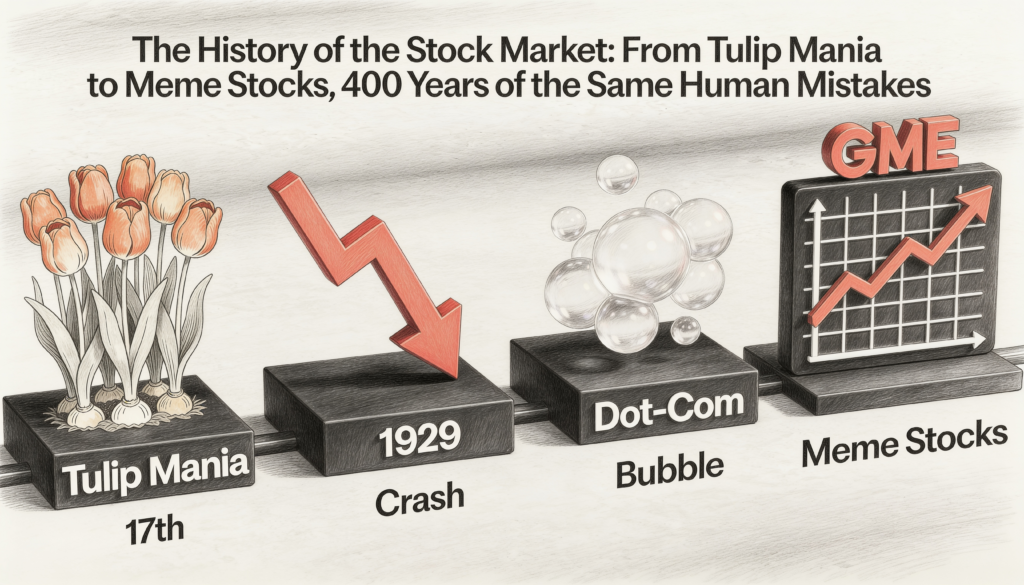
From Tulip Mania in 1637 to the meme stock frenzy of 2021, the script barely changes. A new asset appears. Excitement builds. Everyone piles in. Someone gets left holding worthless inventory. We have repeated this exact sequence so many times that you could set a clock by it. This is the story of how we got here, and why the smartest people in every generation still managed to lose their shirts in ways their grandparents would have recognized instantly.
Amsterdam, 1602: The Accidental Invention of the Stock Market
The stock market was never designed. It emerged out of necessity. The Dutch East India Company, known as the VOC, needed an enormous amount of capital to send ships across the world, buy spices, and bring them home before the crew died of scurvy. No single merchant could fund a voyage of that scale and risk.
So the VOC did something genuinely radical. It sold shares to the public. Anyone could buy a piece of the venture. Butchers, bakers, and politicians all threw their money into the pot. With that one decision, the Dutch created the world’s first publicly traded company and the first formal stock exchange.
Here is where it becomes fascinating. The VOC did not only create shareholders. It created the first investors who had no real idea what the company actually did. They simply knew the price was rising, and that was enough. Within a few years, Amsterdam had a functioning exchange complete with speculators, short sellers, and people trading options on, of all things, tulip bulbs.
In 1637, the famous Tulip Mania saw the price of rare bulbs climb to the cost of a canal house before collapsing overnight. It was the first recorded asset bubble in financial history, and it followed a pattern that would repeat with eerie precision for the next 400 years.
The Dutch gave us the stock market and the cautionary tale at the very same moment. We kept the first invention and quietly ignored the second.
That ignorance is the through line of everything that follows. The early stock market proved that pooling capital could fund extraordinary things. It also proved that human beings, given the chance, will absolutely pay a fortune for a flower.
London, 1700s: Coffeehouses, Gossip, and the South Sea Disaster
The London Stock Exchange did not begin in a grand marble building. It began in coffeehouses. Traders gathered at Jonathan’s Coffee House in the late 1600s, buying and selling shares over cups of something that barely qualified as coffee. The setting was casual. The financial consequences were not.
By 1720, England produced a spectacular bubble of its own. The South Sea Company promised investors it would generate fortunes by trading with South America. There was one enormous problem. Spain controlled most of South America and had absolutely no intention of sharing. This was not a small technicality. Investors ignored it anyway, because the share price was rising, and a rising price felt like proof that the company must be doing something right.
The Lesson Even Isaac Newton Could Not Learn
Isaac Newton, arguably the most brilliant human who ever lived, invested early in the South Sea Company. He made a tidy profit and sold his shares. Then he watched the price keep climbing without him. Unable to bear the feeling of missing out, he bought back in near the very top and lost roughly 20,000 pounds, which would be several million in today’s money.
Newton reportedly said afterward that he could calculate the motion of the heavenly bodies but not the madness of people. This single sentence should be printed on the welcome screen of every brokerage app ever made.
The South Sea Bubble taught England a hard lesson about financial regulation, which the country promptly forgot and was forced to relearn every few decades thereafter. More importantly, it revealed something permanent about how markets work. Greed and fear are not flaws in the system. They are the engine of the system.
America Enters the Game: Wall Street and the Robber Barons
The New York Stock Exchange traces its origins to 1792, when a group of stockbrokers signed an agreement under a buttonwood tree on Wall Street. It is a charmingly modest beginning for what would eventually become the financial capital of the entire world.
For most of the 1800s, the American stock market was a private playground for insiders and robber barons. Men like Cornelius Vanderbilt and Jay Gould manipulated prices with all the subtlety of a sledgehammer. There were no meaningful regulations. If you had enough money, you could corner a market, spread false information, and bankrupt a competitor before lunch.
The average person did not invest in stocks during this era at all. Stocks were widely regarded as gambling, which, to be honest, they largely were. The notion that ordinary citizens should place their hard earned savings into the market would not arrive for another full century.
The 1920s: Everybody In, Everybody Out
The Roaring Twenties transformed the relationship between the public and the market. For the first time, regular Americans began buying stocks in enormous numbers. Brokers made it dangerously easy by offering margin accounts, which allowed people to buy shares with borrowed money. You could put down 10 dollars and control 100 dollars worth of stock.
When prices climbed, this leverage felt like genius. When prices fell, it became a catastrophe. And prices fell hard. The crash of 1929 did not unfold in a single afternoon, despite Black Tuesday receiving most of the attention. It was a slow unraveling that began in September and accelerated through October. By the time it ended, the market had lost nearly 90 percent of its value from peak to trough. The Great Depression followed, and an entire generation learned to distrust Wall Street completely.
Here is the counterintuitive twist. As devastating as the crash was, it led directly to the creation of the Securities and Exchange Commission in 1934. The SEC introduced rules that made markets more transparent and far less rigged. The disaster forced the system to become more fair. Sometimes the worst outcomes plant the seeds for the best reforms. The open question is always whether the cost was worth paying.
The Post War Boom and the Birth of the Modern Investor
After World War II, something fundamental shifted. The American economy surged. Suburbs sprawled outward. A confident middle class emerged with money to save and nowhere particularly exciting to put it. The stock market, scrubbed clean by Depression era regulations, finally started to look respectable rather than reckless.
Mutual funds, which had quietly existed since the 1920s, became genuinely popular in the 1950s and 1960s. They offered a simple promise. Hand us your money, we will choose the stocks, and you can get on with your life. This was the beginning of accessible investing for the masses, even though the funds themselves were actively managed and often expensive.
The deeper revolution, however, was happening inside universities. In 1952, Harry Markowitz published a paper on portfolio theory arguing that investors should weigh risk and return together rather than simply chasing the highest possible gains. It sounds obvious today. At the time it was radical enough to eventually earn him a Nobel Prize.
Then came Eugene Fama in the 1960s with the Efficient Market Hypothesis, which argued that stock prices already reflect all available information. If that were true, then trying to beat the market consistently was largely a waste of energy. Professional fund managers, in this view, were not meaningfully better than dart throwing monkeys. The industry did not enjoy the comparison. Decades of data have mostly proven the comparison fair.
Index Funds and the Greed Decade: Two Roads Diverge
In 1976, John Bogle launched the first index fund available to everyday investors through Vanguard. The concept was almost embarrassingly simple. Rather than paying a manager to pick winners, you simply buy every stock in an index like the S&P 500 and hold them. Costs stay minimal. Returns match the market.
Wall Street openly mocked him. They sneered at the product and called it Bogle’s Folly. Why would any sane person settle for merely average returns? The answer, it turned out, was that average market returns beat the vast majority of professional stock pickers over the long run, especially once fees were subtracted. Bogle was not selling mediocrity. He was selling mathematics.
It took decades, but the index fund became the single most important investment vehicle of the modern era. Bogle never became a billionaire from it because he structured Vanguard to be owned by its own fund holders.
He surrendered enormous personal wealth so that millions of ordinary investors could keep more of theirs. There are not many stories like that in financial history.
When Greed Became a Career Plan
Meanwhile, the 1980s brought a wildly different energy to Wall Street. Junk bonds, leveraged buyouts, and a culture of pure excess defined the decade. Michael Milken made billions trading high yield debt before eventually going to prison. Gordon Gekko, the fictional villain of the film Wall Street, declared that greed is good, and far too many real people treated the line as professional advice.
The tension between Bogle’s quiet discipline and the loud excess of the 1980s captures something essential about investing itself. There have always been two roads. The boring one that works slowly and reliably, and the thrilling one that works beautifully right up until the moment it does not.
The Dot Com Bubble: History Rhymes Once Again
By the late 1990s, the internet had arrived, and investors lost their collective minds in a way that would have felt deeply familiar to any Dutch tulip trader. Companies with no revenue, no business plan, and a name ending in dot com were suddenly valued at billions.
Pets.com became the perfect emblem of the absurdity. It was an online pet supply store that spent more on advertising than it ever earned in sales, went public, and collapsed within a single year. The Nasdaq peaked in March 2000 and then fell nearly 80 percent over the following two years. Trillions of dollars evaporated. Retirement accounts were gutted.
Yet most retellings miss the most important detail. The dot com bubble was not actually wrong about the internet. The internet truly did change everything. It simply did not change everything within 18 months. The investors who bought Amazon at its 1999 peak and held through the crash eventually earned extraordinary returns. The investors who bought Pets.com earned nothing.
Manias are almost always built on a genuine kernel of insight, then wrapped in thick layers of delusion. The bubble got the thesis right and the timeline catastrophically wrong.
2008: When the System Itself Broke
The financial crisis of 2008 was unlike the crashes that came before it, because the real danger was not hiding in the stocks. It was buried in the plumbing of the financial system itself. Banks had bundled risky mortgages into complex securities, stamped them with high credit ratings, and sold them to investors all over the world.
When housing prices began to fall, the entire structure collapsed like a Jenga tower with too many pieces pulled out. Lehman Brothers went bankrupt. The global economy nearly seized up entirely. Governments rushed in with massive bailouts. The people who caused the crisis mostly kept their bonuses. The people who had nothing to do with it lost their homes.
The crisis exposed something deeply uncomfortable. The financial system had grown so interconnected that the failure of a handful of institutions could threaten the entire global economy. The phrase “too big to fail” entered everyday language, carrying with it the unsettling suggestion that the game was rigged in ways ordinary people were only beginning to grasp.
The Current Era: Apps, Memes, and Infinite Information
Today, anyone holding a phone can open a brokerage account in minutes and begin trading almost instantly. The barriers to entry have never been lower in the entire history of the stock market. This is genuinely a good thing. Access to markets should never have been reserved for the wealthy alone.
But access is one thing. Understanding is something else entirely. The GameStop saga of 2021, in which retail traders organizing on Reddit drove a struggling video game retailer’s stock to absurd heights, was widely celebrated as a populist uprising against Wall Street. In certain ways, it genuinely was.
Yet many of the people who bought near the top lost real money while the exciting narrative simply moved on without them. The crowd was fighting both the establishment and the establishment’s math at the same time. Math tends to win eventually.
We now live in an age of infinite financial information. Podcasts, newsletters, YouTube channels, and social media accounts all compete to hand out investment advice. The bitter irony is that more information has not produced better investors. It has mostly produced more confident ones, and confidence without discipline has emptied more accounts than any market crash.
What 400 Years of Stock Market History Actually Teach Us
When you compress four centuries of market history into a single view, a handful of lessons emerge with stubborn, almost comic clarity. These are the principles that survive every era, every technology, and every generation that swears this time is different.
- Human nature does not upgrade. The same psychology that drove Dutch merchants to overpay for tulips drives modern investors to buy cryptocurrencies they do not understand at prices they cannot justify. Technology changes the medium, never the message.
- The boring strategy usually wins. Diversification, low costs, and long time horizons are not thrilling, which is precisely why they work. Excitement in investing is almost always a hidden cost rather than a benefit.
- Crashes are features, not exceptions. If you intend to invest for decades, you will live through several of them. The people who build lasting wealth are not the ones who dodge every downturn. They are the ones who survive the downturns without panicking out.
- The industry generates fees far better than wisdom. The best advice in financial history, which is to buy a diversified basket of stocks and hold it for a very long time, is completely free. Almost everything else is decoration.
There is something both reassuring and quietly hilarious about all of this. We have produced 400 years of dazzling financial innovation, founded thousands of institutions, and built supercomputers that trade in microseconds. And after all of it, the single best investment strategy still fits comfortably on a 3 inch index card.
The history of the stock market is, in the end, less a story about money than a story about people. The same hopes, the same fears, the same fatal certainty that we are smarter than everyone who came before us. Understanding that pattern will not make you immune to it. But it just might make you pause for one extra moment before you buy the modern equivalent of a tulip.