Table of Contents
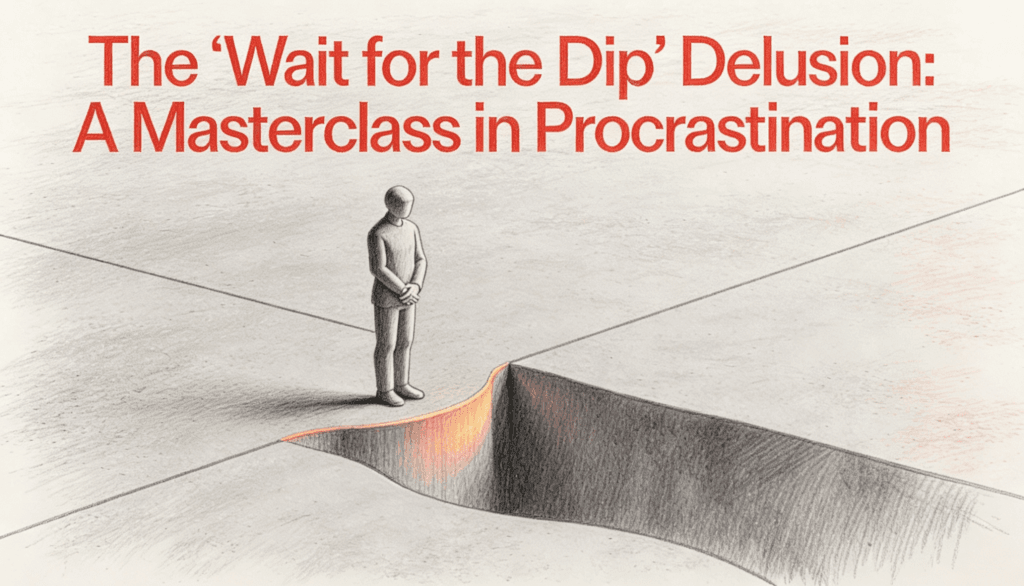
There is a particular kind of investor who has been waiting since 2016. They watched the market climb. They watched it stumble in 2018 and thought about buying. They watched it crash in 2020 and froze. They watched it recover faster than anyone expected and told themselves the next dip would be the real one. The one worth waiting for. The perfect one.
They are still waiting.
This is not a story about market timing. Plenty of people have written that article, complete with charts and compound interest calculators and stern warnings. This is a story about something stranger and more human. It is about how a perfectly rational sounding strategy becomes a psychological trap. How waiting for the dip is less about finance and more about the stories we tell ourselves to avoid doing something that scares us.
The Comfort of the Conditional
“I will invest when the market drops 20 percent.” On the surface, this sounds disciplined. Strategic, even. But pay attention to the grammar. It is a conditional statement. And conditional statements are the native language of procrastination.
We do not say “I will never invest.” That would feel too final, too defeatist. Instead, we attach our action to a condition that may or may not arrive, and in doing so, we get to feel like investors without ever actually investing. We get the identity without the risk. The costume without the stage.
This is not unique to finance. People do this everywhere. “I will start the business when the economy stabilizes.” “I will write the book when I have more free time.” “I will have that conversation when the moment feels right.” These are not plans. They are permission slips for inaction dressed up as patience.
The Dip That Already Happened
Here is something that rarely gets discussed. Most people who say they are waiting for a dip have already lived through several.
So why did these disciplined dip waiters not buy during the last one?
Because when the dip actually arrives, it does not feel like a dip. It feels like the beginning of something worse. The news is terrible. Experts are calling for further declines. The very thing you were waiting for now looks like a warning to stay away. The menu said “market correction” but the meal that arrived looks a lot like “financial crisis.”
This is the cruel joke at the center of the strategy. You can only identify a dip with certainty after it is over. In real time, every dip is indistinguishable from the early stages of a collapse. And so the person waiting for the dip encounters one, feels the fear that always accompanies falling prices, and decides this particular dip is not the right one. They will wait for the next one. A cleaner one. One that comes with less panic and more certainty.
They are waiting for a dip that feels safe. That is like waiting for a rainstorm that keeps you dry.
The Ancestor Problem
It helps to understand why our brains work this way, and for that, we need to go back further than Wall Street.
For most of human evolutionary history, the penalty for being wrong was death. Eat the wrong berry, approach the wrong animal, trust the wrong stranger, and your genetic line ends right there. Our brains evolved under conditions where false positives (seeing danger that was not there) were mildly inconvenient, but false negatives (missing danger that was there) were fatal.
This is a brilliant operating system for surviving on a savannah. It is a terrible one for investing in index funds.
When the market drops sharply, your brain processes it through the same threat detection system that once kept your ancestors alive. The amygdala does not know the difference between a bear market and an actual bear. It registers falling numbers, alarming headlines, and rising volatility, and it does exactly what evolution designed it to do. It screams at you to stay still, stay hidden, do not move.
There is another psychological layer here that deserves attention. When people imagine the future, they tend to weigh regret asymmetrically, and not in the way you might expect.
Most people think they are afraid of losing money. And they are, to some degree. But the deeper fear, the one that really drives the waiting game, is the fear of looking foolish. Of buying at the wrong time and having to sit with that decision while prices fall further. Of being the person who bought at the top.
This is why dip waiters often have very specific numbers in mind. “I will buy when the S&P drops to 4,000.” The precision is not analytical. It is emotional. A specific number creates a specific scenario in which you were provably right. You do not just want to invest. You want to invest and be validated for your timing.
But here is the counterintuitive part. The research on regret shows that over longer time horizons, people regret inaction far more than action. In the short term, doing something and getting a bad outcome feels worse than doing nothing. But over years and decades, the things we did not do haunt us far more than the things we did. The investments we never made. The businesses we never started. The conversations we never had.
The dip waiter is optimizing for short term emotional comfort at the expense of long term psychological peace. They just do not know it yet.
The Spectator Trap
There is a concept in sports psychology called “paralysis by analysis.” It describes what happens when an athlete thinks too much about mechanics and loses the fluid, instinctive quality of their performance. The golfer who starts consciously thinking about grip pressure, hip rotation, and follow through angle will almost certainly hit a worse shot than the one who just swings.
Something similar happens with market watching. The more you study charts, follow financial news, and track daily price movements, the harder it becomes to actually commit capital. Every new data point creates a new reason to wait. Every analyst opinion introduces a new variable. You are not becoming more informed. You are becoming more paralyzed.
The irony is that the people who invest most successfully over long periods tend to be the ones who pay the least attention. Studies of 401(k) accounts have consistently found that the best performing accounts often belong to people who forgot they had them. Not sophisticated traders. Not chart readers. People who set up automatic contributions and then got busy living their lives.
There is something almost offensive about this finding. It suggests that the optimal investment strategy is not smarter analysis but benign neglect. That the best thing you can do with your portfolio is ignore it. For anyone who has spent years carefully watching the market, waiting for the perfect entry point, this is a deeply uncomfortable truth.
The Hidden Cost of Waiting
People who wait for the dip tend to think about risk in one direction only. They calculate how much they might lose if they invest and the market drops. What they almost never calculate is how much they have already lost by waiting.
This is not about specific numbers or percentage points. It is about something more fundamental. Every day you hold cash waiting for a dip, you are making an active bet. You are betting that the market will fall far enough, soon enough, to compensate for all the time you have spent on the sidelines. This is not cautious. It is actually one of the most aggressive speculative positions available. You are just speculating on inaction instead of action, and somehow that feels conservative.
It is a bit like refusing to board any flight until you find one with zero turbulence. You are not reducing risk. You are just guaranteeing you never go anywhere.
The Permission to Be Imperfect
If there is a cure for the dip waiting delusion, it probably is not more data, better charts, or a more sophisticated understanding of market cycles. It is something much simpler and much harder.
It is giving yourself permission to be imperfect.
The dip waiter is, at their core, someone who has confused investing with performing. They want the entry point that proves they are smart, disciplined, and in control. They want the purchase that looks good in retrospect. And because no entry point can guarantee that feeling, they never enter at all.
The uncomfortable truth is that nearly every investment, viewed at the moment of purchase, feels slightly wrong. Too high, too uncertain, too risky. If you wait until investing feels completely comfortable, you will wait forever, because comfort and opportunity rarely show up at the same time.
The best investors are not the ones who buy at the bottom. They are the ones who buy consistently, imperfectly, and without needing the emotional satisfaction of perfect timing. They have made peace with the fact that they will sometimes buy before a drop. They will sometimes miss the bottom by weeks or months. Their portfolios will sometimes look foolish in the short term.
And they invest anyway.
The Last Dip
There is one final thought worth sitting with. Every market dip that has ever occurred, every crash, every correction, every terrifying headline, eventually became a point on a chart that future investors would look at and say, “I wish I had bought there.”
Every single one. Without exception.
The dip you are waiting for has probably already happened. And the next one, when it arrives, will not feel like an opportunity. It will feel like a threat. That is how dips work. They are only visible in the rearview mirror.
The question is not whether you can time the market. The question is whether you are willing to be in it. Imperfectly. Uncomfortably. Starting now.
Because the most expensive dip of all is the one you spend your whole life waiting for.