Table of Contents
There’s a peculiar gap in American finance that most people never think about. Banks love lending to massive corporations because the deals are huge and the risks are calculable. Venture capitalists chase technology startups with dreams of hundred-fold returns. But what about the company that makes industrial fasteners in Ohio? The regional logistics firm in Georgia? The software company with $30 million in revenue that needs capital to expand but isn’t sexy enough for Silicon Valley?
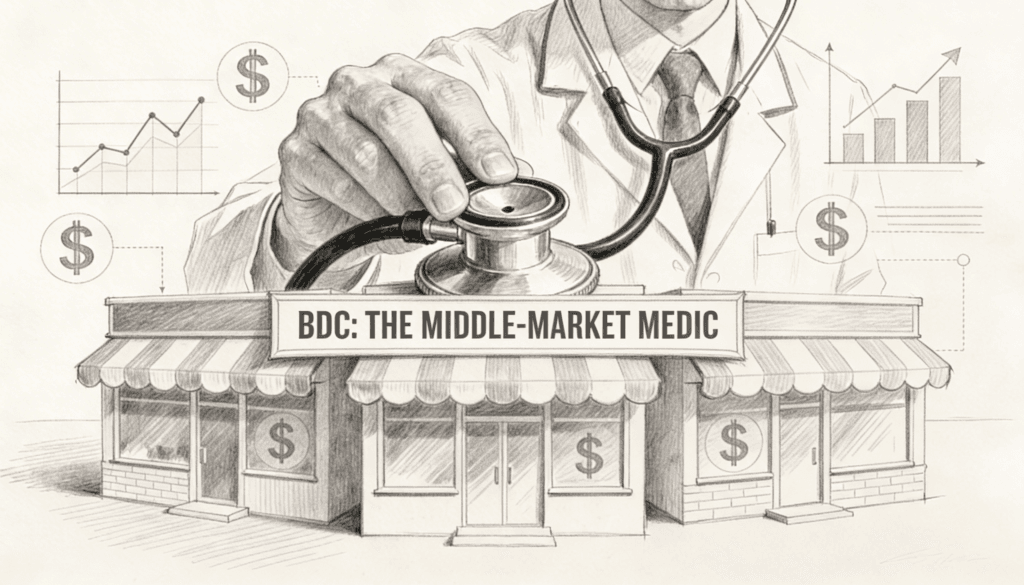
This is where Business Development Companies come in, operating in what might be the least glamorous corner of finance. They’re essentially publicly traded private equity funds, but that description doesn’t capture what they actually do. Think of them as the emergency room doctors of the business world, except they treat companies that aren’t dying but aren’t quite thriving either.
The Forgotten Middle
The middle market represents about a third of private sector GDP. These aren’t household names. They’re businesses too big for a bank loan but too small or too boring for traditional Wall Street attention. They exist in a financing desert, and that’s precisely where BDCs have built their oasis.
What makes this interesting is that the middle market lives in a strange paradox. These companies are often more stable than startups and more nimble than corporations, yet they’re systematically ignored. It’s like being the middle child of the economy. Not the celebrated firstborn, not the coddled baby, just reliably there, doing the work.
BDCs were created by Congress in 1980, which should tell you something. When politicians have to legislate a solution to a market problem, it usually means the market failed in an interesting way. The idea was simple: create investment vehicles that could raise capital from regular investors and deploy it into businesses that banks wouldn’t touch and that were too small for conventional private equity.
The Economics of Attention
Here’s where it gets counterintuitive. You might think smaller companies are riskier investments, and statistically they can be. But there’s an offsetting factor: lack of competition. When Goldman Sachs and JP Morgan aren’t fighting over a deal, the terms get better. When a company can’t just hop over to another lender, relationships matter more. The economics of lending aren’t just about default risk. They’re about what economists call information asymmetry, and BDCs thrive in exactly those conditions.
Large banks have become remarkably efficient at certain things. They can process a mortgage application in days. They can handle millions of transactions per second. But efficiency requires standardization, and standardization means fitting into boxes. Middle market companies are irregularly shaped. They have unique assets, unusual cash flow patterns, and specific needs that don’t map neatly onto a credit model built for predictability.
This is where BDCs function almost like translators. They can understand a business that a bank’s algorithm can’t process. They’ll lend against assets that don’t fit standard categories. They’ll structure deals with covenants and terms that actually match how the business operates rather than how the lending manual says deals should work.
The Yield Hunter’s Paradox
From an investor’s perspective, BDCs offer something increasingly rare: yield. In an era when savings accounts pay nearly nothing and bond yields have spent years near historic lows, BDCs often distribute 8% to 10% annually. This attracts a certain type of investor, usually someone closer to retirement who needs income, not growth.
But here’s the paradox. The people who need steady income the most are often the ones least equipped to handle the volatility and complexity of BDCs. These aren’t bonds. The distributions can get cut. The share prices swing around. During financial stress, they can drop 30% or 40% because they’re thinly traded and because fear is contagious.
It’s almost like BDCs created a product for one customer profile but ended up attracting a different one. The structure makes sense for sophisticated investors who understand leverage, credit cycles, and portfolio company performance. But the high yield attracts income seekers who might not fully grasp what they’re buying. It’s the investment equivalent of a restaurant that advertises steak but whose best dish is actually the fish.
Leverage as Amplifier
BDCs are allowed to borrow up to one dollar for every dollar of equity they have. This leverage amplifies everything. When times are good and borrowers pay on time, returns get boosted. When times are rough and defaults rise, losses get magnified. It’s a structural feature that makes BDCs fundamentally different from mutual funds or ETFs.
Think of leverage like a megaphone. It makes your voice louder, but it also makes your mistakes more noticeable. A BDC that invests wisely can generate impressive returns for shareholders. A BDC that makes poor credit decisions can implode quickly. The leverage doesn’t create the quality of decision making, it just makes the consequences more extreme.
This structure mirrors something we see throughout finance: risk isn’t eliminated, just relocated. Banks don’t want the risk of lending to middle market companies, so BDCs take it. BDC shareholders don’t want boring returns, so they accept volatility. The risk doesn’t vanish, it just finds people willing to carry it, usually for a price.
The Information Game
One underappreciated aspect of what BDCs do is information production. When they lend to a company, they’re essentially doing deep research on a business that doesn’t have analyst coverage, doesn’t file detailed public reports, and exists largely outside the financial media’s attention. They’re creating knowledge about economic activity that would otherwise be invisible.
This has broader implications. The health of middle market companies is a leading indicator for the economy, but it’s hard to measure because these firms aren’t public. BDCs, through their portfolio performance, inadvertently create a window into economic conditions that official statistics might miss. When BDCs start seeing more defaults or having trouble finding attractive deals, that’s a signal. When they’re putting money to work easily and borrowers are performing well, that tells a different story.
It’s similar to how doctors tracking influenza cases can predict epidemics before official health statistics catch up. BDCs are taking the temperature of the middle market in real time, and that information has value beyond their own portfolios.
The Relationship Business
Banking used to be about relationships. You knew your banker. They knew your business. That model has largely disappeared at big banks, replaced by credit scores, automated underwriting, and risk management committees. BDCs, almost by accident, have ended up recreating relationship banking for the middle market.
When a BDC lends to a company, they’re often on the board or at least deeply involved in strategic decisions. They can’t just sell the loan easily like a big bank might. They’re stuck with their choices, which means they have to actually care about whether the business succeeds. This creates alignment that’s increasingly rare in modern finance.
There’s an irony here. The most modern investment structure, publicly traded funds with daily pricing and quarterly reporting, ends up practicing one of the oldest forms of finance: patient capital that sticks around. It’s the investment equivalent of using a smartphone to make a phone call. We used the most advanced technology to recreate something simple we used to do naturally.
The Economic Ecosystem
BDCs sit in a specific niche, but their effects ripple outward. They fund the expansion of a manufacturing company, which needs to hire more workers. Those workers spend money in their communities. The company buys equipment from suppliers, creating demand elsewhere. It’s mundane economic activity, the kind that doesn’t make headlines but accumulates into actual prosperity.
This is fundamentally different from what happens at the extremes of finance. Venture capital creates unicorns and disruption, which is exciting but benefits relatively few people. Large corporate finance moves billions but often involves financial engineering rather than real economic activity. The middle market is where actual productive investment happens at scale.
If you want to understand why some regions thrive while others stagnate, following middle market capital flows tells you more than looking at venture funding or Fortune 500 headquarters. A BDC funding companies in Tennessee or Wisconsin is facilitating economic development in a way that’s less visible but more distributed than headline-grabbing deals.
The Governance Question
Here’s something that doesn’t get discussed enough: BDCs are often externally managed, meaning a separate company manages the BDC and charges fees for doing so. This creates a principal-agent problem that would make any economics professor wince. The managers get paid based on assets under management, not necessarily on returns. They have incentives to grow the BDC and to put capital to work, even if the opportunities aren’t great.
This structure emerged partly for regulatory reasons and partly because it was easier to launch BDCs this way. But it means shareholders need to pay attention to whether management interests align with their own. Some BDCs have navigated this well, others less so. It’s a reminder that structure matters, sometimes more than strategy.
The parallel to mutual fund management is instructive. Both involve someone else investing your money for a fee. Both require trust. But BDCs add complexity because they’re investing in illiquid assets and using leverage. When structures get complicated, opportunities for misalignment multiply. It’s not that people are necessarily bad actors, it’s that incentives shape behavior in subtle ways.
The Measurement Problem
How do you know if a BDC is doing well? The obvious answer is look at returns, but that’s complicated. BDCs hold illiquid investments that they value themselves. There’s room for judgment, which means room for optimism. A BDC might carry a loan at par value on its books while that loan is actually impaired. You won’t know until they write it down, which might happen quarters after problems emerge.
This creates an information lag that’s troubling for investors. You’re making decisions based on backward looking, potentially optimistic data about assets that don’t trade. It’s like driving by looking in the rearview mirror. You can do it, but you need to go slowly and accept that surprises are coming.
The better BDCs are conservative in their valuations and transparent about problems. But even then, you’re trusting their judgment. In public equity markets, prices reflect what buyers will actually pay. In BDC portfolios, prices reflect what management thinks someone would pay if they tried to sell, which isn’t the same thing.
When BDCs work well, they create a virtuous cycle. Companies get capital they couldn’t access otherwise. They grow, hire, and generate returns that flow back to BDC investors. Those investors, often retirees, use that income to live on, spending it in their own communities. Capital circulates through the real economy rather than bouncing around in financial markets.
When BDCs work poorly, the cycle reverses. Bad loans pile up, distributions get cut, and shareholders lose money. Companies that might have been viable with better capital or better terms struggle or fail. The failures aren’t spectacular like tech bankruptcies, but they ripple through communities and supply chains.
The Unglamorous Essential
There’s no crescendo moment in middle market lending. No IPO bells, no billion dollar acquisitions, no founders on magazine covers. Just companies that grow a little each year, employ people, make things, deliver services, and pay their debts. It’s so boring that it’s almost radical in its ordinariness.
BDCs have made a business out of this mundane necessity. They’ve created a structure that channels impatient public market capital into patient private investments. They’ve built a bridge between Wall Street’s hunger for yield and Main Street’s hunger for growth capital. The bridge is imperfect, sometimes shaky, occasionally overloaded. But it stands, and thousands of companies cross it every year to reach opportunities they couldn’t access otherwise.
That’s worth understanding, even if it never makes for exciting headlines. The middle market medic doesn’t save lives in dramatic fashion, but keeps the patient healthy enough to work another day.
Sometimes that’s exactly what’s needed.