Table of Contents
Both groups think the system is rigged. One of them built a religion around that belief. The other made it into a joke. And somehow, the joke has been almost as profitable.
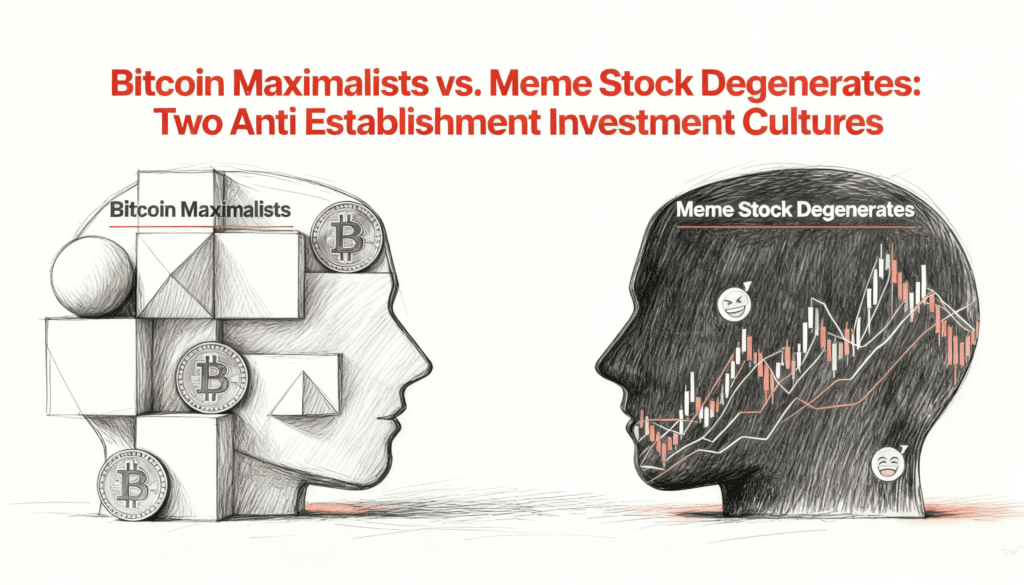
Bitcoin maximalists and meme stock degenerates are the two loudest voices in modern retail investing. They overlap in demographics, share the same distrust of institutions, and spend roughly equal amounts of time on the internet. But they disagree on something fundamental. One side believes money itself is broken and needs to be replaced. The other side believes money is a game and the point is to play it as recklessly as possible before someone changes the rules.
This is not a debate about which investment is better. It is a debate about what money means. And that makes it far more interesting than most financial arguments.
The Monk and the Carnival Worker
The easiest way to understand the difference is to watch how each group handles a crash.
When Bitcoin drops forty percent, maximalists do not sell. They buy more. They call it “stacking sats.” They reference the protocol, the fixed supply, the hash rate. They quote Satoshi. They are monks during a drought, praying harder because the suffering confirms their faith. A maximalist who sells during a crash is not just making a financial decision. They are committing apostasy.
When a meme stock drops forty percent, the response is a screenshot. Loss porn. A post titled “my wife is going to leave me” that gets ten thousand upvotes. Then someone in the comments posts a position that is down even more, and suddenly it is a competition. Nobody is praying. Nobody is quoting a whitepaper. The entire emotional architecture is built around the idea that losing money can be funny if you are honest about it.
Here is the counterintuitive part. The monks are often more fragile than the carnival workers.
Maximalists build an identity around being right. Every purchase is a vote of conviction. Every hold through a crash is proof of discipline. This works beautifully when the price eventually recovers. But when someone has wrapped their entire worldview around an asset, a prolonged decline does not just hurt financially. It threatens the self. And threatened identities do not process information well. They double down. They attack critics. They retreat into echo chambers where the only acceptable analysis is bullish.
Meme stock culture, for all its chaos, has a built in pressure valve. The humor. You cannot betray a joke. When the trade goes wrong, you laugh about it and move on. There is something psychologically sturdier about treating the whole thing as entertainment, even when real money is at stake. The self is never on trial because the self was never on the line.
The Theology of Scarcity
Bitcoin maximalism is, at its core, a monetary philosophy dressed in the language of technology. The central argument is simple. Governments print money. Printing money devalues money. Bitcoin has a fixed supply. Therefore Bitcoin is better money.
This is not a crazy argument. The historical record supports the claim that governments tend to debase currencies over time. Inflation is real. The purchasing power of the dollar has declined steadily for decades. Maximalists are not wrong about the problem. Where things get interesting is how they handle the solution.
Because maximalism does not just say Bitcoin is a good investment. It says Bitcoin is the only investment. Gold is a distraction. Stocks are fiat games. Real estate is just a bet on government currency that will eventually fail. The whole point of being a maximalist, as opposed to someone who simply owns some Bitcoin, is the rejection of everything else.
This is where it becomes theology. The structure is identical to religious fundamentalism. One truth. One path. Everyone else is either ignorant or corrupt. The faithful will be rewarded. The doubters will regret it. There is even an eschatological narrative: “hyperbitcoinization,” the moment when all other money collapses and Bitcoin becomes the global standard. This is a rapture story for people who own hardware wallets.
And like all fundamentalist movements, it produces two things simultaneously: genuine insight and total blindness. The insight is that the current monetary system has real problems. The blindness is the assumption that one asset can fix everything.
The Gospel of Chaos
Meme stock culture has no theology. It has vibes.
The closest thing to a shared belief is this: the financial system is a casino, the house always wins, and the only rational response is to play so aggressively that you either get rich or get a story worth telling. There is no whitepaper. There is no founding figure. There is just a collective recognition that the game was never fair, and a decision to stop pretending it was.
This sounds nihilistic, and it partly is. But there is something going on beneath the surface that deserves more attention than it usually gets.
Meme stock traders are performing a kind of economic protest. When millions of people buy a struggling video game retailer’s stock specifically because hedge funds are betting against it, that is not a traditional investment decision. It is a statement. The financial content of the trade is almost secondary to the social content. The act of buying is the message.
This connects to something the sociologist Emile Durkheim described over a century ago in a completely different context. He studied how groups create solidarity through shared rituals that do not need to have practical outcomes. The ritual itself is the point. It binds the group together and creates meaning that individual action cannot. A meme stock buying frenzy is a Durkheimian ritual for people who grew up during the financial crisis and watched their parents lose their homes while banks got bailouts.
The difference between this and Bitcoin maximalism is that meme stock culture does not pretend the ritual is rational. Maximalists need Bitcoin to be correct. The whole framework requires it. Meme stock traders do not need GameStop to be a good company. They need it to be a good fight.
Where They Accidentally Agree
Strip away the aesthetics and both cultures are responding to the same underlying reality: a generation that was handed a financial system designed for their parents and told to be grateful.
The math is straightforward. Housing costs have outpaced wages for decades. Student debt loads make early wealth accumulation nearly impossible for most people. The traditional advice of save ten percent, invest in index funds, and retire at sixty five assumes a starting position that most people under forty do not have. If you accept that premise, then both maximalism and meme stock trading start to make a different kind of sense. Not as investment strategies, but as responses to a rigged game.
The maximalist says: this game is broken, so I am going to opt out and build a new one. The meme stock trader says: this game is broken, so I am going to play it so hard it breaks further.
Same diagnosis. Opposite prescriptions. And both contain a truth that traditional finance does not want to engage with: the standard path does not work for everyone, and the people it does not work for are not stupid. They are just responding rationally to an irrational situation.
The Convergence Problem
Here is what neither group wants to hear. They are becoming each other.
Bitcoin, for all its anti establishment origins, is now on corporate balance sheets, in ETFs, and in the portfolios of the same institutions maximalists spent a decade criticizing. The rebellion got acquired. When BlackRock is your biggest buyer, you are not fighting the system anymore. You are the system wearing a different hat.
Meanwhile, meme stock culture has drifted from coordinated chaos into something more like a standing community with beliefs, heroes, and orthodoxies. There are people who have held GameStop for years now, not as a joke but as a conviction trade. They have theories about short interest and market manipulation that sound a lot like maximalist eschatology. The carnival workers are starting to build a church.
What Both Get Wrong
The maximalist error is certainty. The meme stock error is indifference. And both errors come from the same place: a refusal to sit in the uncomfortable middle where most of reality actually lives.
Good investing is boring. It does not confirm your identity. It does not produce content. It does not feel like a movement or a punchline. It is the slow, unglamorous process of putting money into things that are likely to be worth more later, while managing the risk that you might be wrong.
Neither maximalists nor meme stock traders are interested in that, because being right slowly does not generate the psychological rewards that either community runs on. One needs the vindication. The other needs the dopamine. Both need the audience.
The irony is that both groups started by identifying something true about the financial system and then built cultures that made it harder to act on that truth. The maximalist who is right about monetary debasement but has one hundred percent of their net worth in a single volatile asset has turned a good insight into a bad portfolio. The meme stock trader who is right about institutional unfairness but expresses it through weekly options has turned a valid critique into a donation to market makers.
Being right about the system is not the same as being good at navigating it. And the gap between those two things is where most of the money gets lost.