Table of Contents
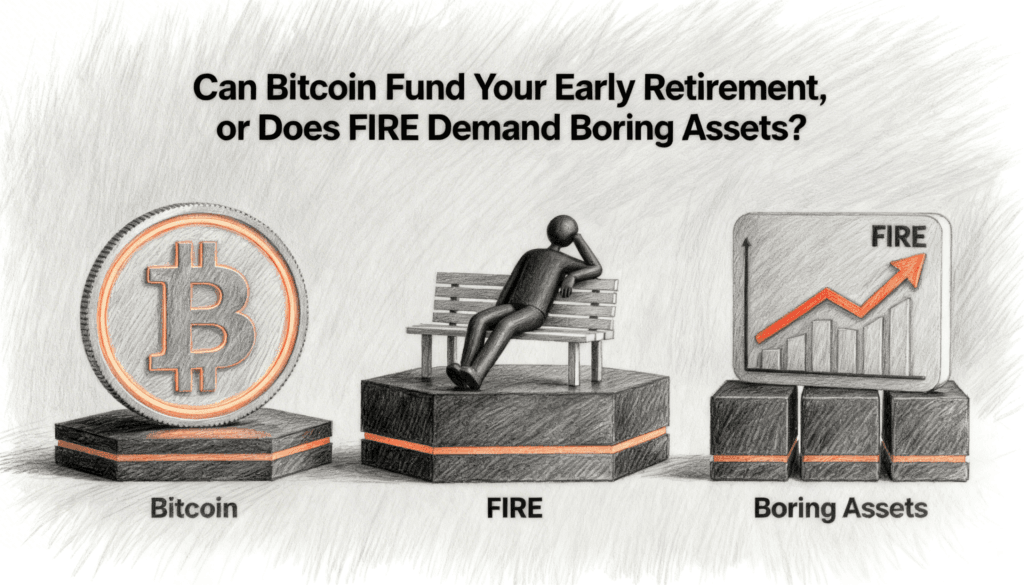
There is a quiet joke that the fastest way to retire early in the last decade was to ignore every piece of FIRE advice and buy Bitcoin. And the second fastest way to go broke trying to retire early was also to buy Bitcoin.
Both things are true. That is what makes the argument so uncomfortable.
FIRE, at its heart, is a philosophy of patience dressed up as a math problem. Save a huge portion of your income. Park it in something boring. Let the boring thing compound for ten or twenty years. Walk away from your job while your coworkers are still arguing about the coffee machine. The entire system depends on one assumption: that the thing you parked your money in will behave itself.
Bitcoin does not behave itself. Bitcoin is the financial equivalent of a houseguest who might clean your kitchen or might set it on fire, and you will not know which until morning.
The Temperament Problem
Most arguments about Bitcoin and FIRE get framed as arguments about returns. This misses the point entirely. The real argument is about temperament.
FIRE is built for a specific kind of person. Someone who can look at a spreadsheet, calculate a withdrawal rate, and then genuinely not think about it for the next fifteen years. Someone who finds comfort in predictability. Someone whose nervous system can handle a forty percent market drop without checking their phone.
Bitcoin attracts the opposite nervous system. It attracts people who are energized by volatility, who feel alive when a chart moves, who want their money to have a pulse. These are not bad people. But they are not, by nature, the people who quietly index for twenty years and then retire to a cabin.
The question is not whether Bitcoin can fund early retirement. Mathematically, it already has for some people. The question is whether the kind of person drawn to Bitcoin is the kind of person who can actually stop once they have won. And that is a much harder question, because it is really a question about psychology pretending to be a question about assets.
There is a concept from behavioral economics called the hedonic treadmill. It is the idea that whatever you have, you adjust to, and then you want more. Bitcoin investors are not immune to this. In fact, they might be especially vulnerable to it. Someone who watched their stack go from ten thousand to a million does not usually think “time to retire.” They think “imagine what happens at ten million.” The asset that got them to financial independence becomes the asset that prevents them from claiming it.
What FIRE Actually Requires
People tend to misread what FIRE is asking for. They think it is asking for the highest possible return. It is not. It is asking for a return that is high enough and predictable enough that you can plan around it.
Those are different requirements. Planning requires stability. Stability requires boringness. Boringness is the whole point.
When you retire at thirty five, you are signing up for something strange. You are asking your portfolio to support you for potentially sixty years. Sixty years is longer than some countries have existed in their current form. Sixty years ago, nobody had heard of the internet. Predicting what any asset will do over that timeframe is less investing and more fortune telling.
FIRE handles this by leaning on boring assets with long historical track records. Stocks have been traded for centuries. Bonds have existed since there were governments to issue them. Real estate has been a store of value since humans invented fences. These things are not guaranteed to work forever. But they have survived world wars, depressions, pandemics, and roughly every form of political experiment humans have tried.
Bitcoin has existed since 2009. It is younger than most dogs. Asking it to reliably fund six decades of your life is a bit like asking a toddler to run your company. It might grow into the job. It might not. The toddler is not the problem. The timeframe is.
The Contrarian Middle
Here is where I am going to be minimally contrarian. The standard FIRE advice is to avoid Bitcoin entirely. The standard Bitcoin advice is to put everything into Bitcoin. Both of these positions are wrong in the same way. They both assume the answer is about the asset. The answer is about the role the asset plays in your life.
A small Bitcoin position inside a FIRE portfolio is not a betrayal of FIRE principles. It is an acknowledgment that the world might contain surprises your historical data cannot predict. Call it insurance against the possibility that boring assets stop being boring. Call it a hedge against your own certainty.
A huge Bitcoin position, on the other hand, is not FIRE. It is something else. It might be a winning strategy. It might be a losing strategy. But it is not a plan. It is a bet. And the difference between a plan and a bet is that a plan assumes you will be wrong sometimes and still works, while a bet assumes you are right and falls apart if you are not.
The Part Nobody Wants to Say
Here is the part that annoys both camps. Whether Bitcoin can fund your early retirement depends almost entirely on when you were born.
Someone who bought Bitcoin in 2013 and held it could have retired in 2021 without any FIRE discipline at all. Someone who bought in 2021 and held it spent most of the next two years watching their retirement plan get shorter. Same asset. Same strategy. Wildly different outcomes. The only variable was timing, and timing is the one thing nobody can plan for.
FIRE is supposed to remove luck from the equation. That is its whole appeal. You save, you invest in boring things, you wait, and the math does its work regardless of when you started. Bitcoin reintroduces luck in a big way. It can make your retirement faster. It can also make it impossible. The people who are most confident about which outcome you will get are usually the people selling you something.
The honest answer is that Bitcoin can fund early retirement, but it cannot plan one. Those are two different functions. Bitcoin is good at the first and bad at the second. FIRE needs both. This is why the boring assets keep winning arguments they seem to lose on returns. They are not better at making money. They are better at making plans that survive reality.
So What Should You Actually Do
If you are pursuing FIRE, the boring core should stay boring. Index funds, bonds, maybe some real estate if that suits your temperament. This is the part of your portfolio that has to work. Not mostly. Not probably. It has to work.
Around that core, you can afford a small slice of something less predictable. Bitcoin qualifies. So do individual stocks, commodities, whatever you find interesting. The job of this slice is not to get you to retirement faster. The job is to keep you engaged and to capture upside you cannot get from the boring part. If it fails, your plan still works. If it succeeds, you retire a little earlier or a little richer. Either outcome is fine.
What does not work is treating Bitcoin as your retirement plan and hoping it behaves. Hope is not a strategy, although it has fooled many people into thinking it is.
The uncomfortable truth is that FIRE does demand boring assets. It does not demand only boring assets. But the engine has to be boring, because boring is the only thing you can count on for long enough to actually stop working.
Bitcoin can be the spice. It cannot be the meal. And anyone who tells you otherwise is either lucky, lying, or has not been doing this long enough to know the difference.