Table of Contents
There is a famous line attributed to Baron Rothschild, an 18th century financier who made a fortune during the panic that followed the Battle of Waterloo. “Buy when there is blood in the streets,” he supposedly said, “even if the blood is your own.” It is one of the most quoted phrases in investing history. It is also one of the least followed.
And that gap between knowing and doing is where the entire game of investing actually lives.
Everyone agrees with the idea of buying low and selling high. It is so obvious that it barely qualifies as advice. Yet when markets actually crash, when prices are falling and every headline reads like a disaster movie, most people do the exact opposite. They sell. They panic. They watch their portfolios bleed and decide to stop the pain. Then, a year or two later, they watch the recovery happen without them and wonder what went wrong.
What went wrong is that they are human. And being human, it turns out, is the single greatest disadvantage an investor can have.
The Paradox of Comfortable Investing
Here is something that sounds wrong but is not: if an investment feels comfortable, it is probably too late. The best buying opportunities in history have all arrived disguised as catastrophes. March 2009, March 2020, the dot com rubble of 2002. In each case, the moment of maximum opportunity was also the moment of maximum terror.
This creates a paradox that sits at the heart of investing. The rational thing to do often feels irrational. Buying stocks during a crash feels like catching a falling knife. Holding a position while the news screams about collapse feels like arrogance or delusion. Doing nothing during a bubble while your neighbor brags about his returns feels like cowardice.
But comfort is not a signal. Comfort is a trap. The market does not care about your emotional state. It does not reward you for feeling brave or punish you for feeling scared. It rewards correct positioning and punishes incorrect positioning, and those two things have almost nothing to do with how the process feels while you are living through it.
The Temperature of Good Decisions
Cold blooded is an interesting phrase. In everyday language, it means cruel. In biology, it means something different. A cold blooded animal does not generate its own internal heat. It adapts its temperature to the environment. It conserves energy. It does not waste resources on reactions that do not serve survival.
That is a remarkably good description of what a successful investor actually does.
The warm blooded investor generates constant internal heat. Every headline triggers a reaction. Every red day in the market produces cortisol. Every green day produces dopamine. The warm blooded investor is always reacting, always adjusting, always feeling something. And all that metabolic activity, all that emotional expenditure, almost never translates into better returns. Usually it translates into worse ones.
The cold blooded investor matches the environment. When the market is quiet, they are quiet. When the market is chaotic, they are still quiet, but they are paying attention. They do not waste energy on anxiety. They do not confuse activity with progress. They have a plan that was made when conditions were calm, and they follow that plan when conditions are not.
This is not the same as being emotionless. It is the same as being disciplined about which emotions you act on. There is a massive difference.
Why the Crowd Is a Lagging Indicator
There is a concept in physics called phase transition. Water does not gradually become ice. It stays liquid, stays liquid, stays liquid, and then at a precise threshold, it transforms. The change appears sudden, but the conditions for it were building invisibly the whole time.
Markets behave similarly. Sentiment does not shift gradually. It flips. One month everyone is confident, and then seemingly overnight, everyone is terrified. Or vice versa. The shift looks sudden from the outside, but the pressure was accumulating quietly in the background.
The crowd, by definition, recognizes the phase transition only after it has happened. This is not because people are stupid. It is because the crowd is a consensus mechanism, and consensus requires confirmation, and confirmation requires time. By the time the crowd agrees that a crash is happening, the crash is well underway. By the time the crowd agrees that a recovery has started, much of the recovery has already occurred.
This is why following the crowd in investing produces reliably mediocre results. Not because the crowd is always wrong. The crowd is often right. But the crowd is right late. And in markets, being right late is functionally identical to being wrong.
The cold blooded investor understands this intuitively. They are not contrarian for the sake of being contrarian. That is just a different flavor of emotional investing. Instead, they recognize that the consensus view is already reflected in prices, and that the opportunity lies in the gap between what the crowd believes now and what will turn out to be true later.
The Stoic Portfolio
Marcus Aurelius, the Roman Emperor and Stoic philosopher, once wrote that we suffer more in imagination than in reality. He was talking about life, but he could just as easily have been talking about bear markets.
Most of the pain in investing is anticipatory. It is the dread of what might happen, not the reality of what has happened. A portfolio drops 20 percent and the owner feels like they have been ruined. But unless they sell at that point, they have not lost anything. They own the same number of shares of the same companies. The only thing that changed is the price that other people are currently willing to pay for those shares. And other people, as we have established, are frequently irrational.
The Stoics had a practice called premeditatio malorum, the premeditation of evils. The idea was to imagine the worst case scenario in advance, calmly and deliberately, so that if it arrived, you had already made peace with it. You had already decided how you would respond.
This is exactly what a good investment plan does. It is not a prediction of what will happen. It is a set of pre committed responses to various scenarios. If the market drops 10 percent, I will do this. If it drops 30 percent, I will do that. If a particular stock loses half its value, here is my threshold for reassessment. The decisions are made in advance, during a period of calm, when the prefrontal cortex is running the show instead of the amygdala.
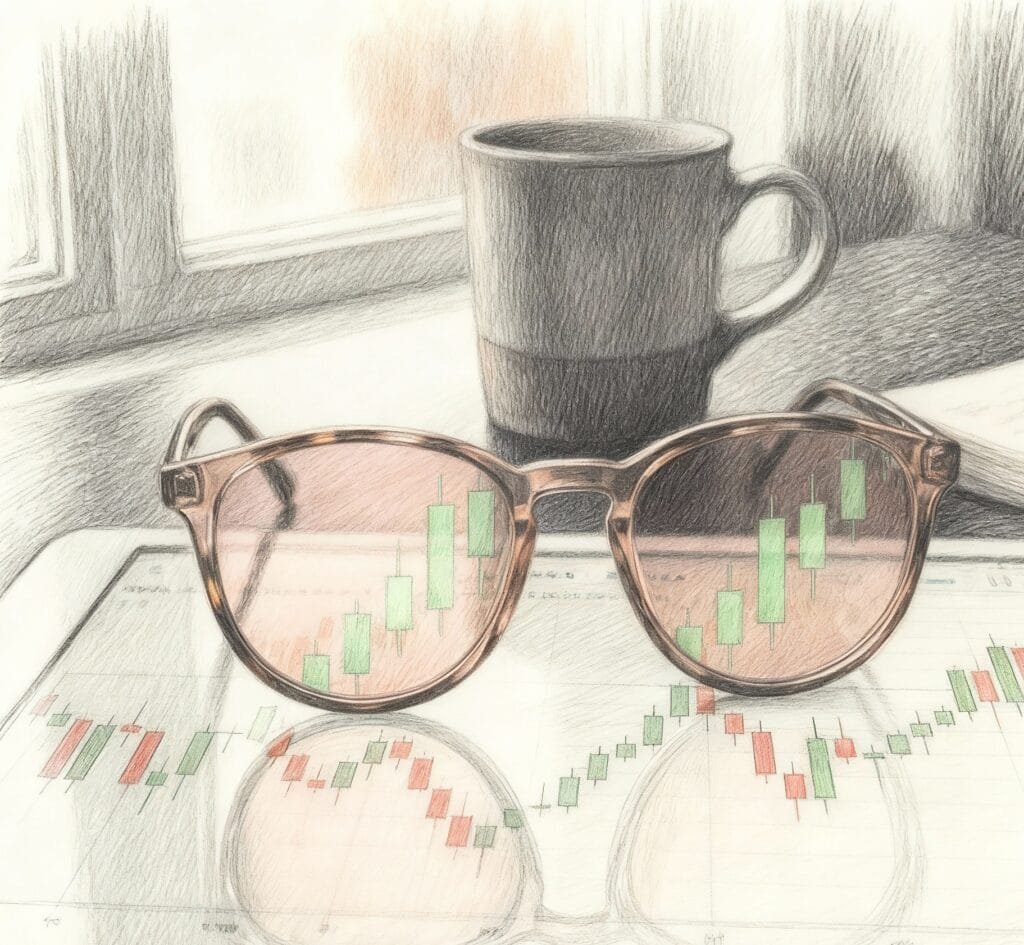
The investors who navigate crises best are not the ones with the highest IQs or the most sophisticated models. They are the ones who did their panicking ahead of time, on paper, in a quiet room, with a cup of coffee. By the time the real panic arrives, they have already rehearsed their response. They just execute.
The Myth of the Perfect Entry
One of the most destructive ideas in investing is the belief that timing matters more than time. People sit on the sidelines for months or years, waiting for the perfect moment to invest. They want to buy at the bottom. They want to enter when the coast is clear.
The coast is never clear. That is what makes it the coast.
Study after study has shown that time in the market beats timing the market over any reasonably long horizon. An investor who put money into a broad index fund on the single worst day of every year for 30 years would still end up with dramatically more money than someone who kept that money in cash waiting for the right moment. The math on this is not ambiguous. It is overwhelming.
Yet people still wait. They wait because waiting feels prudent. It feels like caution. It feels like the responsible thing to do. But what it actually is, in most cases, is fear dressed up as strategy. And the cost of that fear, compounded over decades, is enormous. Not dramatic. Not sudden. Just a slow, quiet erosion of wealth that never announces itself because the loss is invisible. You cannot see the returns you did not earn.
Boredom as a Competitive Advantage
Here is an underrated truth: the best long term investment strategy is boring. It is not interesting to talk about at parties. It does not make for good social media content. Nobody has ever gone viral for saying “I bought a diversified index fund and then did nothing for 15 years.”
But that is essentially what works.
The financial media, the brokerage apps, the YouTube channels, the investment newsletters. They all share a common incentive: they need you to do something. Their business model depends on your activity. Every trade, every click, every portfolio adjustment generates revenue for someone. The entire infrastructure of modern financial media is designed to make you feel like you should be doing something right now.
The cold blooded investor recognizes this for what it is. Not a conspiracy, but an incentive structure. The people telling you to act are not necessarily wrong about the market. They are responding to their own economic incentives, which are different from yours. Their goal is engagement. Your goal is returns. These two things are not aligned, and pretending they are is one of the most expensive mistakes an investor can make.
Doing nothing, when nothing needs to be done, is one of the hardest skills in investing. It looks like laziness. It feels like negligence. Every instinct says you should be monitoring, adjusting, optimizing. But the data is clear: the investors who check their portfolios least frequently tend to outperform those who check daily. The ones who trade the least tend to outperform the ones who trade the most. Activity is not the same as progress. Often, it is the opposite.
The Long Game and the Short Memory
Markets have a peculiar relationship with time. In the short term, they are driven by emotion, narrative, and momentum. In the long term, they are driven by earnings, productivity, and innovation. The short term is a voting machine. The long term is a weighing machine. Benjamin Graham said this decades ago, and it has not stopped being true.
The cold blooded investor operates on the weighing machine timeline. They understand that short term price movements are mostly noise, a reflection of collective mood rather than collective reality. They do not ignore the noise entirely, because sometimes the noise carries useful information. But they do not mistake it for the signal.
This requires an unusual relationship with memory. Most people remember market crashes vividly and recoveries vaguely. The pain of 2008 is seared into a generation of investors. The subsequent decade long bull market that followed, which was one of the most profitable periods in market history, is remembered as a kind of background hum. This asymmetry of memory is another feature of human psychology that works against investors. We are built to remember threats, not opportunities. The cave person who forgot about the tiger did not become an ancestor.
But investing is not a savanna. The tigers in the market are almost always temporary, and the landscape almost always recovers. Not always in the same shape. Not always on the same timeline. But the broad trajectory of markets over any sufficiently long period has been upward, driven by the simple and persistent fact that human beings wake up every morning and try to create value.
The Final Degree
There is one more thing about cold blooded animals that is worth noting. They are among the most successful organisms on the planet. Crocodiles have been around for over 200 million years. They have outlasted the dinosaurs. They did not do this by being the fastest or the strongest or the most aggressive. They did it by being patient, efficient, and extremely difficult to kill.
That is not a bad model for building wealth.
The blood in the streets will come. It always does. It will come with fear and headlines and the sickening feeling that this time is different, that the bottom is not in, that the world is ending in some new and unprecedented way. And it will feel absolutely real in the moment.
The question is not whether you will feel the fear. You will. The question is whether you have built a system, a plan, a set of pre committed decisions, that functions independently of that fear. Whether you have trained yourself to be the crocodile rather than the gazelle. Whether you can sit still while everything around you jump around.
Cold blooded investing is not about suppressing your emotions. It is about building a structure that does not depend on your emotions being correct. Because they will not be. Not when it matters most.
The blood comes. The ice holds. That is the whole strategy.