Table of Contents
There is a civil war in personal finance, and most people do not even know they have picked a side.
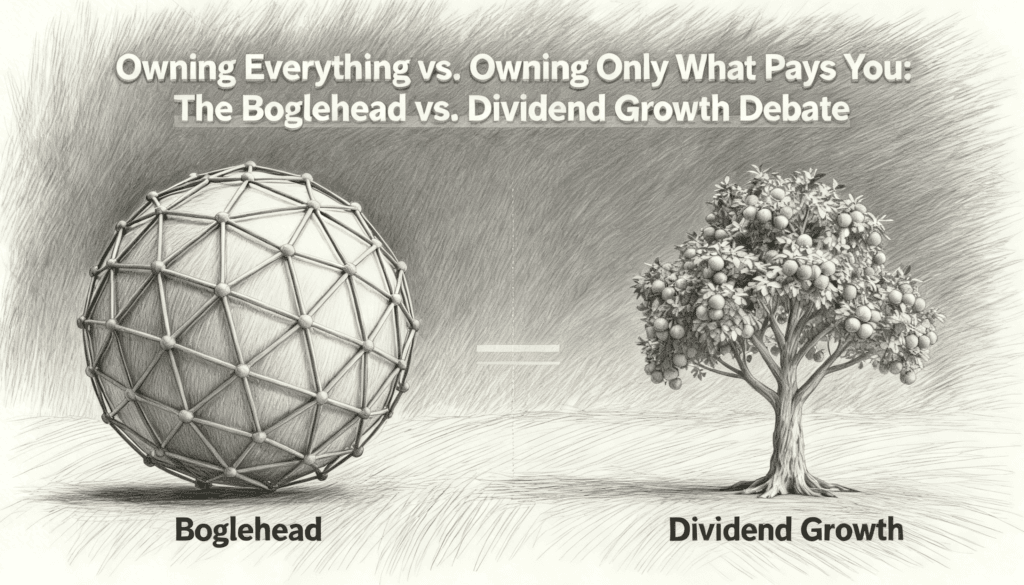
On one end, you have the Bogleheads. Named after Vanguard founder Jack Bogle, they believe in owning the entire market through low cost index funds. Do not pick. Do not choose. Do not think too hard. Just buy everything and wait. On the other end, you have the dividend growth investors. They believe in owning only businesses that send you cash, regularly, and in increasing amounts. They want their portfolio to function like a collection of rental properties, each one mailing them a check every quarter.
Both groups are convinced they are right. Both groups think the other side is missing something fundamental. And both groups, if you spend five minutes in their forums, will talk about the other the way rival football fans talk about each other after a bad call.
But here is the thing. This is not really a debate about which strategy produces better returns. It is a debate about what money is for. And that distinction matters more than any spreadsheet comparison ever could.
The Church of the Index
Bogleheads operate with a kind of mathematical faith. Their core belief is elegant and, frankly, hard to argue with: most professional fund managers fail to beat the market over long periods. If the experts cannot do it, why would you try? Just own the whole market. Capture the average. Pay almost nothing in fees. Move on with your life.
This philosophy has the rare quality of being both intellectually humble and statistically ruthless. It says, “I am not smart enough to pick winners, and neither are you, and neither is the guy on television.” There is something almost Buddhist about it. Surrender the ego. Accept the market as it is. Stop trying to be clever.
The practical result is a portfolio that owns everything. When you buy a total market index fund, you own the best companies and the worst companies and every company in between. You own the future winners before anyone knows they are winners. You also own the future disasters before anyone knows they are disasters. It does not matter. You own the average of all of it, and historically, that average has been very generous.
Bogleheads tend to measure success in one dimension: total return. Did your portfolio go up more than it went down over time? Good. That is the only question that matters. Whether that return came from stock prices rising, dividends being paid, or some combination of the two is irrelevant. A dollar is a dollar regardless of which pocket it fell out of.
This is logically airtight. And that is precisely where the trouble begins.
The Psychology of the Paycheck
Dividend growth investors look at the same financial universe and see something entirely different. They do not want to own everything. They want to own businesses that do one specific thing: pay them. And then pay them more next year. And more the year after that.
The dividend growth investor treats their portfolio the way a landlord treats a building. They do not care much about what the building would sell for on any given Tuesday. They care about rent collection. Is the rent coming in? Is it going up? Good. Everything else is noise.
This creates a fundamentally different relationship with money. Instead of watching a single number (the portfolio balance) bounce around every day, the dividend growth investor watches a different number: income. And income from quality dividend growers tends to move in one direction. Up. Even during recessions, even during crashes, the best dividend growers keep raising their payments.
Here is where it gets psychologically interesting. When the market drops thirty percent, the Boglehead and the dividend growth investor are looking at different dashboards. The Boglehead sees their net worth fall off a cliff. They know, intellectually, that it will recover. But knowing something and feeling something are two very different experiences. The dividend growth investor sees their portfolio value drop too, but their income statement barely changes. The checks keep arriving. Maybe some companies froze their dividend. But the best ones raised it anyway.
Which investor sleeps better? The one whose wealth is an abstraction on a screen, or the one whose wealth shows up in their bank account every ninety days?
This is not a small thing. It is arguably the most important thing.
The Landlord and the Economist
To understand this debate more clearly, think about it through the lens of two different professions.
The Boglehead thinks like an economist. Economists care about efficiency. They want the system to produce the maximum output for the minimum input. They do not care how you feel about the system. They care about the numbers. And the numbers, in many studies, suggest that total market index investing produces outcomes that are extremely difficult to beat after fees and taxes.
The dividend growth investor thinks like a landlord. Landlords care about cash flow. They want to know what the property produces each month. They are not checking Zillow every day to see if the building went up in value. They are checking their bank account to see if the rent cleared.
Both are rational. But they are optimizing for different things. The economist optimizes for terminal wealth. The landlord optimizes for lifestyle sustainability. These sound like they should be the same thing, but they are not. Not even close.
Terminal wealth is what your portfolio is worth on the day you die. Lifestyle sustainability is whether your bills get paid between now and then without you having to sell anything. A person can have tremendous terminal wealth and still feel anxious every month about whether they can afford their grocery bill. This happens more often than people think, especially to retirees sitting on large index fund portfolios who have to sell shares to generate income.
The Sell Problem Nobody Talks About
This is the uncomfortable truth that Boglehead philosophy tends to gloss over. If your portfolio does not produce income, you have to create income by selling pieces of it. This is the systematic withdrawal strategy, and on paper it works beautifully. You sell a small percentage of your portfolio each year, historically around four percent, and the remaining investments grow enough to replace what you sold.
But living inside that strategy feels very different from modeling it on a spreadsheet.
Imagine you retired in early 2008 with a million dollars in index funds. Your plan says to withdraw forty thousand dollars a year. The market then drops nearly fifty percent. Your portfolio is now worth roughly five hundred thousand. But your expenses have not changed. You still need forty thousand. Except now that forty thousand is not four percent of your portfolio. It is eight percent. You are selling twice as much of your shrinking pie, and every share you sell at a depressed price is a share that will never participate in the recovery.
The dividend growth investor in the same scenario is doing something different. They are not selling anything. Their income stream might have taken a small hit if a few companies cut dividends, but the core of their portfolio, the companies with decades of dividend increases, kept paying. They kept eating without having to slaughter the herd.
There is an analogy here to agriculture. The Boglehead approach is like farming where you periodically sell off portions of your land to buy food. The dividend growth approach is like farming where the land itself produces the food. Both can work. But one of them has a much more obvious failure mode.
The Counter Argument That Actually Lands
Now, the Bogleheads are not wrong about everything. Far from it. Their strongest argument against dividend growth investing is one of concentration risk and opportunity cost.
When you build a portfolio of only dividend paying stocks, you are, by definition, excluding a large portion of the market. You will own very little of the technology sector. You will own almost nothing in biotech. You will miss some of the greatest wealth creating companies in history because they chose to reinvest profits instead of distributing them.
Amazon has never paid a dividend. Neither did Google for most of its existence. Tesla, Nvidia during its biggest growth years, Netflix. The dividend growth investor watched all of these from the sideline while collecting steady but comparatively modest payments from utility companies and consumer staples firms.
This is a real cost. And it compounds. Missing the best performing stocks over a twenty or thirty year period can mean arriving at retirement with significantly less total wealth than someone who simply owned everything.
What Neither Side Admits
Here is what makes this debate so persistent: both sides are right about their own strengths and remarkably quiet about their own weaknesses.
Bogleheads rarely acknowledge that their strategy requires an almost superhuman level of emotional discipline during drawdowns. The entire system depends on the investor not selling at the worst possible time. They cannot sit and watch their life savings evaporate, even temporarily, without doing something. The strategy is perfect in theory and brutally difficult in practice for the average human being.
Dividend growth investors rarely acknowledge that their focus on income can lead to a kind of tunnel vision. They will sometimes hold onto a deteriorating company because it still pays a dividend, ignoring the fact that the stock price has been telling them something important for months. They can also fall into the trap of chasing yield, buying companies that pay high dividends precisely because the market is pricing in future trouble.
The Real Question Behind the Debate
Strip away the spreadsheets and the forum arguments and the backtested charts, and this debate comes down to a single question: Do you trust the system, or do you trust yourself?
The Boglehead trusts the system. They trust that markets go up over time, that capitalism creates wealth, and that the average return of all businesses combined will be enough. They are willing to surrender control because they believe the system is smarter than any individual within it.
The dividend growth investor trusts themselves. They trust their ability to select quality businesses, to read financial statements, to identify companies with durable competitive advantages. They want control. They want to see the income. They want to know exactly where their money is coming from.
This mirrors a tension that exists far beyond finance. In politics, it is the difference between those who trust institutions and those who trust individual agency. In career planning, it is the difference between joining a large corporation with a predictable trajectory and building something of your own.
Neither disposition is wrong. But pretending you can hold both at the same time, with equal conviction, is a form of self deception.
A Third Way That Nobody Likes
There is a compromise position, and it annoys both camps equally. You could do both. You could hold a core of total market index funds for broad exposure and low cost growth, and then build a satellite portfolio of dividend growth stocks for income stability and psychological comfort.
This is actually what many experienced investors end up doing after years of arguing on the internet. They discover that purity is a luxury of the young and that real life demands flexibility. The zealots on both sides will tell you this approach is incoherent. But incoherence is sometimes just another word for pragmatism.
The core and satellite model accepts that you are a rational being who is also an emotional being, and that a portfolio should account for both. It lets you capture the broad market while also building an income stream. It is not the mathematically optimal solution. But the optimal solution only works if you can execute it flawlessly under pressure. And most people cannot.
What This Debate Is Really About
In the end, the Boglehead vs. dividend growth debate is not about finance. It is about identity. People do not just adopt an investment strategy. They join a community. They read the forums. They learn the vocabulary. They defend the philosophy against outsiders. It becomes part of how they see themselves.
The Boglehead sees themselves as rational, humble, and disciplined. The dividend growth investor sees themselves as discerning, independent, and income focused. Both are telling themselves a story about who they are, and the investment strategy is just the plot.
This is not a criticism. Stories are how humans make sense of the world. The danger is not in having a story. The danger is in forgetting that it is a story.
Own the market or own what pays you. Both paths lead somewhere good if you walk them long enough. The one that will actually get you to the finish line is the one you will not abandon when the weather turns.
Pick the story you can believe in during the storm. That is the only investment advice that matters.