Table of Contents
There is a phrase that floats around investing circles with the confidence of a man who has read exactly one book about Warren Buffett. “I am buying the dip.” People say it like a mantra. They say it in group chats, on social media, at dinner parties where nobody asked. They say it while their portfolio bleeds out quietly in the background.
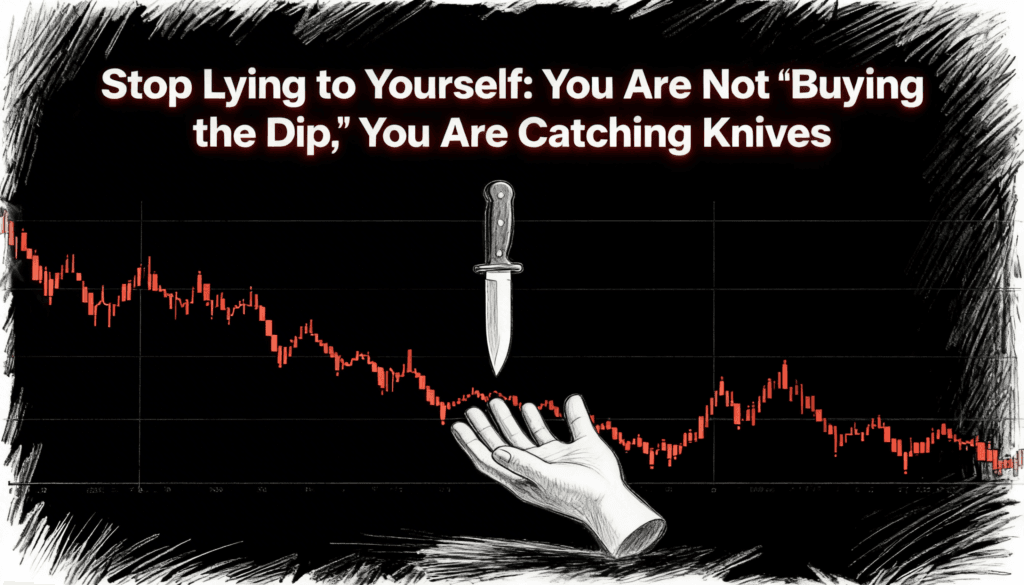
And most of the time, they are not buying the dip. They are catching a falling knife. The difference between those two things is not semantic. It is the difference between strategy and self deception. And if you have ever watched a stock drop 15%, bought more, watched it drop another 20%, and then told yourself you were “averaging down,” this article is for you.
Let us talk about what is actually happening.
The Dip Is a Story You Tell After It Works
Here is the problem with “buying the dip” as a concept. It only makes sense in retrospect. A dip, by definition, is a temporary decline followed by a recovery. You do not know it is a dip until the recovery happens. Before that, it is just a decline. It could be the beginning of a 40% drawdown. It could be the early stage of a company slowly becoming irrelevant. It could be the market telling you something you do not want to hear.
But humans are remarkably talented at one thing above all else: constructing narratives that make them feel smart. So when a stock drops, we do not say “I do not know what is happening.” We say “this is a buying opportunity.” We frame uncertainty as conviction because conviction feels better. It feels like control.
The psychologist Daniel Kahneman spent decades studying how people make decisions under uncertainty, and one of his central findings was that humans are almost allergic to admitting they do not know something. We would rather be confidently wrong than honestly uncertain.
In investing, this allergy is expensive. It turns corrections into traps because we walk into them believing we already know how the story ends.
The Anatomy of a Knife Catch
Let us walk through how this actually plays out, because it follows a pattern so predictable it is almost funny.
A stock you own or have been watching drops 10% in a week. Your first instinct is not fear. It is excitement. You have been conditioned by years of “buy low, sell high” rhetoric to see red numbers as opportunity. So you buy. You feel good. You feel like you just outsmarted everyone who panic sold.
Then it drops another 8%. A small knot forms in your stomach, but you push through it. You buy more. You are “averaging down” now, which sounds sophisticated. It sounds like something a professional would do.
Then it drops another 12%. The knot is no longer small. But you are in too deep now. Selling would mean admitting you were wrong, and your brain would rather lose money than lose the narrative. So you hold. Maybe you buy a little more. You post something online about “diamond hands” or “long term thinking” to externalize the anxiety.
What just happened is not investing. It is the sunk cost fallacy wearing a financial costume. You did not buy the dip. You made a bet, the bet went against you, and instead of reassessing, you doubled down because reversing course would require you to update your beliefs. And updating beliefs, as any behavioral scientist will tell you, is one of the most psychologically painful things a person can do.
Corrections Are Not Discounts
Here is where the intellectual dishonesty gets thick. People treat market corrections like department store sales. As if a stock that was $100 and is now $70 is simply “30% off.” But a stock is not a television. Its price is not a fixed value with a temporary markdown. Its price is a constantly updating reflection of what the collective market believes about its future.
When a stock drops 30%, the market is not running a promotion. It is repricing risk. Something has changed, or at least enough participants believe something has changed, and the new price reflects that belief. Buying at $70 is not getting a deal on a $100 stock. It is paying $70 for a stock that the market currently believes is worth $70. You might be right that the market is wrong. But you should at least be honest about the fact that you are making a contrarian bet, not picking up free money.
This distinction matters because it changes how you approach the decision. If you think you are getting a discount, you do not do much analysis. Discounts do not require analysis. They require a credit card. But if you understand that you are betting against the current consensus, suddenly you need a thesis. You need to know why you think the market is mispricing this asset. You need to be specific about what the market is getting wrong and what catalyst will eventually prove you right.
Most people catching knives do not have a thesis. They have a feeling. And feelings, in the context of financial markets, are usually just pattern recognition gone haywire.
The Seduction of Being Early
There is a particular breed of investor who takes pride in being early. They wear it like a badge. “I bought it before anyone else saw the value.” And sometimes this is genuinely prescient. But more often, being early is indistinguishable from being wrong.
The market can stay irrational longer than you can stay solvent. This is not just a clever quote. It is a mechanical reality. Even if you are correct about the long term value of an asset, the short and medium term price can move so far against you that your position becomes untenable. Margin calls do not care about your thesis. Rent payments do not wait for mean reversion.
This is where investing intersects with something that looks a lot like gambling psychology. In casinos, researchers have found that near misses activate the same reward circuitry as actual wins. Your brain treats almost winning as evidence that you are on the right track. In investing, a stock that drops 30% and then bounces 5% does the same thing. That tiny bounce feels like vindication. It feels like the beginning of the recovery you predicted. And so you hold on, or buy more, interpreting noise as signal.
The difference between a disciplined investor and a knife catcher is not intelligence. It is the willingness to separate the desire to be right from the process of making good decisions.
What Actual Dip Buying Looks Like
To be clear, buying during market declines is not inherently foolish. Some of the best returns in history have come from deploying capital during periods of widespread fear. But the people who do this successfully tend to share a few characteristics that separate them from the crowd posting motivational quotes about Warren Buffett.
First, they have a plan that predates the decline. They are not making decisions in the moment. They decided months or years ago what they would buy and at what price. The decline is just the trigger, not the thesis.
Second, they are buying broad markets or assets they have deeply researched, not individual stocks that are falling because something is fundamentally broken. There is an enormous difference between buying an index fund during a broad market correction and buying a single company that just reported catastrophic earnings. The first is a bet on the long term trajectory of the economy. The second is a bet that you know better than everyone who just sold.
Third, and this is the part nobody wants to hear, they are genuinely comfortable being wrong. They have sized their positions so that if the decline continues, they are not financially or psychologically destroyed. They do not need the bounce to happen this month or this quarter. They can wait, not because they are brave, but because they structured their exposure to make waiting painless.
Most people who say they are buying the dip have done none of these things. They are reacting, not executing.
The Role of Identity in Bad Decisions
There is a deeper layer here that goes beyond finance, and it is worth exploring because it explains why smart people keep making this mistake.
For many retail investors, their investment decisions are not just financial. They are identity statements. Saying “I bought the dip” is not really about the trade. It is about signaling a certain kind of person. Calm. Contrarian. Sophisticated. The kind of person who sees opportunity where others see danger.
This is the same psychological mechanism that drives a lot of consumer behavior. People do not buy luxury goods purely for quality. They buy them to signal status. Similarly, people do not always buy falling stocks because the analysis supports it. They buy them because the act of buying during a decline tells a story about who they are.
And this is where it gets truly dangerous. Because once an investment becomes part of your identity, you cannot sell it without experiencing something that feels like self betrayal. Selling at a loss does not just mean you lost money. It means the story you told about yourself was wrong. You were not the calm, contrarian thinker. You were just another person who bought something at the wrong time.
This is why you see people hold positions far past the point of rationality. The financial loss has become secondary to the narrative loss. And narrative losses, psychologically speaking, cut deeper.
A Useful Test
If you want to know whether you are buying the dip or catching a knife, here is a simple test. Ask yourself: “If I did not already own this, would I buy it right now at this price?”
Most people, if they are honest, will find the answer is no. They are not buying because the opportunity is compelling. They are buying because they already bought, and buying more is the only way to maintain the story that the first purchase was smart.
This is not a strategy. This is emotional accounting.
A second test is even more revealing. Ask yourself: “Can I write down, in two sentences, what specifically the market is getting wrong about this asset?” If you cannot, you do not have a thesis. You have hope. And hope is a beautiful thing in most areas of life, but in a brokerage account, it is a slow leak.
The Counterintuitive Wisdom of Doing Nothing
Here is something that will irritate every action oriented investor: sometimes the best response to a market decline is to do absolutely nothing. Not buy. Not sell. Just watch.
This feels wrong because we are wired to respond to threats with action. It is an evolutionary impulse. When something is falling, our instinct is to either run or try to catch it. But markets are one of the few arenas where inaction is a legitimate and often optimal strategy.
The greatest risk during a correction is not missing the bottom. It is making a decision based on incomplete information while your emotions are elevated. The bottom will not announce itself. It never does. And the cost of waiting for clarity is almost always lower than the cost of acting on anxiety disguised as conviction.
This does not mean you should never act during a decline. It means you should be deeply suspicious of the urge to act. If the urge feels urgent, if it feels like you will miss something if you do not move right now, that is almost certainly your amygdala talking, not your prefrontal cortex. And your amygdala, for all its usefulness in keeping your ancestors alive on the savannah, is a terrible portfolio manager.
The Honest Conversation
The investing world does not reward honesty. It rewards confidence. The people who get the most attention are the ones who speak in absolutes. “This is the bottom.” “This is a generational buying opportunity.” “I am loading up.” The people who say “I genuinely do not know what is going to happen” get ignored, even though they are the only ones telling the truth.
If you take one thing from this, let it be this: the next time a stock or market drops and you feel the pull to buy, pause. Not for five minutes. For days. Let the excitement fade. Let the narrative instinct quiet down. Then look at the situation with fresh eyes and ask yourself whether you are making a decision or performing one.
Because buying the dip and catching a knife feel exactly the same in the moment. The difference only shows up later. And by then, the story you told yourself has already been written.
The question is whether you will have the honesty to read it clearly.