Table of Contents
Mathematics is supposed to be clean. One plus one equals two. Always has, always will. Except when it comes to compound interest, where one plus one somehow equals three, then five, then eight, then numbers that make your calculator question its own existence.
This isn’t magic. It’s not even a trick. It’s just that we live in a universe where most interesting things don’t add up the way they should.
The Problem With Addition
Our brains are built for linear thinking. You stack one block on another block, you get two blocks. Simple. Clean. Predictable. This served us well when we were hunting gazelles and gathering berries. But it fails spectacularly when we try to understand systems that feed on themselves.
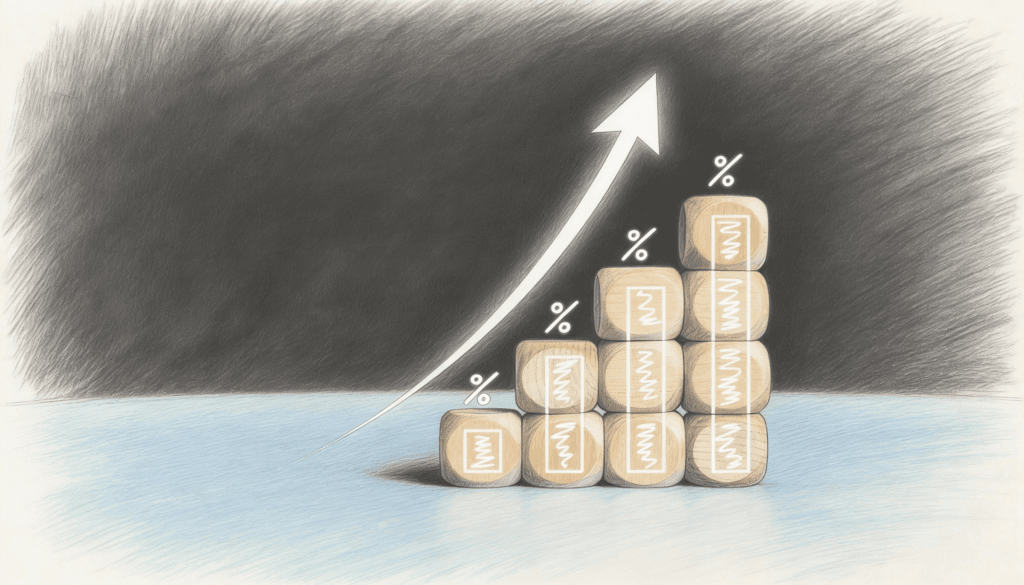
Compound interest is one of those systems. It’s the financial equivalent of a photocopier that makes copies of copies. Each generation of returns produces its own offspring. The money you earned yesterday starts earning money today. And that new money will earn money tomorrow. None of this shows up in basic arithmetic because addition assumes things stay separate and static.
But reality is neither.
Consider what happens when you plant an apple tree. You don’t just get apples. You get seeds from those apples that become more trees that produce more apples with more seeds. The orchard compounds. Nobody looks at this and thinks, “Well, I planted one seed, so I should get one apple.” That would be absurd. Yet we routinely think about money as if it behaves like rocks instead of seeds.
Time as the Secret Ingredient
The illogical logic reveals itself most clearly when you add time to the equation. Not calendar time. Not the kind of time you waste scrolling through your phone. The kind of time that accumulates weight as it passes.
Most things in life depreciate with time. Your car loses value. Your milk goes bad. Your hot take from three years ago becomes embarrassing. But compound interest inverts this relationship. Time stops being the enemy and becomes the collaborator. The longer you wait, the less sense the math makes to your intuition.
A dollar invested at a young age doesn’t just sit there being a dollar. It becomes a dollar and a dime, then a dollar twenty, then exponentially more as the years stack up. By the time you’re old, that dollar might be fifty dollars, having multiplied not through any additional effort but through pure patience.
This feels wrong to us because we’re used to earning money through work. We trade hours for dollars. But compound interest doesn’t work. It just exists and multiplies. It’s the financial equivalent of being paid to sleep.
The Exponential Blind Spot
Humans are terrible at understanding exponential growth. It’s not a personal failing. It’s a species level design flaw.
The famous thought experiment asks: if you fold a piece of paper 42 times, how thick would it be? Most people guess something like a few feet, maybe the height of a room. The actual answer? Thick enough to reach from Earth to the moon. Our brains simply cannot process how quickly things escalate when each step multiplies the previous one.
This blind spot explains why compound interest feels illogical. We see the early years and think nothing is happening. You put in a hundred dollars, wait a year, and you have a hundred and seven dollars. Thrilling. You could find more than that in your couch cushions.
But that’s like judging an oak tree by its first week as a sapling. The real action happens later, in years twenty and thirty and forty, when the numbers start behaving like they’re trying to escape the page. By then, you’re not just earning returns on your original investment. You’re earning returns on returns on returns on returns. The system has become self perpetuating.
The Network Effect of Money
Compound interest shares DNA with other phenomena that seem to create something from nothing. Social networks work the same way. The first person to join Facebook got zero value from it. The billionth person joined a living ecosystem. Each new user made the platform more valuable for everyone else already there.
Money compounds through a similar mechanism. Each dollar you accumulate makes future dollars easier to acquire. Wealth creates leverage. You can take smarter risks. You can wait for better opportunities. You can negotiate from a position of strength. The system rewards itself for existing.
This is why wealth inequality tends to compound too. It’s not primarily about rich people being smarter or working harder, though some might be both. It’s that money itself has momentum. The more you have, the faster it reproduces. The less you have, the harder it is to get the compounding started. The illogical math works in both directions.
Knowledge Compounds Too
Before you think this is just about money, consider how learning works. You don’t absorb information in a linear fashion. The first concept you learn in a new field feels impossibly hard. The tenth concept feels easier. By the hundredth, you’re learning faster than you did at the start.
Why? Because knowledge compounds. Each new thing you learn connects to what you already know, creating a web of understanding. The web makes future learning easier, which expands the web, which makes learning even easier. It’s recursive. Self amplifying.
Charlie Munger called this a “latticework of mental models.” But it’s really just compound interest applied to your brain. Early learning feels like you’re getting nowhere. Then suddenly you’re absorbing entire fields of knowledge in weeks instead of years. The illogical math strikes again.
The Dark Side of Compounding
Not everything that compounds is good. Debt compounds. So does stress. Small bad habits, repeated daily, don’t just add up. They multiply into dysfunctional patterns that reshape your entire life.
This is where the logic becomes genuinely uncomfortable. If small positive actions compound into extraordinary results over time, then small negative actions compound into extraordinary disasters. The math doesn’t care about your intentions.
Consider relationships. A small act of disrespect doesn’t stay small. It creates resentment. The resentment creates distance. The distance creates more disrespect. Soon you’re in a compounding cycle where the relationship degrades exponentially. One plus one doesn’t equal two. It equals a divorce.
The illogical logic works both ways, which means you have to be careful what you allow to compound in your life. Some seeds should never be planted.
The Paradox of Doing Nothing
Here’s what makes compound interest genuinely strange: the optimal strategy often involves doing nothing.
In most areas of life, doing nothing is disastrous. Don’t work? You starve. Don’t exercise? Your body falls apart. Don’t maintain your friendships? They evaporate. Action is typically rewarded. Inaction is typically punished.
But with compound interest, the best performers are often the ones who do the least. Buy an index fund. Wait forty years. Don’t touch it. Don’t try to time the market. Don’t panic when things drop. Don’t get excited when things spike. Just… exist near the investment and let time do the work.
This drives active people crazy. We want to do something. We want to optimize and tinker and improve. But compounding doesn’t need your help. It needs your absence. The math performs better when you’re not interfering with it.
It’s counterintuitive in the deepest sense. Most systems require constant input to produce output. Compound interest requires one input and then patience. The rest happens on its own.
Why We Resist the Logic
Part of why compound interest feels illogical is that it makes us confront uncomfortable truths about time and mortality.
To truly benefit from compounding, you need decades. Not months. Not years. Decades. This forces you to think about a version of yourself that exists in a future you can barely imagine. Your sixty year old self is a stranger to your twenty five year old self. Planning for that stranger feels abstract and unreal.
We also resist it because it highlights opportunity costs. Every dollar you save for compounding is a dollar you don’t spend today. Every year you wait is a year you could be enjoying life. The math might work out beautifully in forty years, but you’ll be forty years older. Is that a good trade?
These aren’t easy questions. The illogical logic demands sacrifices that feel very real in exchange for benefits that feel very theoretical. It asks you to trust a mathematical principle more than you trust your own immediate desires.
The Asymmetry of Compounding
Here’s something most people miss: compound interest is profoundly asymmetric.
Starting ten years late doesn’t just cost you ten years of growth. It costs you ten years of growth plus all the compounding that would have happened on that growth. The difference between starting at twenty five and starting at thirty five isn’t small. It’s enormous. Exponentially enormous.
This creates brutal inequalities. Two people with identical savings habits can end up with vastly different wealth purely based on when they started. Time is the most valuable ingredient in the compound interest formula, and time is the one thing you can never get back.
This asymmetry makes compound interest slightly unfair. The people who figure it out early get rewarded beyond their wisdom or virtue. The people who figure it out late get punished beyond their foolishness or vice. The math doesn’t care about fairness. It just compounds.
The Math That Isn’t Math
At its core, compound interest reveals something deeper than finance. It reveals that the universe runs on feedback loops, not simple addition.
Nothing exists in isolation. Everything affects everything else. Causes create effects that become causes of new effects. The output of one cycle becomes the input of the next. This is how simple systems create complex results.
Your financial returns compound. But so does your reputation. So does your health. So does your misery or your joy. The logic is always illogical because we’re not wired to think in loops and cycles. We think in straight lines.
But reality doesn’t care what we’re wired for.
If there’s anything useful to take from this, it’s that small things matter more than we think, and time matters more than we realize. The tiny decision to save an extra fifty dollars this month seems meaningless. And it is meaningless in isolation. But it’s not isolated. It’s the first domino in a chain that extends decades into the future. That fifty dollars might become a hundred dollars which might become a thousand dollars which might give you freedom when you’re sixty.
The same applies to everything else that compounds. The tiny workout today seems pointless. The tiny act of kindness goes unnoticed. The tiny improvement to your skill feels like nothing.
But nothing stays tiny when time gets involved. Everything compounds into something larger than itself. One plus one never equals two in systems that have memory and momentum. It equals three, then ten, then infinity.
The math is illogical. But the universe runs on it anyway.