Table of Contents
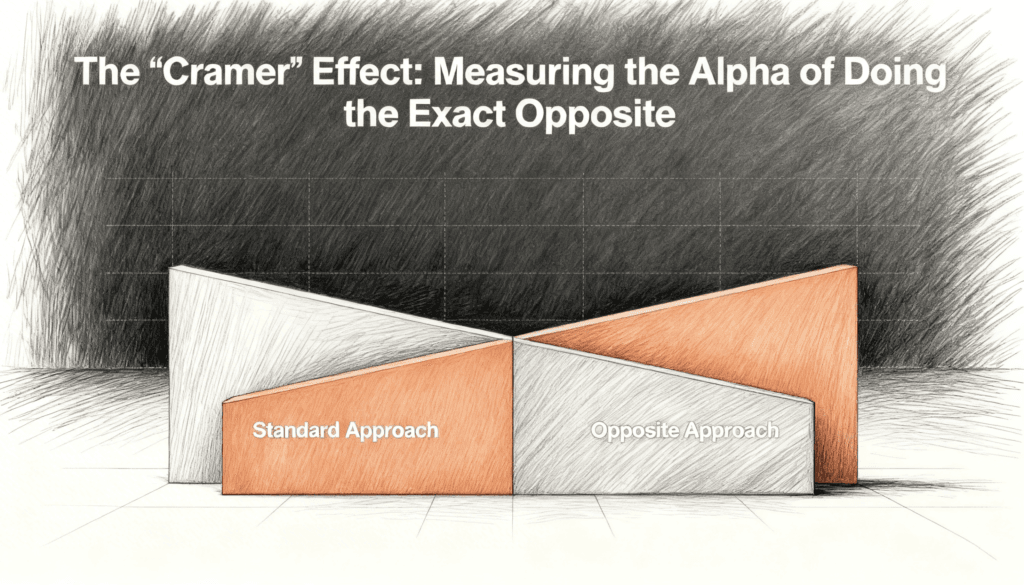
There is a strange corner of financial culture where one man’s stock picks have become a reliable compass, but only if you read the compass backwards. Jim Cramer, the host of CNBC’s Mad Money, has spent decades telling millions of viewers what to buy and what to sell. And for almost as long, a growing tribe of investors has built an entire strategy around doing precisely the opposite of whatever he says.
This is not just internet trolling. There is an ETF for it. There are academic papers dancing around it. There are Reddit threads with more rigor than some sell side research reports. The “Inverse Cramer” phenomenon is one of the most entertaining ideas in modern markets. But beneath the jokes, it raises a question that cuts much deeper than one television personality: what happens when consensus itself becomes the signal to fade?
The Setup: A Man, A Soundboard, and a Nation of Followers
To understand the Inverse Cramer thesis, you first need to understand what Cramer represents. He is not just a guy yelling about stocks on television. He is a condensation point. When Cramer says “buy,” he is rarely expressing an original view that no one else holds. He is channeling the mood. He is packaging the prevailing sentiment of Wall Street, financial Twitter, and the general retail investing public into a sixty minute show with sound effects.
This matters because Cramer is not the disease. He is the symptom. His picks tend to reflect what the crowd already believes or is already leaning toward. When he pounds the table on a stock, it is often a stock that has already run up, that analysts already like, that the narrative already supports. He is the final, loudest voice in a chorus that has been singing for a while.
And this is precisely why doing the opposite has, at various points, appeared to work. Not because Cramer is bad at picking stocks. But because by the time a view reaches peak consensus and lands on national television during prime time, the trade is crowded. The upside has been pulled forward. The risk reward has quietly inverted while everyone was clapping.
The Inverse Fund That Became a Mirror
In 2022, Tuttle Capital Management launched the Inverse Cramer ETF (ticker: SJIM), designed to short whatever Cramer recommended and go long whatever he told viewers to avoid. It was part serious financial product, part cultural commentary. The fund did not last forever, but its brief existence told us something important about the limits and the logic of contrarian strategies.
The results were mixed, which is actually the most interesting outcome. If doing the opposite of Cramer were a guaranteed money printer, it would have been arbitraged away years ago. Markets are not that generous. What the fund revealed instead was something subtler: the Inverse Cramer trade works in bursts. It tends to outperform during periods of peak euphoria or peak fear, when consensus is at its most stretched and most fragile. During calmer, more rational markets, it drifts. It chops around. It acts like what it is, which is a bet against the median opinion.
This pattern should sound familiar to anyone who has studied market making or mean reversion strategies. The alpha is not constant. It clusters around moments of extreme positioning. It is, in essence, a volatility harvest disguised as a meme.
Market Making and the Philosophy of the Other Side
Now here is where things get genuinely interesting. The Inverse Cramer idea is a folk version of something that professional market makers do every single day. Market makers profit by standing on the other side of order flow. When everyone wants to buy, the market maker sells. When everyone wants to sell, the market maker buys. They do not care about the story. They do not care about the narrative. They care about the spread, the flow, and the positioning.
The parallel is almost exact. Cramer generates order flow. His viewers buy after his recommendations and sell after his warnings. The Inverse Cramer strategy is simply a retail scale version of market making: absorbing that flow, betting that the initial reaction overshoots, and collecting the reversion.
Professional market makers at firms like Citadel Securities or Virtu Financial do this with algorithms, co located servers, and risk models that would make a NASA engineer feel at home. The Inverse Cramer crowd does it with Twitter screenshots and a brokerage app. The sophistication differs. The underlying principle does not.
Both are expressions of a deeper truth about markets: the person who is willing to take the other side of an emotional trade has a structural edge. Not always. Not in every trade. But over time, the willingness to sell into excitement and buy into panic generates a return that looks, on paper, like it should not exist. And yet it persists, because the human emotions that create the opportunity are not going anywhere.
Why Consensus Is a Lagging Indicator
One of the most counterintuitive ideas in investing is that being right and making money are not the same thing. You can be completely correct about a company’s fundamentals and still lose money if the price already reflects that correctness. This is the efficient market hypothesis waving at you from across the room, except it is wearing a clown nose because markets are only efficient on average and over time. In the short run, they are a mood ring.
Cramer’s picks tend to be correct in the fundamental sense more often than his critics admit. The companies he recommends are frequently good companies. The problem is not the analysis. The problem is the timing and the crowding. When a stock pick reaches the level of cultural saturation where your uncle mentions it at Thanksgiving dinner, the marginal buyer has already bought. There is no one left to push the price higher. The only direction with available energy is down, or at best sideways.
This is why the Inverse Cramer strategy is not really about Cramer at all. He is a proxy for peak retail attention. You could build the same strategy around any sufficiently popular and widely followed source of investment opinion. The magazine cover indicator, which suggests that by the time a trend makes the cover of a major magazine, it is already over, operates on exactly the same logic. So does the old Wall Street adage about shining shoes: when your shoe shine guy is giving you stock tips, it is time to sell.
These are all different ways of saying the same thing. Consensus is a lagging indicator. By the time everyone agrees, the opportunity has migrated to wherever everyone is not looking.
The Ecology of Contrarianism
But here is the wrinkle that most Inverse Cramer enthusiasts do not talk about: contrarianism has a shelf life. If enough people start doing the opposite of Cramer, then the opposite of Cramer becomes its own consensus. The contrarians become the crowd. The signal degrades. The edge evaporates.
This is a well known problem in ecology, and the parallel is worth drawing. In predator prey dynamics, a successful predator population grows until it depletes its prey, then crashes. The prey recovers, the predators recover, and the cycle repeats. Contrarian strategies in markets follow a remarkably similar rhythm. A contrarian edge emerges because few people are willing to take the other side. It gets discovered. Money flows in. The edge shrinks. The contrarians leave. The edge re-emerges.
The Inverse Cramer ETF may have been a casualty of this cycle. By the time a contrarian idea becomes a branded, tradable product with its own ticker symbol, it has arguably already passed peak utility. The very act of institutionalizing a contrarian bet transforms it into a consensus bet wearing a contrarian costume.
This does not mean contrarianism is useless. It means the real edge is not in having a fixed rule like “always do the opposite.” The real edge is in understanding when the crowd is most wrong and most vulnerable. That requires judgment, not a formula.
The Information Cascade Problem
There is a concept in behavioral economics called an information cascade. It describes what happens when people stop making decisions based on their own analysis and start making decisions based on what they see others doing. The classic example is a restaurant: you walk down a street, see one restaurant packed and another empty, and choose the packed one. Not because you evaluated the menu, but because you assumed the crowd had information you did not.
Markets are information cascades on steroids. When Cramer recommends a stock and it goes up the next day, that price movement is not purely a reflection of the company’s value. It is partly a reflection of the cascade itself. People bought because Cramer said to buy, the buying pushed the price up, the rising price attracted more buyers, and so on. The cascade feeds itself until it exhausts its fuel.
What Cramer Teaches Us About Alpha
The deepest lesson of the Inverse Cramer phenomenon is not about Cramer himself. It is about where alpha actually comes from. Alpha, the excess return above what you would expect from simply holding the market, is not a reward for being smart. It is a reward for being uncomfortable.
Every genuine source of alpha involves doing something that most people are unwilling to do. Value investing means buying companies that look broken. Momentum investing means chasing stocks that feel overextended. Market making means stepping in front of order flow that could run you over. Short selling means betting against companies that everyone loves. These strategies all share a common trait: they require you to act against the grain of human instinct.
The Inverse Cramer idea captures this truth in its crudest and most digestible form. It says: the crowd is wrong at the extremes, and there is money in being the person who does not flinch when everyone else is panicking or cheering. That is not a sophisticated quantitative insight. It is a philosophical one. And it happens to be correct often enough to matter.
The Limits of the Mirror
It would be irresponsible to leave this discussion without noting the obvious: doing the opposite of anyone, Cramer included, is not a viable long term investment strategy in isolation. Markets trend. Sometimes the consensus is right, and it stays right for months or years. If you mechanically shorted every stock Cramer recommended during the 2020 to 2021 bull run, you would have been carried out on a stretcher.
The Inverse Cramer strategy, like market making, works best as a component within a broader framework. Market makers do not just take the other side of every trade blindly. They manage inventory. They hedge. They size positions relative to their confidence in the reversion. The retail version of this discipline is knowing when the consensus is genuinely overextended versus when it is simply correct and you are the one who is wrong.
That self awareness is the hardest part of any contrarian strategy. It is easy to feel clever going against the crowd. It is much harder to recognize the moments when the crowd is right and you are the one caught in a narrative of your own making.
The Punchline
Jim Cramer has been on television for nearly two decades. He has made thousands of stock picks. Some were brilliant. Some were catastrophic. Most were somewhere in the middle, which is exactly what you would expect from anyone making that many public calls in real time.
The fact that an entire counter industry has emerged around inverting his advice is not really a commentary on his skill. It is a commentary on the structure of attention in financial markets. Cramer sits at the intersection of entertainment, information, and crowd psychology. He is a one man sentiment indicator, a human VIX, a barometer of what the masses are feeling at any given moment.
And the lesson of the barometer is always the same. When the pressure reaches an extreme, the weather is about to change. You do not need to be a meteorologist to understand this. You just need to be willing to carry an umbrella when the sun is shining.
That willingness, unglamorous and often lonely, is the closest thing to a free lunch that markets will ever offer. It is not really free, of course. The price is discomfort. But for those willing to pay it, the returns have a funny way of showing up right when everyone else is wondering where theirs went.