Table of Contents
There is a strange kind of civil war happening inside the fast money world. On one side, you have the day trader. A person who wakes up at five in the morning, studies charts, sets alerts, keeps a trading journal, and speaks about risk management the way a monk speaks about meditation. On the other side, you have the WallStreetBets trader. A person who wakes up whenever, buys far dated call options on a company they heard about in a meme, and types the phrase “YOLO” into a public forum with the confidence of someone who has made peace with loss.
They are both trading in the same markets. They are both moving fast. They are both trying to get rich without waiting thirty years. And they cannot stand each other.
This is not a clash between fast money and slow money. It is something stranger. It is a clash between two people who both chose speed, but who disagree about what speed is supposed to look like.
The Discipline Paradox
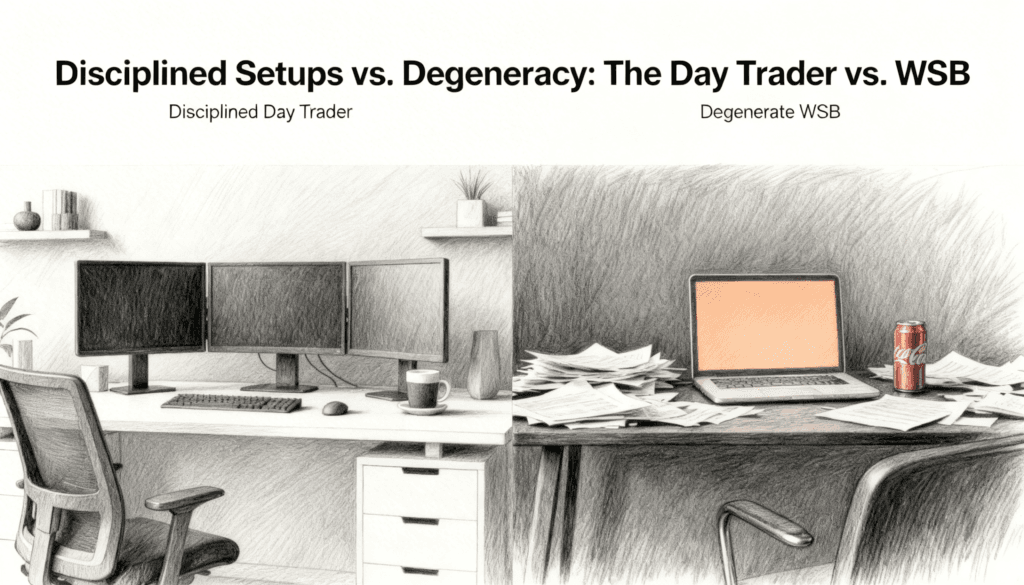
The day trader sees themselves as a professional. The charts are tools. The setups are proven. The losses are part of a system that, over enough trades, should produce a positive result. Every action has a reason. Every entry has a stop loss. Every exit has a rule. If you asked a day trader to describe their ideal day, it would sound less like gambling and more like a pilot running through a preflight checklist.
The WSB trader sees themselves as something else entirely. Not a professional. Not even an amateur. Something closer to a performance artist whose medium happens to be their brokerage account. The whole point is that there is no system. Or rather, the system is the absence of one. The setup is vibes. The analysis is a screenshot with crayon arrows. The exit strategy is whatever happens next.
Here is where it gets interesting. The day trader looks at the WSB crowd and sees reckless idiots destroying their lives in public. The WSB crowd looks at the day trader and sees someone who has convinced themselves that a coin flip becomes science if you do it with enough rules. Both views contain something true. And that is what makes this fight so much more revealing than it looks.
What Discipline Is Actually For
The deeper question underneath all of this is what discipline is actually doing for a trader. The day trader assumes that discipline produces better outcomes. The WSB trader quietly suspects that discipline produces better feelings, and that the outcomes are roughly the same.
This is not a comfortable thing to sit with if you are the day trader. You have spent years building a process. You keep spreadsheets. You watch your win rate. You believe, deeply, that the structure is what separates you from the degenerates. But the uncomfortable truth is that a large portion of active day traders do not beat the market over long periods. Most of the good ones earn their edge from narrow, specific conditions that are hard to replicate and even harder to sustain. The discipline is real. The edge is often not.
The WSB trader, by abandoning the pretense entirely, is making a different bet. They are betting that if the game is mostly random, the most rational response is to stop pretending otherwise and have fun with it. If you are going to lose, lose in a way that becomes a story. If you are going to win, win in a way that nobody will forget. Think of it as the financial version of someone who stops dieting and orders the dessert first. There is something almost philosophically honest about it, even if it wrecks you.
This is the counterintuitive part. The day trader and the WSB trader are both responding to the same underlying problem. They both know that beating the market is hard. One of them responds by building a fortress of rules. The other responds by lighting the fortress on fire and dancing in the flames. Neither approach reliably solves the problem. But they handle the emotional weight of the problem in opposite ways.
The Theater of Seriousness
There is a concept from sociology that fits here. The idea that people often perform their identities rather than simply live them. You do not just become a doctor. You wear the coat. You use the language. You adopt the posture. The costume is part of the work, because the costume is how you and everyone else knows the work is real.
Day trading has its own costume. Multiple monitors. A darkened room. Hotkeys. A certain kind of language about “the tape” and “liquidity” and “risk to reward.” The costume is not a lie. It may genuinely help the trader focus. But it is also a performance, and part of what it performs is seriousness. The costume says: this is a craft, not a hobby. I am a trader, not a gambler. Please respect me.
WSB is also a costume. The “loss porn” screenshots. The absurd nicknames for stocks. The self deprecating language about being “regarded.” The insistence on showing up in the comment section with a new cartoon of a rocket. This costume is not a lie either. It performs something too. It performs the idea that the whole thing is a joke, which has a protective function, because if it is a joke, then losing money is the punchline instead of a tragedy.
Each community hates the other partly because each one exposes the theater of the other. The WSB trader, by refusing to take the game seriously, makes the day trader look like someone who is taking a casino very, very seriously. The day trader, by trying to be professional about it, makes the WSB crowd look like they are coping with chaos by turning it into entertainment. Both sides end up feeling accused of something they have been trying not to think about.
The Honest and the Delusional
Here is where I have to say something mildly contrarian. The WSB trader, in a specific way, is often more honest than the day trader. Not wiser. Not better off. Just more honest about what is happening.
The WSB trader knows they are gambling. They call it gambling. They make jokes about it being gambling. Their entire community is built on the premise that they are gambling. When they lose, they laugh, because the premise did not change. When they win, they laugh harder, because the premise got even funnier.
The day trader, by contrast, often tells themselves a story about skill that the numbers do not fully support. This is not a dig at good day traders. Some of them are extraordinary. But the average person watching YouTube videos and buying a course and calling themselves a day trader is, statistically, not in the skilled minority. They are in the gambling majority, with extra steps and better lighting.
The WSB trader loses money and has a story. The day trader often loses money and has a method. A story costs nothing. A method costs hours, focus, and the slow erosion of confidence every time the method does not work. It is worth asking which loss is heavier.
None of this means WSB is a good idea. It very much is not. But there is a certain clarity in its absurdity that the disciplined approach sometimes lacks. And the discipline, when it is covering for a lack of real edge, can be its own kind of delusion. Just quieter. Better dressed.
What the Fight Is Really About
Strip it all down and the real argument is not about strategy. It is about dignity. The day trader wants their activity to count as work. They want the hours to matter. They want the process to separate them from luck. The WSB trader wants permission to stop caring about dignity at all, because dignity is exhausting, and the whole appeal of degeneracy is that it costs nothing to maintain.
These are two different answers to a question that almost nobody asks out loud. What is the point of trying hard if trying hard does not reliably produce a better result? The day trader answers by saying that the trying is itself the reward. Structure creates meaning. Meaning creates identity. Even if the returns are the same as a coin flip, the trying makes you a trader instead of a gambler. The WSB trader answers by saying that if the returns are the same as a coin flip, you should at least enjoy flipping the coin.
Both answers are human. Neither is obviously right.
The really uncomfortable thought is this: both communities exist because the math of getting rich quickly is very hard, and both are rituals for coping with that hardness. One ritual involves spreadsheets and discipline. The other involves rockets and jokes. The spreadsheets do not guarantee you will win. The jokes do not guarantee you will lose. They are just very different ways of being inside the same uncertain room.
Somewhere in a different room, a boring investor is dollar cost averaging into a broad market fund and will likely outperform most people in both camps. Nobody wants to hear about them. Nobody writes memes about them. They do not need a costume. That is probably why nobody pays attention to them until it is too late to catch up.