Table of Contents
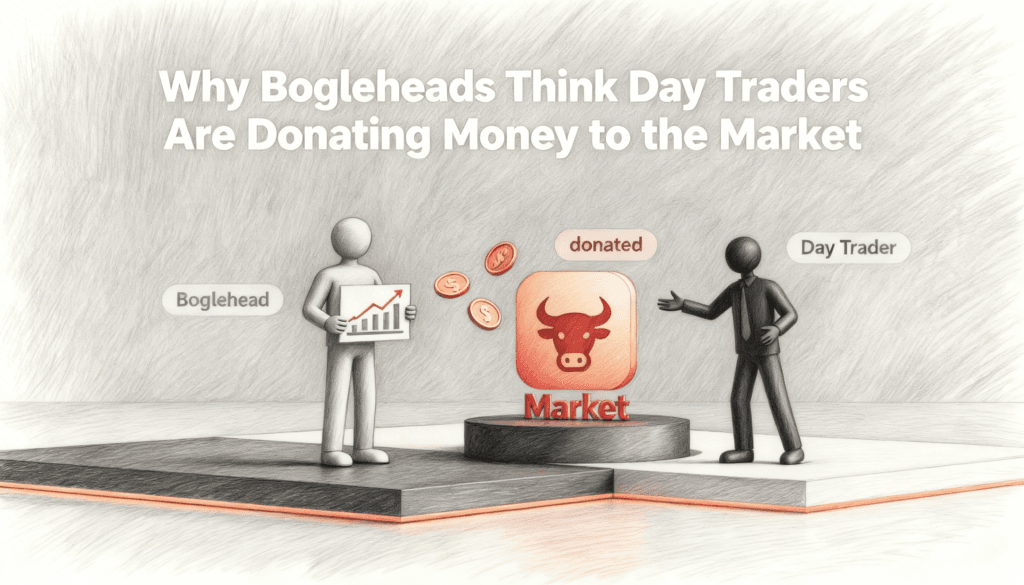
There is a joke that floats around Boglehead forums, usually delivered without a smile. It goes something like this: day traders are not really investors. They are philanthropists. Every time they click buy and sell, they are making a small charitable contribution to the rest of the market. The joke is not meant to be cruel. It is meant to be accurate.
And to understand why Bogleheads genuinely believe this, you have to understand something strange about their worldview. They do not think day traders lose because they are stupid. They think day traders lose because of geometry. The math of the market is shaped in a specific way, and the shape itself does most of the work. Skill barely gets a vote.
The Market as a Zero Sum Costume Party
Start with a quiet fact that most people nod at and then immediately forget. For every buyer, there is a seller. For every winner on a trade, there is someone on the other side who wishes they had not taken it. In the long run, the market as a whole goes up, because companies actually produce value and grow. But that slow upward drift is not what day traders are chasing. They are chasing the short term wiggles. And the short term wiggles are a different game entirely.
In that short term game, nothing is being created. No new value enters the room. It is just money changing hands. If you win a trade by a dollar, someone else lost that dollar. That is it. There is no magical growth happening in a ten minute window. There is only redistribution.
Now ask the uncomfortable question. Who is on the other side of your trade when you, a person with a laptop and three monitors, click buy on a stock at 9:47 in the morning?
The Boglehead answer is brutal. It is not another person like you. It is a firm with servers in the same building as the exchange, trading in microseconds, staffed by people who publish research papers for fun, backed by hundreds of millions of dollars in infrastructure built specifically to extract value from people who think they have an edge. The market is a costume party, and you have shown up dressed as a trader, while the professionals have shown up dressed as the house.
The Friction Nobody Likes to Talk About
Bogleheads love to point at a specific thing that makes the geometry even worse. It is friction. Not the emotional kind. The mechanical kind.
Every trade has a small cost baked into it. Sometimes it is a commission, though those are mostly gone now. Sometimes it is the spread between what buyers are bidding and what sellers are asking. Sometimes it is taxes. Sometimes it is the simple fact that when you try to buy, your buying slightly pushes the price up, and when you sell, your selling slightly pushes it down. None of these things hurt much on any single trade. That is the point. They are designed to be forgettable.
But day traders do not make single trades. They make hundreds. Thousands over a year. And friction is the kind of thing that does not care whether you forget about it. It accumulates anyway. It is like walking through a room with slightly sticky floors. One step is nothing. Ten thousand steps and you are exhausted and you have not really gone anywhere.
The Boglehead watches this and sees something almost beautiful in its cruelty. The more you trade, the more friction you pay. The more friction you pay, the worse your returns become. The worse your returns become, the more pressure you feel to trade your way out of the hole. Which means more friction. It is a loop that tightens around you while you are busy blaming the market.
The Part Where Confidence Becomes Expensive
Here is where Bogleheads get almost philosophical, though they would never admit it. They think the real enemy of the day trader is not the market. It is the day trader. Specifically, it is a feature of the human mind that makes it extremely hard to tell the difference between a skill and a streak.
If you flip a coin ten times, you will sometimes get six or seven heads in a row. Nothing mystical is happening. It is just how randomness behaves in small samples. The trouble is, the person holding the coin does not experience it as randomness. They experience it as a run. And runs feel earned. They feel like proof of something. The brain is not equipped to look at a short winning streak and shrug. The brain wants to explain it. And the easiest explanation, always, is that you are good.
This is why day trading is so psychologically dangerous. Early success is almost a curse. A beginner who loses immediately will probably quit and go do something else with their life. A beginner who wins their first few trades has been handed a loaded story about themselves. They are now, in their own mind, a trader. They have a gift. They saw the pattern. The market spoke to them.
What has actually happened is they got six heads in a row. What will happen next is they will trade bigger, because the confidence is real even if the skill is not. And the bigger trades will meet the geometry of the market, and the friction, and the invisible professionals on the other side. The result is predictable in the way that gravity is predictable.
The Boglehead does not laugh at this. Not really. They have seen it too many times. It is less like watching someone fail and more like watching someone audition for a role in a play whose ending was written before they walked in.
Why the Boring Strategy Is Not Really About Being Boring
There is a tendency to frame the Boglehead position as lazy or unambitious. Just buy the whole market and wait. That is the whole strategy. It sounds almost insulting in its simplicity, especially to someone who has just spent six hours studying chart patterns.
But the Boglehead is not being lazy. The Boglehead is making a very specific philosophical bet, and it is worth saying out loud. The bet is this. In a game where most participants are trying to outsmart each other, the person who refuses to play the outsmarting game wins by default. Not because they are clever. Because everyone else is paying the costs of being clever, and they are not.
It is a little like the old story about two friends running from a bear. One stops to tie his shoes. The other asks, you cannot outrun a bear. And the first friend says, I do not need to outrun the bear. I need to outrun you.
The Boglehead does not need to beat the market. They need to avoid the things that make other people lose to it. They do this by doing as little as possible, which turns out to be one of the hardest strategies in the world, because doing nothing feels like failing to try.
This is where I think the Boglehead view connects to something much older than finance. It connects to a pattern you find in monastic traditions, in certain schools of philosophy, even in the way experienced doctors talk about medicine. The wisest moves are often the restrained ones. The instinct to act is almost always stronger than the reason to act. And the discipline of not acting is something most people never develop, because it feels indistinguishable from doing nothing at all.
Day trading, in this frame, is not just a bad strategy. It is a failure of restraint dressed up as a skill.
The Donation, Reconsidered
So when a Boglehead says that day traders are donating money to the market, what do they actually mean? They do not mean the day trader is foolish. They mean something more precise and, in a way, more generous. They mean that the day trader has entered a contest with invisible professionals, wearing the wrong equipment, carrying friction in their pockets, paying taxes on every victory, and trusting a brain that is wired to confuse luck with talent. Under those conditions, losing is not a personal failure. It is the expected outcome of the structure.
The money the day trader loses does not disappear. It goes somewhere. It goes to the firms with the servers. It goes to the tax authority. It goes to the other side of the trade. The day trader is, quite literally, transferring wealth from themselves to people who have built their entire business model around the existence of people like the day trader. If that is not a donation, it is at least a subscription.
And maybe that is the most unsettling part of the Boglehead view. They are not angry at day traders. They are not even dismissive. They are something worse. They are sympathetic. Because they know the day trader is trying. They know the hours are real. They know the study is real. They know the discipline, in many cases, is real.
It just does not matter. The shape of the game eats the effort.
Somewhere, in the background of all this, a Boglehead is doing nothing. They have automated a monthly contribution into a broad market fund and they have turned off the app. They will not check it this week. They will not check it this month. They are not winning any particular trade. They are simply refusing to enter the contest where losing is the default. And over twenty years, that refusal will almost certainly make them richer than the person who fought hard every single day.
That is not a strategy. That is a worldview. And it is the quietest, most infuriating kind of worldview there is. The kind that wins by walking away.