Table of Contents
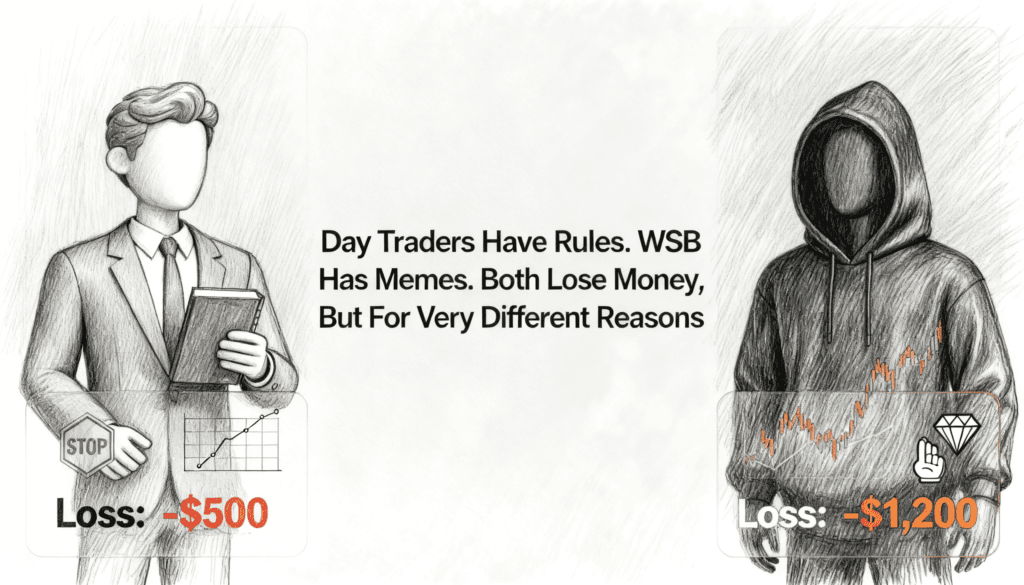
There is a cruel joke hiding inside the fast money world. Two groups of people are trying very hard to get rich from the markets. One group has written down a strict set of rules and follows them with something close to religious devotion. The other group has abandoned rules entirely and replaced them with jokes, rocket emojis, and a shared vocabulary that sounds like a foreign language to anyone over thirty.
And here is the punchline. Both groups, on average, lose money. The rules do not save the day trader. The memes do not save the WSB crowd. The market takes from both of them with the same polite indifference.
But the interesting part is not that they both lose. The interesting part is that they lose for completely opposite reasons. And those opposite reasons say something uncomfortable about how humans try to control things they cannot control.
The Day Trader Loses Because of the Rules
This sounds backward, so let me explain. The day trader does not lose because the rules are bad. The day trader loses because the rules create a feeling of safety that is almost entirely psychological.
A rule based system gives a person a checklist. Wait for the setup. Confirm the signal. Set the stop loss. Size the position. Take the trade. Journal the result. Review on the weekend. Each step feels like a small act of professionalism. Each step is a little wall between the trader and the chaos of the market. Enough walls, and the trader starts to feel like an engineer instead of a gambler.
The problem is that the walls are made of paper. The market does not care about your checklist. The setup that worked a hundred times in a row can fail the hundred and first time, and it will fail exactly when you have the largest position on. The stop loss that was supposed to protect you will get hit three minutes before the trade would have gone your way. The journal will reveal patterns that existed for six months and then stopped existing without warning.
None of this means the rules were wrong. It means the rules were never in charge. And the day trader, after enough of these experiences, usually does one of two things. They either double down on the rules and add more of them, which makes the system more complicated without making it more accurate. Or they abandon the rules in a moment of frustration and take a huge impulsive trade, which is the exact thing the rules were written to prevent.
This is the trap. The discipline does not protect you from the market. It protects you from yourself, which is a real thing, but it is a much smaller thing than people advertise. And when the discipline finally breaks, it tends to break at the worst possible moment, because the moment the discipline breaks is by definition the moment the pressure got too high.
WSB Loses Because of the Memes
The WSB trader has taken the opposite path. No rules. No setups. No journals. Just vibes, screenshots, and a collective sense that the whole thing is a joke that might also accidentally make you rich.
It would be easy to say they lose because they are reckless. That is partly true and also boring. The more interesting thing is that the memes are not just decoration. The memes are the strategy. Or rather, the memes are a replacement for strategy, and that replacement does something very specific to the brain.
When you buy a stock because you ran the numbers, a loss feels like a personal failure. You did the work and the work did not pay off. That kind of loss hurts. It makes people quit.
But when you buy a stock because somebody posted a picture of a rocket next to its ticker, a loss does not feel like a personal failure. It feels like a shared bit. You lost, but you lost with style, and you can post a screenshot of the loss and get upvotes and comments that say things like “welcome to the club.” The pain is distributed across a crowd. The community absorbs it. And because the community absorbs it, the trader keeps coming back.
This is the real function of the memes. They are not jokes. They are a shock absorber. They take the normal human experience of losing money and turn it into a social experience of belonging. And belonging is addictive in a way that discipline is not.
The problem is that shock absorbers let you drive over worse and worse roads without feeling the damage. The WSB trader does not stop after the first big loss because the first big loss was a meme. They do not stop after the second one either. They might not stop at all, because the framework they are operating inside was never designed to include the concept of stopping. It was designed to include the concept of posting.
There is a loose parallel here to how casinos work. Casinos do not get rich because people are bad at math. They get rich because they have designed an environment where losing feels like a part of the experience instead of the point of the experience. WSB has accidentally built the same thing, except the casino is run by the players, and nobody is skimming a profit. The house, in this case, is just the market itself, which takes its cut and walks away without saying anything.
The Mirror Image
Here is where it gets strange. The day trader and the WSB trader are actually the same person running two different operating systems. Both are trying to solve the problem of uncertainty. Both have landed on a coping mechanism that works until it does not. One has chosen structure. The other has chosen camaraderie. Both are real things. Both are doing real psychological work. Neither one is actually a reliable way to beat the market.
The day trader thinks the WSB crowd is lazy. The WSB crowd thinks the day trader is deluded. They are both a little bit right about each other and almost entirely wrong about themselves.
The day trader is not as disciplined as they think. The rules are followed most carefully when the market is calm, which is also when the rules matter the least. When the market is wild, which is when the rules would matter most, the rules get bent. Everyone knows this and almost nobody admits it.
The WSB trader is not as free as they think. The memes feel like rebellion, but they are a tight cultural script. You are supposed to use certain words. You are supposed to post losses as well as wins. You are supposed to never admit you are actually trying. The whole thing is a performance, and performances have rules even when they pretend they do not.
So one group has visible rules that hide invisible chaos. The other group has visible chaos that hides invisible rules. They are mirror images, and they spend most of their time insulting the reflection.
What This Actually Says About Us
If you step back far enough, the day trader and the WSB trader are both answering the same question that nobody phrases out loud. How do I stay sane while doing something that might not work?
The day trader answers by building a process. If I cannot control the outcome, I will control the inputs, and I will find meaning in the quality of my inputs. This is a respectable answer. It is also the answer of somebody who needs to feel competent even when they are not being rewarded for it.
The WSB trader answers by joining a crowd. If I cannot control the outcome, I will at least not be alone while the outcome happens. This is also a respectable answer, even if it sounds less respectable on paper. It is the answer of somebody who has noticed that pain shared is pain reduced, and who has decided that the reduction is worth more than the illusion of control.
Neither answer makes you money. Both answers make the losing tolerable. And once you see that, the whole argument between the two groups starts to look less like a debate about strategy and more like two different religions arguing about who has the better funeral.
Somewhere else, a person is buying an index fund once a month and not thinking about any of this. They do not have rules. They do not have memes. They do not have a community. They have a boring little automatic transfer and an average return that will, over a long enough timeline, quietly outperform almost everyone in both of the louder camps.
Nobody writes memes about that person. Nobody writes rulebooks about them either. They are the invisible third option in a fight that was never really about them, and they are winning without needing to show up.
Which might be the real lesson hiding in all of this. The market does not reward your relationship with uncertainty. It just reveals it.