Table of Contents
There is a peculiar hierarchy inside day trading that outsiders almost never see. From the outside, it all looks the same. People staring at charts, buying and selling stocks within the same day, talking about candles and volume and momentum. It looks like one community.
It is not.
Inside day trading, there is a fracture that runs deep. On one side, execution focused traders. These are people who care about how they enter, how they exit, how their orders interact with the market at a mechanical level. On the other side, FinTwit callers. These are people who post trades publicly, announce entries in real time, and build audiences around their ability to identify what to buy and when.
Both call themselves day traders. One group quietly makes money. The other loudly tells you about it.
The Call Is Not the Trade
Here is something that sounds obvious but is not. Telling someone to buy a stock is not the same as buying a stock.
When a FinTwit caller posts “long TSLA at 345,” that looks like useful information. It feels like transparency. Someone is sharing their position, which seems generous. But what that post does not tell you is far more important than what it does.
It does not tell you their position size relative to their account. It does not tell you where their stop is, or if they even use one. It does not tell you how they plan to manage the trade if it moves against them. It does not tell you their exit plan. It does not tell you how their entry interacted with the order book or whether they got filled at 345 or 345.30 because their order moved the price on a thin tape.
The trade call is a skeleton. The execution is the entire body.
Serious day traders understand this instinctively. They have learned, usually through painful experience, that knowing what to buy is maybe twenty percent of the job. The other eighty percent is managing the trade once you are in it. And that part is invisible. It cannot be posted. It happens in real time, in response to price action that unfolds differently every single day.
This is why a FinTwit caller can post ten winning trades in a row and still not be telling you anything useful. The wins are real. The information is not transferable.
The Survivorship Problem Nobody Talks About
There is a concept in statistics called survivorship bias. You study the winners and draw conclusions while ignoring the vastly larger pool of losers who are no longer around to be studied.
FinTwit is a survivorship bias machine.
The callers you see are the ones who survived long enough to build a following. The ones who blew up their accounts are not posting anymore. They are not sharing their journey. They disappeared quietly, which is what failure usually looks like in trading. Not dramatic. Just silent.
This creates a distorted picture where it seems like calling trades publicly is a viable strategy, because look at all these people doing it successfully. What you are actually seeing is a filtered sample. The platform does not show you the graveyard. It only shows you the graduates.
Serious traders know this because many of them have friends who used to trade. Past tense. The attrition rate in day trading is brutal, and it does not discriminate between smart people and foolish ones. It discriminates between people who manage risk and people who do not. That distinction almost never shows up in a tweet.
Why Execution Traders Stay Quiet
There is an interesting parallel here with professional kitchens. The best chefs in the world are not the ones posting recipes on social media. They are the ones running the line, adjusting heat in real time, feeling the texture of a sauce, making dozens of micro decisions per minute that cannot be captured in a list of instructions.
Day trading execution works the same way. It is a craft that lives in the hands, not in the plan.
This is precisely why serious execution traders tend to be quiet. Not because they are secretive or elitist, though some certainly are. But because explaining what they do is genuinely difficult. Their edge lives in the speed and quality of their decision making during the trade, not before it. Sharing a trade idea strips away the only part that actually matters.
There is also a practical reason for the silence. In certain strategies, especially those involving lower liquidity stocks, sharing your trade is actively harmful to your own position. If you announce you are buying something thinly traded, you invite others to pile in, which can move the price against you if they orchestrate a short. Your transparency becomes your own enemy.
FinTwit callers tend to operate in high liquidity names where this matters less. But this also means they are playing in the most competitive, most efficient corners of the market, where the edge from a public call is thinnest. There is an irony there that does not get discussed enough.
The Incentive Misalignment
Here is where the distrust gets structural, not just philosophical.
A FinTwit caller with a large following has two sources of potential income. One is trading. The other is the audience itself. Courses, subscriptions, Discord servers, affiliate deals, sponsored content. The audience is a business.
This does not mean every caller is dishonest. Many are not. But the incentive structure is bent. A caller who posts losing trades consistently will lose followers. A caller who posts winning trades will gain them. This creates an almost gravitational pull toward selective posting. You do not need to lie. You just need to be quiet on the wrong days.
Serious execution traders see this and recoil. Not because they are morally superior, but because their entire craft is built on the idea that you cannot hide from your results. The market gives you feedback instantly, and that feedback is denominated in money. You cannot curate your profit and loss statement the way you can curate a Twitter feed.
This is the core of the distrust. It is not that callers are wrong. It is that there is no mechanism to verify if they are right. The feedback loop that disciplines an actual trader does not exist for a content creator who trades.
The Dunning Kruger Gradient
Something subtle happens to a trader’s confidence over time, and it maps almost perfectly onto the Dunning Kruger curve.
New traders are terrified. They know nothing and they feel it. Then they have a few wins and their confidence explodes. This is the danger zone. This is when people start posting trades publicly, because they genuinely believe they have figured something out. They have not. They have been lucky during a forgiving market, which is a very different thing.
Experienced traders move past this phase. Their confidence stabilizes at a lower, more honest level. They know what they do not know. They understand that their edge is thin and conditional. They would never post a trade publicly because they are not even sure the trade will work. They just know that their process, applied consistently, produces positive results over hundreds of trades.
FinTwit selects heavily for people in the middle of the Dunning Kruger curve. The peak of unearned confidence is exactly where the urge to broadcast is strongest. The people who actually know what they are doing have moved past the need to prove it.
What Callers Get Right
It would be dishonest to pretend there is nothing valuable about FinTwit trade calls. There is.
For new traders especially, seeing how someone thinks about a setup in real time is educational. It is not a strategy, but it is exposure to pattern recognition. It shows you what experienced eyes focus on and what they ignore. That has value, as long as you treat it as education and not as a signal to follow.
Some callers also perform a useful filtering function. In a market with thousands of stocks, having someone point you toward names that are moving or setting up interesting patterns can save time. Again, not a trade recommendation. A starting point.
The problem is that most followers do not treat it as a starting point. They treat it as the entire journey. They see the call, they enter the trade, and they have no plan for what comes next because the caller did not give them one. Could not give them one, because the management of a trade is not a thing that transfers through text.
The Uncomfortable Truth
The deepest reason serious day traders distrust FinTwit callers is not about dishonesty or incompetence. It is about a fundamental disagreement over what trading actually is.
Callers treat trading as a series of ideas. Good ideas make money. Bad ideas lose money. The skill is in having good ideas.
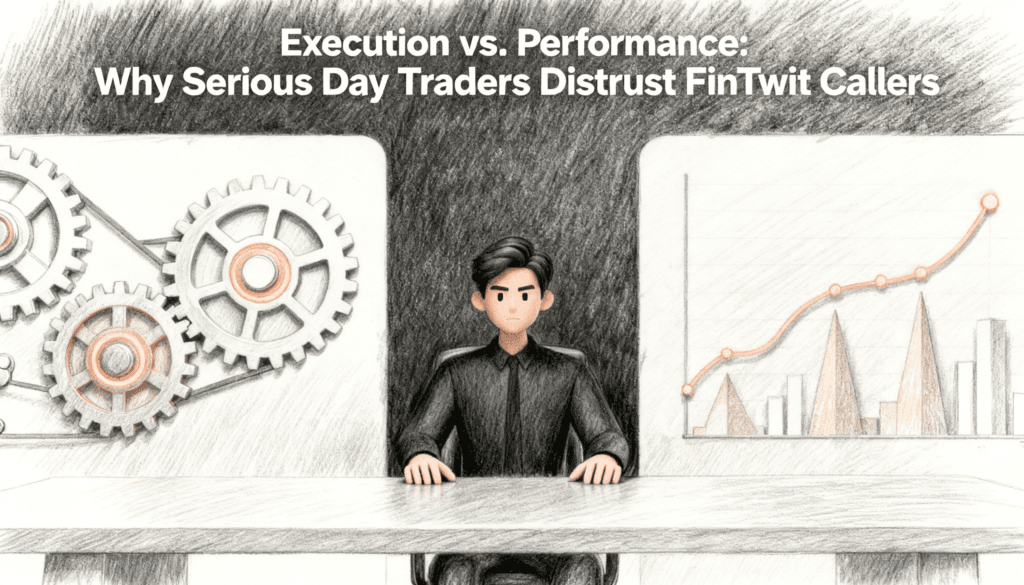
Execution traders treat trading as a process. The idea is almost incidental. The skill is in the doing. How you manage risk, how you read the tape, how you adjust when the trade does not do what you expected. The whole craft lives in the part that cannot be tweeted.
This is not unlike the difference between someone who writes screenplays and someone who directs films. The screenplay is important. But the movie does not exist until someone makes a thousand decisions on set that were never in the script.
FinTwit gives you the screenplay. The market requires a director.
And that is why the loudest traders are rarely the best ones. The best ones are too busy directing.