Table of Contents
There is a strange paradox at the center of modern retail trading. Two communities sit side by side on the same internet, using the same brokerages, often trading the same stocks. One of them treats risk like a sacred discipline. The other treats risk like a punchline. And somehow, they both end up losing money at roughly the same rate.
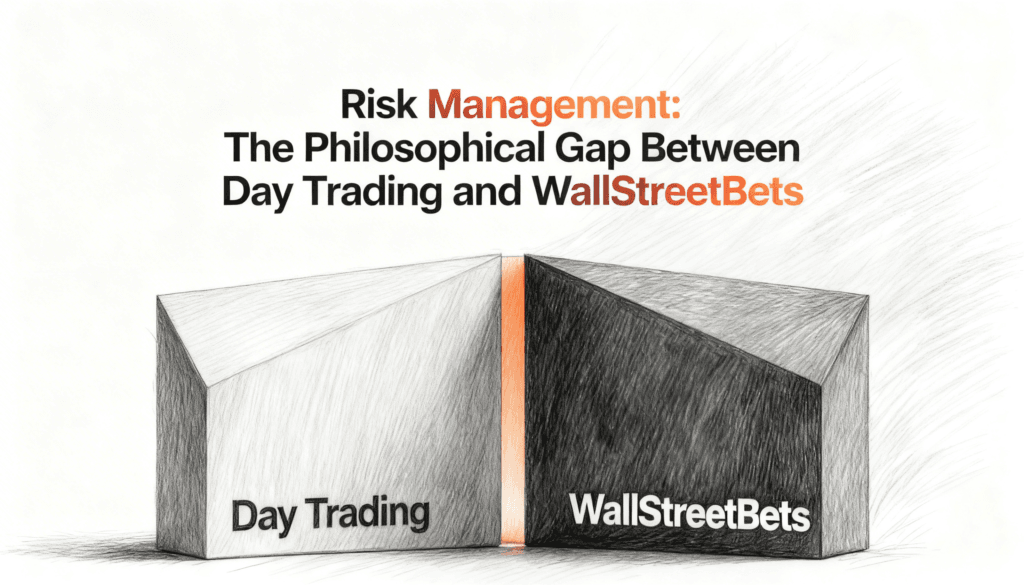
Day traders and WallStreetBets participants are often mistaken for the same people. From the outside, they look similar. Both stare at screens. Both make short term trades. Both post results online. But the philosophical distance between these two groups is enormous. It is the difference between a surgeon and someone who just grabbed a scalpel because it looked cool.
This is not really a clash about strategy. It is a clash about whether controlling your outcomes is even possible.
The Church of the Stop Loss
Day trading culture is built on a specific belief: that risk can be measured, managed, and contained. Every trade has a plan. Every plan has an exit. Every exit has a number attached to it before the trade even begins. The stop loss is not just a tool. It is a worldview.
This is a community that talks about risk to reward ratios the way theologians talk about scripture. A two to one ratio is acceptable. Three to one is better. Anything below one to one is a sin. The entire framework assumes that you will be wrong often, and that the system works anyway because the wins are bigger than the losses.
There is something almost Stoic about it. Day traders accept that they cannot control the market. They can only control their response to the market. The good trade is not the one that makes money. The good trade is the one that followed the rules. You can lose money and still have traded well. You can make money and still have traded poorly.
This is a genuinely unusual way to think about success. In almost every other area of life, results are the measure. In day trading culture, process is the measure. The results are just a byproduct.
The Cathedral of YOLO
WallStreetBets operates on a completely different set of assumptions. Risk is not something to be managed. It is something to be embraced, paraded, and if possible, maximized. The entire culture runs on a rejection of caution that would give any financial advisor chest pains.
The logic, and there is a logic, works like this: if you are starting with a small amount of money, conservative strategies will never produce life changing returns. A careful ten percent annual gain on five thousand dollars gets you nowhere meaningful in any time frame that matters. So why bother being careful? The only path to a different life is a wildly asymmetric bet. And wildly asymmetric bets require wildly asymmetric risk.
This is not ignorance. Or at least, it is not always ignorance. It is a calculated rejection of moderation based on a clear eyed assessment of starting position. When someone on WallStreetBets puts their entire account into a single options trade, they are not unaware that they might lose everything. They are saying that “everything” was not enough to matter anyway.
There is something almost existentialist about it. If the safe path leads nowhere, then the risky path is the only rational choice, even if it probably fails. The absurdity is the point.
The Psychology Nobody Talks About
Here is where things get counterintuitive. Day traders, for all their discipline, are often more stressed than WallStreetBets traders. The constant monitoring, the rigid rules, the need to be right about timing multiple times per day. It produces a specific kind of anxiety that is less about money and more about performance.
Day traders are essentially taking a test every single market day. And it is a test where a seventy percent failure rate is considered excellent. Imagine going to work knowing you will fail most of the time and calling that a good system. The psychological toll of disciplined trading is one of the least discussed aspects of the culture. The rules protect your account. They do not protect your nervous system.
WallStreetBets, by contrast, has solved the stress problem through what might be the most creative psychological mechanism in all of finance: they turned losing into content. A massive loss is not a failure. It is a post. It is entertainment. It is social currency. The community literally awards people for spectacular wipeouts with the same enthusiasm it reserves for spectacular wins.
This is not a small thing. What WallStreetBets accidentally built is a social structure that removes shame from financial loss. And shame, more than the money itself, is what destroys most traders psychologically. The day trader who blows up an account hides it. The WallStreetBets user who blows up an account screenshots it. Same financial outcome. Radically different emotional outcome.
Control as Illusion, Chaos as Honesty
The deeper philosophical tension here is about whether control is real or performed.
Day trading culture insists that discipline creates edge. Follow the rules, manage the risk, respect the stop losses, and over time, the probabilities work in your favor. It is an appealing narrative. It is also one that the data does not strongly support. Studies consistently show that the vast majority of day traders lose money over any meaningful period. The discipline is real. The edge it supposedly creates is questionable.
WallStreetBets, whether intentionally or not, might be more honest about this reality. If most people are going to lose money trading no matter what they do, then at least lose it in a way that is interesting. The refusal to manage risk is not just recklessness. It is a response to the possibility that risk management in short term trading is largely theater.
The Survivorship Problem
There is a detail that both communities would rather not examine too closely. The visible members of each group are overwhelmingly the survivors.
The day traders you see teaching courses, posting on YouTube, and sharing daily results are the ones who made it through the period where most people quit. For every profitable day trader with a following, there are dozens who followed the same rules, applied the same discipline, and still blew up. You do not hear from them because they left.
WallStreetBets has the same issue, just louder. The legendary gains that define the culture are statistical outliers celebrated as if they were replicable strategies. For every person who turned ten thousand into a million on a single options trade, there are thousands who turned ten thousand into zero. The difference is that on WallStreetBets, both outcomes get upvoted.
This is the dark symmetry between the two cultures. Day trading sells the idea that process guarantees outcomes. WallStreetBets sells the idea that outcomes can happen without process. Both are telling you a version of the truth that conveniently leaves out the base rate of failure.
Where This Actually Matters
The practical difference between these philosophies shows up in longevity. Day traders who survive tend to survive for a long time. The discipline, even if it does not create the edge they think it does, at least prevents catastrophic single day losses. The career of a disciplined day trader ends with a slow bleed, not an explosion.
WallStreetBets participants tend to cycle. They blow up, reload, blow up again, and eventually either stop or accidentally learn risk management through sheer repetition of pain. Getting obliterated a few times turns out to be a surprisingly effective, if expensive, education.
There is a parallel in how people learn to cook. Some start with recipes and measurements and technique, and gradually develop intuition. Others start by burning things and making terrible meals and slowly figure out what not to do. Both paths can produce a good cook. The recipe followers are more consistent. The experimenters sometimes stumble on something genuinely original.
The Real Question
The gap between day trading and WallStreetBets is ultimately about a question that extends far beyond finance: is it better to manage what you can control, or to accept that control is limited and act accordingly?
Day trading says manage. WallStreetBets says accept.
The mature answer is probably some blend of both. Understand risk. Respect it. But also recognize that the appearance of control can be as dangerous as the absence of it. The trader who is so disciplined that they never take a meaningful position is just as stuck as the one who bets everything on a single trade. One is frozen by caution. The other is destroyed by its absence.
The most interesting people in finance are the ones who have internalized both philosophies. They know the rules of risk management. They also know that sometimes the rules are a security blanket for adults. They plan their trades, but they do not pretend that the plan makes them safe. They just make it slightly less likely that tomorrow is a disaster.
That might not make for great internet content. But it makes for a longer career.