Table of Contents
There is a particular kind of investor who reads annual reports the way other people read novels. They underline passages. They make notes in the margins. They develop opinions about the chief executive based on the tone of the shareholder letter. These people are not day traders. They are not meme stock tourists. They are fundamental investors, and they believe that somewhere inside a company’s financial statements lies a truth that the market has not yet priced in.
What most outsiders do not realize is that these quiet readers of balance sheets are actually divided into two tribes who barely speak the same language. One tribe hunts for quality. The other tribe hunts for bargains. And while they both claim to be doing the same thing, which is buying businesses rather than tickers, they are really answering two very different questions about what investing is supposed to feel like.
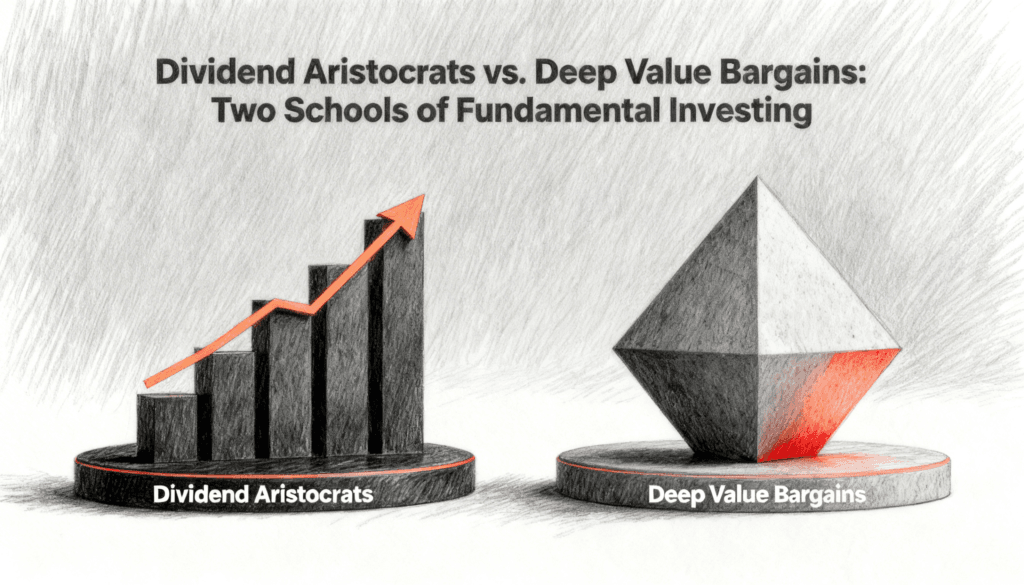
The aristocrats and their admirers
The first tribe loves dividend aristocrats. These are companies that have raised their dividend every year for at least twenty five years, through recessions, wars, oil shocks, and the occasional decade where nothing made sense. Think of the kind of business that makes toothpaste, soda, insurance, or industrial paint. Nothing exciting. Nothing you would brag about at a dinner party. Just a long, uninterrupted record of sending checks to shareholders and slightly increasing the amount each year.
The people who buy these companies are not looking for a moonshot. They are looking for what you might call financial furniture. You want it to be solid, well made, and still there in thirty years. A dividend aristocrat investor is essentially saying: I do not need to be clever. I just need to own something that has already proven it can survive the clever people.
There is an almost monastic quality to this approach. The aristocrat investor rarely sells. They reinvest the dividends. They watch the income slowly grow. They find beauty in a company that has raised its payout for forty consecutive years, because that streak is a kind of evidence that discipline still exists somewhere in the corporate world. If you squint, this is less about money and more about faith in institutions that behave predictably. In a world where everything feels like it is falling apart or being disrupted, a boring consumer goods company that has paid shareholders without fail since before the Vietnam War starts to feel like a piece of the old world you can still hold onto.
The bargain hunters and their strange joy
Now meet the other tribe. The deep value investors. These people are not looking for quality. They are looking for cheapness. Specifically, they are looking for companies that are trading for less than what their assets would be worth if you simply broke them up and sold the pieces. A factory. A piece of land. A pile of cash on the balance sheet that, for some reason, the market has decided to ignore.
Deep value investing has a specific emotional flavor that is hard to describe unless you have felt it. It is the joy of finding a twenty dollar bill on the floor of a room full of people who are too busy staring at their phones to notice. The deep value investor walks into that room and thinks: how is nobody else seeing this. Then they pick it up. Then they wait, sometimes for years, for everyone else to notice.
Where the aristocrat investor wants a company that will never need to be thought about again, the deep value investor wants a company that nobody is currently thinking about at all. These are often ugly businesses. Forgotten industrials. Regional banks in depressed parts of the country. Holding companies with confusing structures. Things that make your eyes glaze over when you try to explain them to a friend. That glaze is part of the point. The glaze is what keeps the price low.
If the aristocrat investor is a monk, the deep value investor is more like an archaeologist. They dig through the financial equivalent of dusty ruins looking for something that has been mispriced by history. They do not want companies that look good. They want companies that look terrible but are secretly fine.
Why they cannot stand each other
Here is where it gets interesting. To the aristocrat investor, deep value looks like masochism. Why would you buy a mediocre company just because it is cheap, when you could own a great company that has already proven itself? The answer from deep value, delivered with a slightly smug expression, is that great companies are almost never cheap. By the time everyone agrees that a company is wonderful, you are paying for that wonderfulness. And if anything goes wrong, you have no margin of safety, which is the phrase deep value people use the way other people use please and thank you.
The aristocrat investor finds this infuriating, because deep value seems to ignore the fact that great businesses compound over time in ways that mediocre businesses cannot. Buying a cheap but declining business is, in their view, picking up pennies in front of a steamroller. Sure, you got the pennies. Enjoy them.
Deep value investors, for their part, see the aristocrat crowd as a group of people who have confused comfort for insight. They did not find an edge. They found a security blanket. And security blankets, however nice they feel, do not tend to produce the kind of returns that actually change your life.
Both sides have a point. That is what makes the argument so durable.
What this is really about
Strip away the spreadsheets and what you are left with is a disagreement about how to deal with uncertainty. The aristocrat investor deals with it by buying things that have a long history of surviving it. The deep value investor deals with it by buying things so cheap that it almost does not matter if they survive or not, because the price already assumes the worst.
These are actually two ancient strategies dressed up in modern clothing. They show up everywhere humans make decisions under uncertainty. In dating, one person picks the partner with the long track record of being reliable, and another picks the overlooked one nobody else saw the potential in. In hiring, one manager wants the candidate from the prestigious company, and another wants the candidate with the weird resume who is being undervalued by the market. Both can work. Both can fail. The difference is mostly about where you feel most comfortable being wrong.
This is the part that almost nobody admits out loud. The choice between dividend aristocrats and deep value is not really a choice about which approach produces better returns. Over long stretches of history, both have had their moments, and both have had their decades of underperformance where their believers had to sit through a lot of teasing. The choice is actually about which kind of wrongness you can emotionally survive.
Can you survive buying a boring high quality company and watching it go nowhere for ten years while your friends make fortunes in technology stocks you refused to touch? That is the aristocrat investor’s specific flavor of suffering. Can you survive buying something ugly and cheap and watching it get even cheaper while everyone around you asks why you own it? That is the deep value flavor. Neither is easy. Both require a personality type that is frankly uncommon.
The counterintuitive part
Here is the thing almost nobody mentions. The two approaches often end up meeting in the middle at exactly the wrong moment. When a dividend aristocrat finally cuts its dividend after forty years, it stops being an aristocrat overnight. It gets kicked out of the club. Its loyal long term holders sell in a panic. And then, sometimes within weeks, the deep value crowd shows up and starts buying it, because now it is cheap enough to interest them.
You end up with the strange situation where the same company passes from one tribe to the other at the exact moment when both tribes are feeling most certain they are right. The aristocrats are sure it has become uninvestable. The bargain hunters are sure it has finally become investable. Neither of them is looking at the business. They are both looking at the story they have told themselves about what kind of business they own. The business itself has not changed much from the week before.
This is the quiet lesson that unites the two schools even as they argue. Fundamental investing is not really about fundamentals. It is about having a consistent framework for deciding what you will own and, more importantly, when you will refuse to own it. The framework is the product. The stocks are just the raw material.
What you should take from all this
If you find yourself drawn to one school more than the other, pay attention to why. The aristocrat path suits people who want investing to be something they do not have to think about often and who find comfort in stability. The deep value path suits people who enjoy being early, being lonely, and being occasionally vindicated after a long wait. Neither is better. They are just answers to different questions about your temperament.
The worst mistake is trying to be both at once. People who pretend to be deep value investors while secretly wanting the emotional comfort of owning high quality companies tend to buy things that are neither cheap enough nor safe enough. They end up in the middle, which in investing is almost always the worst place to be. The aristocrats and the bargain hunters at least have the dignity of knowing what they signed up for.
The quiet readers of annual reports will keep arguing with each other for as long as there are annual reports to read. They should. The argument is the thing that keeps both sides honest. Without the bargain hunters asking whether that lovely aristocrat has become overpriced, the aristocrat investors would drift into paying any price for comfort. Without the aristocrat investors reminding the bargain hunters that some businesses really are better than others, deep value would become an endless search for cigar butts that turn out to be wet.
The most interesting investors usually have a foot in both worlds, even if they will not admit it. They buy quality when quality gets temporarily mispriced. They buy cheap only when cheap still has some underlying reason to exist. They are, in other words, holding both schools in mind at once and picking the moments when the schools briefly agree. Those moments are rare. That is probably why the people who find them tend to do very well.