Table of Contents
There is a particular kind of investor who speaks about dividends the way medieval peasants spoke about the king’s grain. With reverence. With gratitude. As if the cash appearing in their brokerage account every quarter is a gift, a bonus, a little something extra on top of whatever the stock itself happens to do.
This is one of the most expensive misunderstandings in personal finance, and it is everywhere. It hides inside YouTube thumbnails promising passive income. It animates entire subreddits. It powers a small industry of newsletters, ETFs, and books built around the idea that you can simply collect cheques forever and never touch the principal.
The problem is not that dividends are bad. Dividends are fine. The problem is that millions of people have convinced themselves dividends are something they are not, and that belief shapes their portfolios, their taxes, and ultimately their wealth in ways they do not see.
Let us walk through why.
The Magic Trick That Is Not Magic
Imagine you own a small bakery. The bakery is worth one hundred thousand dollars. One day you decide to take five thousand dollars out of the till and put it in your personal pocket. Are you richer?
Of course not. You now have five thousand dollars in cash and a bakery worth ninety five thousand dollars. The total is unchanged. You simply moved money from one pocket (the business) to another pocket (yourself).
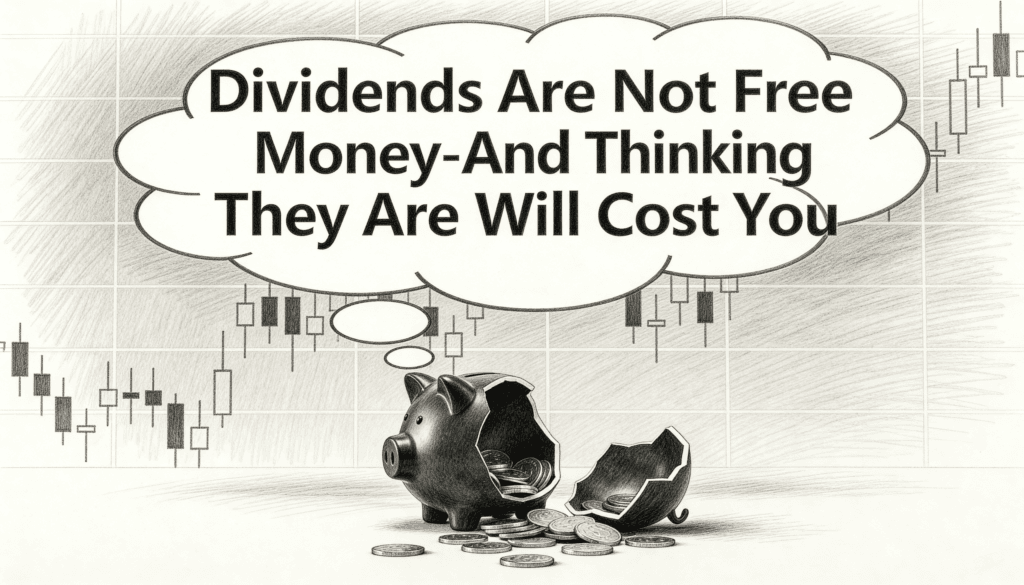
A dividend is exactly this. When a company pays you a dollar per share, that dollar comes from somewhere. It comes from the company’s cash reserves. The company is now worth one dollar per share less than it was the day before. This is not a theory or an opinion. It is mechanical. Stock exchanges actually mark the share price down on the ex dividend date to reflect this. The market is not confused about what happened. Only the investor is.
And yet the language we use around dividends pretends otherwise. We say things like “the stock paid me.” We talk about “income.” We speak as if the dividend appeared from nowhere, like a tip from a generous universe. But you did not get paid. You got handed a portion of your own equity in cash, and the market adjusted the value of what remained accordingly.
This is the heart of the misunderstanding. People treat dividends as additive when they are, in the strictest accounting sense, a transfer.
Why The Illusion Is So Sticky
If the math is this clean, why do so many people get it wrong?
Because human beings did not evolve to think in spreadsheets. We evolved to think in stories, and the dividend story is a beautiful one. It feels like ownership. It feels like the company is acknowledging you, sending a little envelope of thanks every quarter. It feels like the kind of thing a wise grandfather would have done, back when men wore hats and stocks were stocks.
There is also a deep psychological comfort in receiving cash. Behavioural economists have a name for this. They call it mental accounting. We put money into different mental buckets and treat them differently even when they are economically identical. A dollar earned from selling a share feels like you are eating your seed corn. A dollar received as a dividend feels like a harvest. Same dollar. Different story. Different feeling.
This is not a small bias. It is the entire foundation of the dividend industry. Companies know it. Funds know it. They have built marketing around the emotional difference between two things that are, on a balance sheet, exactly the same.
The Tax Bill You Did Not Need To Pay
Here is where the illusion stops being merely philosophical and starts becoming financially expensive.
When a company pays you a dividend, in most jurisdictions you owe tax on it. Right now. This year. Whether you wanted the cash or not. The company decided for you, and the taxman is happy to collect.
Contrast this with the alternative. Imagine the company had simply kept that cash and reinvested it, or used it to buy back its own shares. The share price would reflect that retained value. You would still own the same percentage of the company. But you would not owe a cent in tax until you decided to sell, on a date of your own choosing, in an amount of your own choosing, possibly years or decades later when your tax situation might be more favourable.
A dividend is a tax event the company has imposed on you without asking. If you do not need the income, you are paying taxes today on money that could have compounded untouched for another twenty years. Over a long enough time horizon, this drag is not trivial. It is the difference between arriving at retirement comfortable and arriving at retirement wealthy.
The retiree who needs income from their portfolio at least has a reason to want dividends, though even they could simply sell a small portion of shares periodically and accomplish the same thing with more control. The thirty five year old reinvesting dividends in a taxable account is paying tax every year for the privilege of receiving their own money and immediately handing it back to the company. It is the financial equivalent of taking water out of the pool, getting taxed on it, and then pouring it back in.
The Quality Question
There is a second, more subtle problem. Dividends shape behaviour at the company level too, and not always for the better.
When a company commits to a dividend, it has effectively made a promise to its shareholders. Cutting that dividend is treated as a confession of failure. The stock gets punished. Management gets blamed. So companies will go to extraordinary lengths to keep the dividend intact, even when their business no longer justifies it.
This sounds noble. In practice it can mean borrowing money to pay the dividend. It can mean cutting research budgets. It can mean delaying necessary investments. It can mean a slow erosion of the very business that produced the dividend in the first place, all to maintain the appearance of stability for a particular kind of shareholder.
The dividend is not always a sign of strength. It could be a signal that management could not think of anything better to do with the cash.
The Investor As Tenant Versus The Investor As Owner
Here is a way to think about it that might be useful.
When you focus on dividends, you are behaving like a tenant. You care about the rent cheque. You watch the mailbox. You judge the quality of the building by whether the cheque clears.
When you focus on the underlying business, you are behaving like an owner. You care about whether the building is appreciating, whether the neighbourhood is improving, whether the structure is sound. The rent is one feature of ownership, not the point of it.
Both can be valid mindsets in different contexts. The retiree drawing from a portfolio is genuinely in tenant mode and that is appropriate. But the accumulator, the person still building wealth, is often paying a real cost to feel like a landlord when they could be acting like a developer.
The dividend mindset narrows your universe. It excludes from consideration many of the best businesses in the world simply because they choose to reinvest rather than distribute. It rewards mature companies in slow industries and punishes the ones still growing. It is a filter that pretends to select for quality but often selects for age.
A Quiet Test
If you are not sure where you stand, try this thought experiment.
Suppose you hold a stock that pays a four percent dividend, and tomorrow the company announces it will stop paying dividends entirely and reinvest the cash into the business. The market reacts neutrally. The share price does not move much because everyone understands the money is still in the company, just deployed differently.
How do you feel?
If your first reaction is disappointment, anger, or a desire to sell, you have just learned something important about yourself. You were not invested in the business. You were invested in the cheque. The cheque was the point. The business was scenery.
This is fine if you are honest about it, but it is worth being honest about it. Because investing for the cheque rather than the business changes everything. It changes what you buy. It changes how you measure success. It changes how you respond to news. And in most cases, especially over long horizons and in taxable accounts, it leaves real money on the table.
What To Do With This
None of this is an argument against ever owning a dividend paying stock. Many wonderful businesses pay dividends. Some of them pay growing dividends for decades because they genuinely have more cash than they can productively reinvest, which is itself a sign of a strong business. The argument is not against dividends. It is against the framing.
If you believe dividends are free money, you will chase them. You will buy companies for their yield rather than their quality. You will pay taxes you did not need to pay. You will avoid better businesses because they do not send you a quarterly thank you note. And you will feel virtuous the entire time because you are following advice that sounds prudent and old fashioned and safe.
The investor who understands what a dividend actually is can still own dividend paying stocks. They just own them for the right reasons. They do not confuse a return of their own capital with a return on it. They do not let a quarterly cheque distract them from the larger question of whether the business is actually growing in value.
The dividend is not a gift. It is not extra. It is your money being handed back to you, often with a tax bill attached, by a company that has decided, on your behalf, that it could not find a better use for the cash. Sometimes that is a wise decision. Sometimes it is not. Either way, treating it as found money is the most expensive kind of gratitude there is.
Stop thanking the mailbox. Start asking what the building is worth.