Table of Contents
The same metric. The same formula. Enterprise value divided by revenue. Simple enough that a first year analyst can calculate it, dangerous enough that it has destroyed billions in capital when applied without thinking.
EV/Revenue is one of the most popular valuation shortcuts in finance. It tells you how much the market is willing to pay for every dollar a company brings in the door. And on the surface, it looks like a universal tool. A Swiss Army knife for valuation. Plug in the numbers, compare companies, make a decision.
But here is the thing about Swiss Army knives. They are decent at many tasks and perfect for none. And EV/Revenue is worse than that. Because it is not just imperfect across sectors. It is actively misleading when you drag it from one industry to another without understanding what revenue actually means in each context.
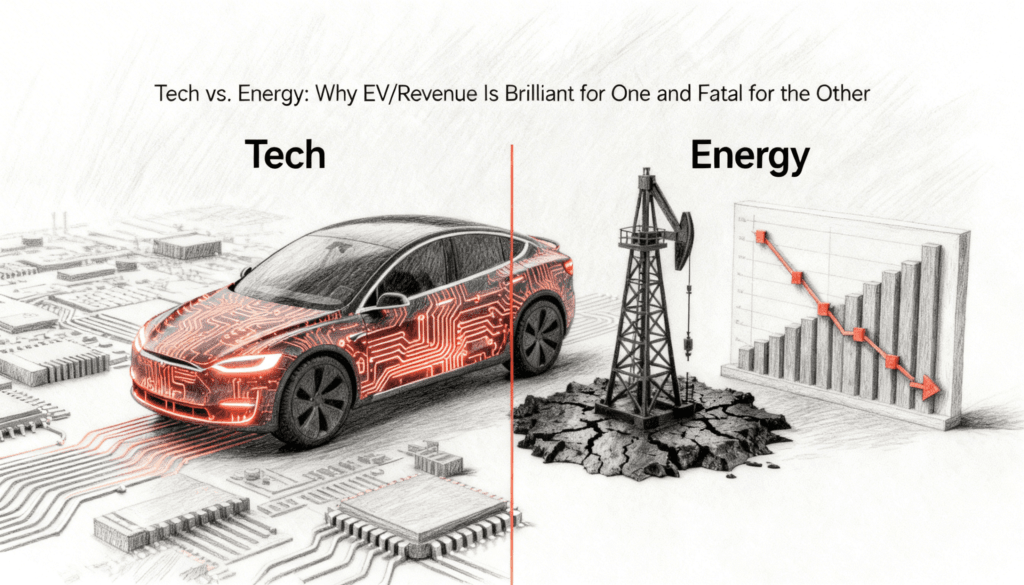
In technology, EV/Revenue is arguably the single best starting point for valuation. In energy, it is a trap dressed in clean formatting.
Let us talk about why.
What Revenue Actually Tells You
Before we compare industries, we need to step back and ask a question that most people skip entirely. What does revenue represent?
Revenue is not profit. It is not cash flow. It is not value created. Revenue is just the top line. The gross number that came through the door before anyone paid the electric bill, the employees, the suppliers, or the tax authorities.
The reason this matters is that revenue carries very different information depending on the business model underneath it. A dollar of revenue at a software company and a dollar of revenue at an oil refinery are not the same economic event. They do not carry the same margins, the same durability, the same capital requirements, or the same relationship to future earnings.
When you use EV/Revenue, you are implicitly saying that revenue is a reasonable proxy for value. And whether that assumption holds depends entirely on the economics of the business you are looking at.
Why EV/Revenue Works in Tech
Technology companies, particularly software and platform businesses, have a feature that makes EV/Revenue almost elegant: gross margins that would make other industries weep.
A typical SaaS company operates with gross margins somewhere between 70 and 85 percent. That means for every dollar of revenue, roughly 75 cents or more is left over after covering the direct cost of delivering the product. The marginal cost of serving an additional customer is often close to zero. The software was already built. The servers are already running. The next user is nearly free.
This changes everything about how revenue should be interpreted. When gross margins are that high, revenue becomes a remarkably clean signal. It is almost a proxy for gross profit, which is almost a proxy for the cash generating potential of the business. The distance between revenue and real economic value is short.
There is another reason EV/Revenue shines in tech. Many of the most valuable software companies are not yet profitable. They are reinvesting aggressively in growth, spending heavily on sales and engineering, and intentionally running at a loss. If you tried to value them on earnings, you would get a negative number or something nonsensical. EV/Revenue sidesteps this problem neatly. It lets you compare companies that are at different stages of maturity without getting tripped up by the timing of when they choose to flip the profitability switch.
And that switch is real. The history of enterprise software is full of companies that ran at a loss for years, then suddenly revealed staggering profit margins once they slowed down their growth spending. The revenue was always there. The margins were always there. The profits were just deferred by choice.
This is what makes EV/Revenue so powerful in tech. Revenue is sticky, high margin, and often recurring. It carries a high information density about the future economics of the business. Paying 15 or 20 times revenue for a fast growing SaaS company with 80 percent gross margins is not the same as paying 15 times revenue for a gas station. The number is the same. The reality is not even close.
Why EV/Revenue Fails in Energy
Now let us cross the street to the energy sector. Same formula, completely different world.
An integrated oil company or a refiner might report billions in revenue. Enormous top line numbers that dwarf most tech companies. But those numbers are deceptive. Because in energy, revenue is not a signal. It is noise.
Consider what happens when an oil company sells a barrel of crude. The revenue looks impressive on the income statement. But the cost of extracting that barrel, transporting it, refining it, and delivering it to market eats up the vast majority of that number. Gross margins in energy are thin. Net margins are thinner. A refinery operating at a five percent net margin is considered to be doing well. Some years, margins go negative.
This means that revenue in energy is mostly a pass through. The company collects a large number on top and hands most of it right back to suppliers, workers, equipment costs, and the ground itself. The informational content of that revenue figure is low. It tells you almost nothing about how much value the business is actually creating or retaining.
Using EV/Revenue in this context is like judging a restaurant by the total dollar amount on all its receipts without checking whether it can afford to keep the lights on. A restaurant doing ten million in annual sales sounds impressive until you learn that nine and a half million goes to rent, food costs, and labor. The revenue number is real. It is also almost meaningless as a measure of value.
Energy companies also face a problem that barely exists in software: commodity exposure. Revenue in energy is largely a function of oil and gas prices, which the company does not control. A tech company with a strong product can raise prices. A SaaS business with high switching costs can retain customers through downturns. An oil producer is a price taker. When crude drops, revenue drops, and there is nothing management can do about it except hedge and hope.
This makes EV/Revenue doubly misleading. Not only are the margins thin, but the revenue itself is unstable. You are paying a multiple on a number that could shrink by 15 percent next quarter because of a decision made in Riyadh or a slowdown in Shanghai.
The Margin Gap Is the Whole Story
If you want to understand why the same metric works in one place and fails in another, you only need to understand one concept: the margin structure tells you how much information is embedded in the revenue line.
High margin businesses compress a lot of economic truth into revenue. Low margin businesses spread it out across the entire income statement. In high margin companies, revenue is the story. In low margin companies, revenue is just the opening line before the actual plot begins.
This is why experienced energy investors tend to focus on metrics like EV/EBITDA, price to cash flow, or reserve based valuations. These metrics cut through the noise of the top line and get closer to what the business actually generates. They respect the reality that in energy, the action happens below revenue.
Tech investors, by contrast, can afford to stay at the top of the income statement because there is not that much distance between the top line and the economic substance of the business. The journey from revenue to value is a short walk. In energy, it is an expedition.
A Borrowed Lens from Ecology
There is a concept in ecology called trophic efficiency. It describes how much energy is transferred from one level of a food chain to the next. When a deer eats grass, it only absorbs about ten percent of the energy stored in that grass. The rest is lost to metabolism, heat, and waste. A wolf eating the deer faces the same loss. At each level, most of the energy disappears.
Businesses work the same way. Revenue enters at the top, and at each stage of the cost structure, value is lost. What matters is how much survives to the bottom. In tech, the trophic efficiency is extraordinarily high. Revenue passes through the system with minimal loss. In energy, the efficiency is low. Most of the revenue is consumed by the cost structure long before it reaches shareholders.
This framing also explains why markets are willing to pay high revenue multiples for tech and not for energy. Investors are not irrational. They are pricing trophic efficiency. A dollar of SaaS revenue that retains 80 cents of gross margin is simply worth more than a dollar of oil revenue that retains 15 cents. The multiple reflects the conversion rate, not a delusion.
The Trap of Cross Sector Comparisons
This brings us to one of the most common mistakes in casual investing: comparing EV/Revenue multiples across sectors and concluding that one is cheap and the other is expensive.
You will occasionally hear someone say that energy stocks trade at one or two times revenue while tech stocks trade at 15 or 20 times, and that this gap proves energy is undervalued. This reasoning sounds logical. It is also completely wrong.
Comparing EV/Revenue across sectors with fundamentally different margin structures is like comparing the price per kilogram of gold and the price per kilogram of sand. Both are measured in the same unit. Both are technically materials you can weigh. The comparison is still absurd because the value density of the two substances has nothing in common.
A low EV/Revenue multiple in energy is not a bargain signal. It is the market correctly pricing the fact that revenue in this sector does not convert efficiently into value. A high multiple in tech is not a sign of excess. It is the market correctly recognizing that software revenue carries an unusual amount of economic substance.
The mistake is treating the metric as absolute when it is deeply contextual.
When the Metric Turns Dangerous
The real damage happens when investors or analysts apply tech style EV/Revenue thinking to energy companies during boom times. When oil prices spike, energy companies report massive revenue growth. If you slap a tech multiple on that revenue, you get a valuation that looks transformative. People start talking about energy companies as growth stories. Capital flows in.
Then prices normalize. Revenue drops. The thin margins that were always there become visible again. And the investors who valued an oil producer like a software company discover that they bought a low margin, capital intensive, commodity exposed business at a price that assumed none of those things were true.
The reverse mistake is rarer but also real. Occasionally, investors dismiss a tech company as expensive based on EV/Revenue without appreciating the margin structure. They see a multiple of 25 and assume it must be overvalued, not recognizing that the business converts nearly all of that revenue into gross profit. The multiple looks high in absolute terms. Relative to what the revenue is actually worth, it might be perfectly reasonable.
The Deeper Lesson
The broader point here goes beyond any single metric. Valuation tools are not neutral instruments. They carry assumptions. And when those assumptions do not match the business being analyzed, the tool does not just become less useful. It becomes actively harmful. It generates confidence in the wrong direction.
EV/Revenue assumes that revenue is a meaningful proxy for value. In technology, that assumption largely holds. In energy, it largely does not. The metric itself is not good or bad. It is context dependent. And the failure to recognize context dependence is one of the most expensive errors in investing.
Every valuation framework is a lens. And every lens clarifies some things while distorting others. The skill is not in finding the perfect lens. It is in knowing which distortions each lens introduces and adjusting accordingly.
The next time someone quotes an EV/Revenue multiple, ask one question before anything else: what do the margins look like? If the answer is 80 percent, the multiple is probably telling you something real. If the answer is five percent, the multiple is telling you a story. And it is not a story with a happy ending.