Table of Contents
We’ve been here before, sort of. Remember when people thought a billion dollars was unfathomable wealth? Then we got used to billionaires. Then trillion dollar companies arrived and we shrugged. Now we’re staring at the possibility of a ten trillion dollar company, and the strange thing is how normal it already feels.
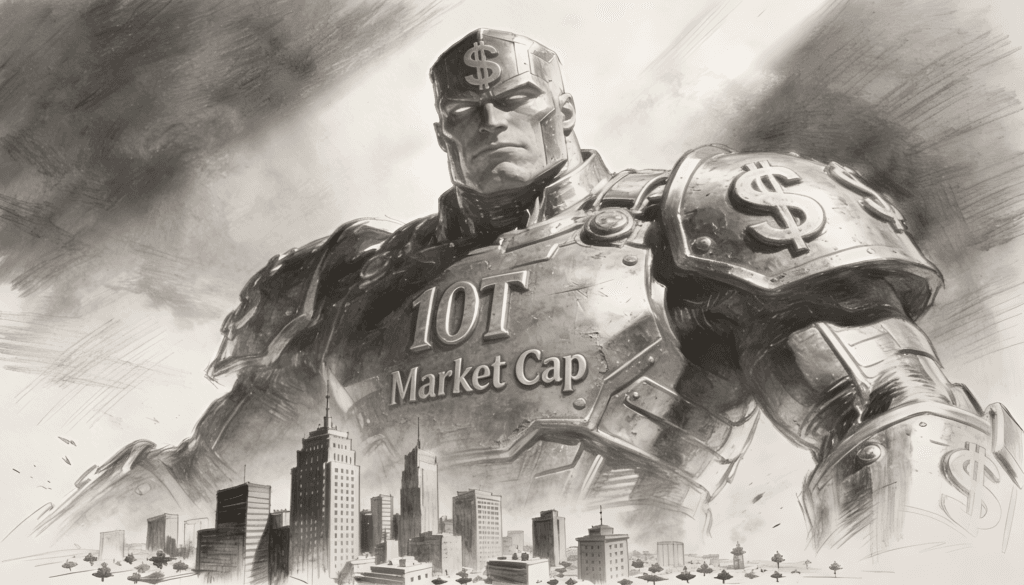
But it shouldn’t feel normal. A ten trillion dollar company isn’t just a bigger version of what we have now. It’s something categorically different, like the difference between a large lake and an ocean. The rules change. The physics change. And the economy around it has to change too.
The Gravity Problem
Think about gravity for a moment. A small object has gravity, technically, but you’d never notice it. A planet has enough gravity to hold an atmosphere. A star has enough gravity to crush atoms together and create fusion. Size doesn’t just add more of the same. It creates entirely new phenomena.
A ten trillion dollar company would have economic gravity so intense that it warps everything around it. Not because anyone planned it that way, but because mathematics doesn’t care about intentions.
Consider what this means in practice. Right now, the largest companies have market caps around three trillion dollars. They’re already massive. They already influence policy, shape culture, and move markets. But a ten trillion dollar entity would represent roughly 8% of global GDP. That’s not a company participating in an economy. That’s a company that essentially is a significant fraction of the economy.
The uncomfortable truth is that we don’t have good frameworks for thinking about this. Economic theory mostly assumes that no single player is large enough to move the whole game. That assumption breaks down here. It’s like trying to play chess but one player has a piece that can move anywhere on the board at will. You’re not really playing chess anymore.
The Talent Vortex
Here’s where it gets weird. A company approaching ten trillion dollars wouldn’t just employ a lot of people. It would fundamentally alter how talent flows through the entire economy.
Think about the best engineer, the best designer, the best marketer in their field. Where do they go? In a healthy economy, talent disperses. The best people scatter across thousands of companies, each betting on different visions of the future. This diversity of bets is how we innovate. It’s how we avoid putting all our eggs in catastrophically wrong baskets.
But a ten trillion dollar company can pay more. It can offer more resources. It can promise more impact. Most importantly, it can offer something subtler and more powerful: certainty. When you’re that large, you’re probably not going away. That stability becomes its own form of compensation.
The result is a kind of economic black hole for talent. Not because the company is evil or even trying to hoard talent, but because rational self-interest points everyone in the same direction. And suddenly you have thousands of the world’s smartest people all working on the same company’s vision of the future, while alternative futures go unexplored.
This should terrify us more than it does. The Soviet Union tried central planning with the economy and it failed spectacularly. A ten trillion dollar company wouldn’t be centrally planning the whole economy, but it would be centrally planning a large enough chunk that the distinction starts to blur.
The Innovation Paradox
You might think a ten trillion dollar company got there through innovation, so surely it would keep innovating. But this misunderstands the nature of innovation at scale.
Small companies innovate because they have to. They have no other competitive advantage. Large companies innovate despite their size, fighting against organizational inertia. But a company so large that it represents a meaningful percentage of the global economy faces a different calculation entirely.
Innovation is inherently destructive. It makes old things obsolete. When you’re small, you’re destroying someone else’s business. When you’re monumentally large, you’re threatening to destroy your own cash cows. The incentive structure inverts.
This is the dark irony of success. The company that innovated its way to ten trillion dollars would find that staying at ten trillion dollars requires not innovating too much. Not because leadership isn’t smart or ambitious, but because the mathematics of preservation overtake the mathematics of growth.
And here’s the really uncomfortable part: this might be optimal for the company but suboptimal for everyone else. We need creative destruction. We need old technologies to die so new ones can flourish. But a sufficiently large company has the power to extend the life of legacy technology far beyond its natural expiration date, simply because replacing it would be too disruptive to too many people.
The Regulatory Dilemma
Governments face an impossible situation with a ten trillion dollar company. Too small to regulate, the company runs roughshod over society. Too heavy handed with regulation, and you risk destroying enormous amounts of wealth and employment.
But there’s a deeper problem that doesn’t get enough attention. At a certain scale, the distinction between corporate policy and public policy becomes philosophical rather than practical.
When a company decides which speech is allowed on its platform, and that platform is where billions of people communicate, is that a private business decision or is it de facto governance? When a company’s internal carbon pricing influences its trillion dollar supply chain, is that corporate strategy or is it environmental policy?
The usual answer is that governments should step in and regulate. But this assumes governments are more powerful than the companies they’re regulating. That assumption worked when governments were clearly the largest entities in their economies. It becomes questionable when a single company rivals the economic output of all but the largest nations.
Some will say this is why we need stronger government. Others will say this is why we need to break up the company. Both responses miss the point. The challenge isn’t really about size. It’s about the fact that our institutional frameworks were built for a world where public and private were clearly separated. A ten trillion dollar company exists in the blurry space between.
The Dependency Trap
Perhaps the most underappreciated risk is dependency. Not just other companies depending on the giant company’s infrastructure, though that’s concerning enough. The deeper danger is cognitive dependency.
When one company is so successful for so long, its way of doing things becomes the way of doing things. Its assumptions become everyone’s assumptions. Its blind spots become systemic blind spots.
Consider Microsoft in the 1990s. It wasn’t nearly as large as we’re discussing, but it was dominant enough that the entire software industry oriented itself around Microsoft’s technology choices. Some of those choices were excellent. Some were mediocre. But because everyone built on the same foundation, we never really explored the alternatives. We didn’t know what we were missing because we stopped looking.
A ten trillion dollar company would have this effect on steroids. Entire sectors would structure themselves around serving it, complementing it, or at minimum, not threatening it. The opportunity cost wouldn’t be measured in dollars. It would be measured in futures that never got built because everyone was too busy building around the colossus.
The Succession Question
Let’s talk about something nobody wants to address. What happens when the leadership of a ten trillion dollar company changes?
In a normal company, succession is important but manageable. In a ten trillion dollar company, succession becomes a macroeconomic event. The new CEO’s philosophy on remote work affects global real estate markets. Their views on AI influence the entire technology sector’s direction. Their risk tolerance impacts capital allocation across the economy.
We’ve essentially recreated monarchy, but for a company instead of a country. And we have no good mechanism for ensuring peaceful, competent transition of power. Shareholders vote, theoretically, but the complexity of these organizations means they’re mostly voting on vibes and track record. The stakes are enormous. The information is limited. The democracy is more notional than real.
This gets worse when you consider that leadership transitions often involve strategic pivots. A new CEO wants to make their mark. They change direction. In a normal company, this is healthy creative destruction. In a company representing 8% of global GDP, this is potentially catastrophic volatility. How many trillions of dollars of market cap in other companies depends on assumptions about what the giant company will do next?
The Efficiency Trap
Here’s a counterintuitive thought. Maybe the scariest thing about a ten trillion dollar company isn’t that it would be inefficient and wasteful. Maybe the scariest thing is that it would be extremely efficient.
Efficiency sounds good. We celebrate it. But efficiency at scale can be terrifying. An efficient ten trillion dollar company would optimize its supply chain so thoroughly that thousands of smaller suppliers have no pricing power whatsoever. It would perfect its hiring algorithms so completely that entire universities restructure their curricula to feed into its pipeline. It would tune its recommendation systems so precisely that cultural trends become manufactured rather than emergent.
This isn’t dystopian sci-fi. This is just what happens when you have enough data, enough scale, and enough optimization power. You don’t need conspiracy. You don’t need evil intent. You just need mathematics and incentives, and suddenly the texture of daily life becomes smooth, predictable, and subtly controlled.
The irony is that this efficiency creates value, at least in the narrow economic sense. Prices fall. Conveniences multiply. Yet something important is lost. Maybe it’s randomness. Maybe it’s the friction that allows small players to survive. Maybe it’s just the feeling that life isn’t entirely calculated by an algorithm somewhere.
The Knowledge Problem
Friedrich Hayek won a Nobel Prize partly for explaining why central planning fails. The basic insight was that knowledge is distributed. No central planner, no matter how smart, can know everything that millions of people know locally about their specific situations.
A ten trillion dollar company doesn’t overcome this problem. It just hides it better.
The company has more data than any central planner in history. It has more computing power. It has smarter algorithms. But it still can’t know what it doesn’t know. It still makes decisions based on the information that flows up through its reporting structures. And the bigger it gets, the more layers those structures have, the more information gets compressed and simplified and stripped of context.
The result is that the company becomes simultaneously very powerful and very blind. It can move mountains, but it might be moving them in slightly the wrong direction and won’t notice until it’s too late. And because of its size, by the time it corrects course, enormous damage has been done.
Smaller competitors would normally exploit these blind spots. But in a world with a ten trillion dollar company, there might not be enough oxygen left for those competitors to survive long enough to prove the giant wrong.
The Currency Question
At some point, a ten trillion dollar company starts to behave less like a company and more like a currency.
Its stock becomes a store of value. Entire investment strategies revolve around it. Other companies measure their worth relative to it. It becomes the benchmark, the safe haven, the thing you rotate into when uncertainty rises.
This is convenient until it isn’t. Currencies need stability. Companies need the freedom to fail. These requirements contradict each other.
If the company stumbles, the portfolio damage is measured in tens of trillions across the global economy. Retirement accounts evaporate. Pension funds crater. The pressure to bail it out, to stabilize it, to protect it, becomes overwhelming. Not because we love the company, but because we can’t afford the alternative.
We’ve essentially created something too big to fail without ever explicitly deciding we wanted to create something too big to fail. It just happened, one quarterly earnings beat at a time.
What It Means for Everyone Else
The existence of a ten trillion dollar company changes what it means to be everyone else.
If you’re a startup, you’re no longer trying to build a great company. You’re trying to build something the giant company will want to acquire. The exit strategy overtakes the mission.
If you’re an employee somewhere else, you’re constantly wondering if you should just go work for the behemoth. The compensation is better. The resume line is unbeatable. The alternative feels like settling.
If you’re a government, you’re trying to regulate something that’s more powerful than you are in many practical ways. You can pass laws, but can you enforce them against an entity with more lawyers, more money, and more lobbying power than you have regulatory budget?
The metacognitive shift is that everything becomes relative to the giant. It’s not that the giant is doing anything to you directly. It’s that its existence reshapes the landscape so dramatically that your options change whether you interact with it or not.
The Path Not Taken
The saddest part might be what we’ll never know we missed.
Every dollar and every talented person that flows toward the ten trillion dollar company is a dollar and a person that doesn’t flow somewhere else. Every strategic decision it makes forecloses other paths. Every technology it chooses not to pursue withers from neglect.
We’ll never know what innovations would have emerged if those resources were distributed differently. We’ll never know which problems would have been solved. We’ll never know which futures were possible but never got built because everyone was too busy building toward the same giant gravitational center.
Economics calls this opportunity cost, but that clinical term doesn’t capture the weight of it. We’re not just missing specific opportunities. We’re missing entire possibility spaces.
Living in the Shadow
If we do end up with a ten trillion dollar company, we’ll probably adapt. Humans are remarkably good at adapting. The question isn’t whether we’ll survive. The question is who we’ll become in the process.
We’ll be more efficient, probably. More convenient. More optimized. But we might also be more homogeneous, more dependent, more constrained in ways we don’t quite notice until they’re already part of the background.
The final boss isn’t a company. It’s the question of what we’re willing to trade for the benefits that scale provides. And the uncomfortable truth is that we might never consciously make that trade. It might just happen, one incremental step at a time, until we wake up one day and realize the economy we inhabit is shaped more by one entity’s decisions than by the collective choices of millions.
That’s not necessarily dystopian. It might even work out fine. But it’s definitely different. And different in ways that our current frameworks for thinking about companies, markets, and economies aren’t quite equipped to handle.
The real final boss might be our own assumption that more of the same is just more of the same. Sometimes more becomes something else entirely. We’re about to find out if ten trillion dollars is that threshold.