Table of Contents
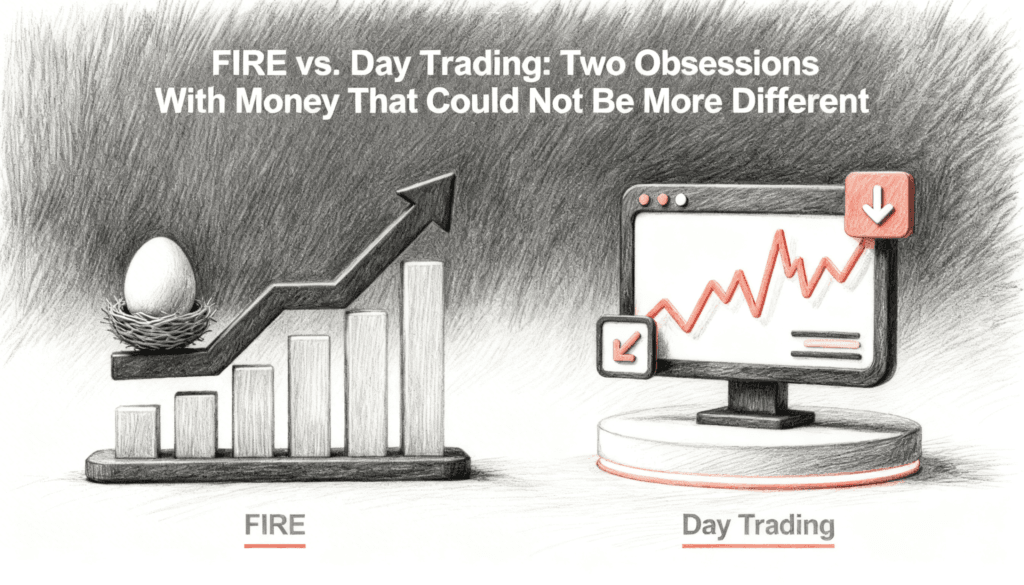
If you wanted to design two financial philosophies that occupy the exact same amount of mental real estate but point in completely opposite directions, you could not do better than FIRE and day trading. Both groups think about money more than the average person thinks about anything. Both have subreddits, YouTube channels, and spreadsheets that would make an accountant nervous. Both have built entire identities around their relationship with the market.
And yet one group is trying to stop thinking about money forever, while the other has made thinking about money their full time occupation. One is sprinting toward the exit. The other built a home inside the building.
This is not a disagreement about tactics. It is a disagreement about what money is for.
The Monk and the Gambler Walk Into a Brokerage
FIRE, Financial Independence Retire Early, is built on renunciation. Cut your expenses. Save an aggressive percentage of your income. Pour everything into index funds or dividend stocks. Hit a number, usually twenty five times your annual spending. Walk away from the workforce. Done.
The entire philosophy bends toward a single moment in time: the day you do not need money anymore. Everything before that day is preparation. Everything after is freedom. There is something almost monastic about it. Delayed gratification as a lifestyle. Frugality as a spiritual practice. The FIRE community talks about spending the way recovering addicts talk about their substance of choice. With caution, measurement, and the constant awareness that one wrong move could pull them back in.
Day trading is the photographic negative of this. It is not about escaping money. It is about engaging with it in real time, all the time, with full intensity. A day trader does not want to reach a number and walk away. A day trader wants to sit in front of screens and feel the pulse of the market every single morning. Where FIRE sees money as a tool to buy freedom from work, day trading sees money as the work itself. The process is the point.
There is a comparison outside of finance that maps onto this surprisingly well. FIRE practitioners are like people who meal prep every Sunday so they never have to think about food during the week. Day traders are like chefs who want to cook every meal from scratch because the cooking is what they love. Same ingredient. Completely different relationship with it.
What Each Side Gets Right That the Other Ignores
The FIRE community has internalized something genuinely profound: most people do not actually enjoy their jobs, and the financial system is designed to keep them working longer than they need to. The math behind FIRE is not complicated, but the insight is. You do not need to earn a fortune. You need to need less than you earn, consistently, for long enough. That is a radical idea in a culture that treats income as a number to spend up to rather than a number to save down from.
Day traders have internalized something different but equally valid: the market is not just a place to park money and forget about it. It is a living system with patterns, psychology, and exploitable inefficiencies. The idea that you can just ignore price movements for thirty years and come out fine is statistically true for index fund investors, but it also glosses over the fact that markets are made by people who are paying attention every second. Someone is on the other side of every trade. Day traders argue they would rather be the someone than the something being traded around.
Here is where it gets interesting. FIRE people are often accused of being obsessed with money, but their obsession is actually with time. Every dollar saved is a unit of future freedom. The spreadsheet is not about wealth. It is about counting down the days until work becomes optional. Day traders are accused of being obsessed with money too, but their obsession is actually with skill. The profit and loss statement is a scoreboard. The money is how they know if they are getting better at reading the market.
Neither side is being honest about what they are really chasing. And both sides would benefit from admitting it.
The Inconvenient Math
There is a number that haunts the day trading community, and it is not a stock price. Studies consistently show that the vast majority of retail day traders lose money over time. The exact percentage varies by study and market, but the direction does not. Most people who try to day trade for a living end up worse off than if they had simply bought an index fund and gone for a walk.
The FIRE community loves to cite this number. It validates everything they believe. Why would you play a game where most players lose when you could play the game where most players win, slowly and boringly, over decades?
But the FIRE community has its own inconvenient math that it does not love talking about. The standard model depends on assumptions about market returns, inflation, and withdrawal rates that have held up historically but are not guaranteed to hold up going forward. A person who retires at thirty five with a million dollars is making a bet that the next fifty years of market behavior will resemble the last fifty years. That is not a sure thing. It is a long, slow, diversified bet. But it is still a bet.
So both groups are gambling. One is gambling with leverage and candlestick charts on a Tuesday morning. The other is gambling with decades of compound interest and the assumption that the global economy will keep growing. The time horizons are different. The confidence levels are different. But the uncertainty is baked into both.
Identity as Investment Strategy
The deeper you look at FIRE and day trading, the more they start to resemble identity movements rather than financial strategies. FIRE has its own vocabulary, its own heroes, its own origin stories. People do not just practice FIRE. They are FIRE. They introduce themselves at parties with their savings rate the way CrossFit people used to introduce themselves with their deadlift numbers.
Day trading has the same dynamic but louder. The trading setup photo. The multiple monitor display. The morning routine content. The language of discipline, edge, and execution. Day traders do not just trade. They are traders. The identity comes first. The profits, if they come at all, come second.
This is not unique to finance. It is the same thing that happens in fitness, dieting, and productivity culture. The method becomes the meaning. You do not just run. You are a runner. You do not just eat plants. You are plant based. The strategy stops being something you do and starts being something you are. And once that happens, changing your mind becomes not a financial decision but an existential one.
This is why FIRE people and day traders do not just disagree. They find each other baffling. A FIRE practitioner looking at a day trader sees someone who has voluntarily chained themselves to the thing FIRE is trying to escape from. A day trader looking at a FIRE practitioner sees someone who has surrendered all agency over their financial life to an index fund and a hope that the future will be kind.
What They Could Learn From Each Other
FIRE could learn something from day trading about engagement. Not with the market, but with financial literacy in general. The FIRE community sometimes treats investing like a solved problem. Buy the index, do not look at it, wait. That works, but it also breeds a strange incuriosity about how markets actually function. Understanding what drives prices, what creates bubbles, what makes corrections happen. These are not distractions. They are part of being a genuinely informed investor rather than just a disciplined one.
Day trading could learn something from FIRE about exit strategies. The FIRE movement is obsessed with the endgame. What is the number? When do you stop? How do you know you have enough? Day trading culture almost never asks these questions. The implicit assumption is that you will trade forever, or at least until you make it big enough to stop. But “big enough” is never defined. The game has no natural ending. And a game without an ending is not a game. It is a treadmill.
If a day trader applied FIRE principles to their trading career, they would set a target, build toward it, and know exactly when to walk away. If a FIRE practitioner applied a trader’s curiosity to their portfolio, they would understand not just that their strategy works but why it works, and under what conditions it might stop working.
But neither side will do this. Because the point was never really about optimizing returns. It was about belonging to something.