Table of Contents
There is a phrase that gets repeated so often in finance that it has lost most of its meaning. Cash is king. People say it during downturns. They say it during rallies. They say it when they do not know what else to say. It has become the financial equivalent of “stay hydrated.” Technically correct, practically useless without context.
But here is the thing. Cash, by itself, is not a strategy. It is a starting point. The real question is not whether a company has cash. It is whether the company can keep producing it, how much of it is truly free, and what that stream of cash looks like relative to the price you are paying. That is where free cash flow yield enters the picture. And once you understand it, you start to see the entire investment landscape differently.
Not as a kingdom ruled by a single monarch, but as an ecosystem where the yield on free cash flow quietly determines who thrives and who merely survives.
The Difference Between Having Cash and Generating It
Imagine two restaurants. One has a vault in the back with a million dollars in it. The other has no vault, but every single night, it fills every seat, keeps costs tight, and deposits steady profit into the bank. Which one would you rather own?
Most people instinctively pick the second. And yet, when it comes to investing, many do the opposite. They fixate on balance sheet cash, on war chests, on how many billions a company is “sitting on.” That is like being impressed by someone’s savings account while ignoring whether they still have a job.
Free cash flow is the job. It is what a business produces after it has paid for everything it needs to keep running and growing. It is revenue minus all the real costs, including the capital expenditures that accountants love to hide in footnotes. When a company generates free cash flow, it has genuine economic profit. Not accounting profit. Not adjusted earnings. Actual money that can be returned to shareholders, used to pay down debt, or reinvested without borrowing a dime.
Cash on the balance sheet is a snapshot. Free cash flow is the movie.
The Metric That Quietly Outperforms
Here is something that should bother more people than it does. Over long stretches of market history, portfolios sorted by high free cash flow yield have tended to outperform portfolios sorted by other valuation metrics. Better than price to earnings. Better than price to book. Better than dividend yield.
Why does not everyone use it then?
Partly because it is less intuitive than earnings. Earnings are clean. They show up on headlines. Analysts forecast them to the penny. Free cash flow is messier. It requires you to think about capital expenditures, working capital changes, and the difference between what a company reports and what it actually produces. It demands more work, and markets consistently underprice things that demand more work.
There is also a behavioral component. Investors love stories, and earnings are easier to build stories around. A company “beat earnings” is a headline. A company “generated a free cash flow yield of nine percent on its enterprise value” is a footnote. But the footnote is often more predictive than the headline.
The irony is thick. The metric that is hardest to manipulate and most directly tied to shareholder value is the one that gets the least attention. Meanwhile, earnings per share, which can be massaged through share buybacks, accounting elections, and creative restructuring charges, gets treated like gospel.
What Free Cash Flow Yield Actually Tells You
Let us break this down without jargon.
If a company has a market capitalization of ten billion dollars and generates one billion dollars in free cash flow, its free cash flow yield is ten percent. That means for every dollar you invest in this company at today’s price, the business is generating ten cents of real, spendable, deployable cash per year.
Compare that to a government bond yielding four percent, or a savings account yielding five. The company with a ten percent free cash flow yield is, in purely mechanical terms, generating twice as much cash per dollar invested. Of course, it comes with more risk. But the comparison matters because it reveals something about relative value that no earnings multiple can show you.
The Hidden Tax of Growth
This is the part that makes some people uncomfortable. Growth, in many cases, is the enemy of free cash flow. At least in the short term.
When a company is growing rapidly, it typically needs to spend aggressively. New factories, new hires, new technology, new markets. All of that costs money. Capital expenditures rise. Working capital gets consumed. The top line looks spectacular, but the free cash flow statement tells a more sobering story.
This is not necessarily bad. Amazon famously ran on thin or negative free cash flow for years while building an empire. But it does mean that investors chasing high growth are often, without realizing it, accepting a lower free cash flow yield in exchange for the promise of a higher one later. That trade works brilliantly when the growth materializes. It is devastating when it does not.
The counter intuitive insight is this. Sometimes the most “boring” company with modest growth but a fat free cash flow yield is actually compounding wealth faster than the exciting company everyone talks about at dinner parties. The boring company can buy back shares, pay dividends, reduce debt, and make acquisitions, all from its own cash generation. The exciting company needs external capital, dilutes shareholders, and lives on the edge of execution risk.
The tortoise and the hare is not just a fable. It is a surprisingly accurate model for long term equity returns.
When High Yield is a Trap
A word of caution, because no metric is bulletproof. A high free cash flow yield can sometimes be a warning sign rather than an opportunity.
If a company is generating a lot of free cash flow because it has stopped investing in its own business, that yield is borrowed from the future. Think of a landlord who stops maintaining a building. For a few years, the cash flow looks fantastic. No repair costs, no renovation expenses. Then the roof caves in.
This is what makes investing an art layered on top of a science. The number alone does not tell you whether the cash flow is sustainable. You need to understand whether the company is harvesting its current position at the expense of its future one. Is it cutting research and development? Deferring maintenance? Running down inventory instead of restocking?
Free cash flow yield is the best single metric, but it is not a substitute for judgment. It is the starting point of the analysis, not the conclusion.
The Kingdom Metaphor, Extended
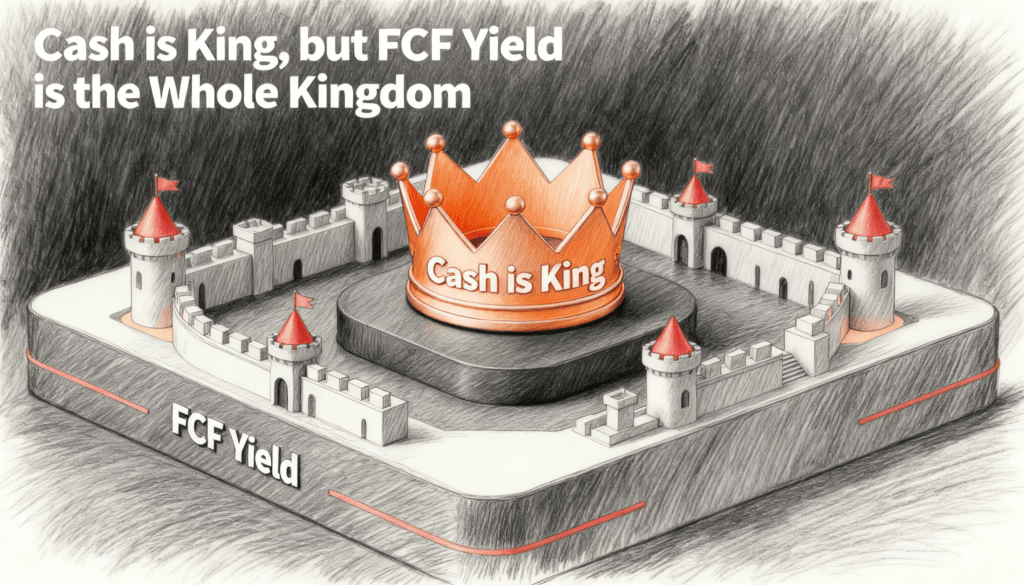
Let us return to the original metaphor, because it is more instructive than it first appears.
If cash is king, then free cash flow is the economy that sustains the kingdom. The king can sit on a throne of gold, but if the fields are not producing grain and the trade routes are not generating commerce, the kingdom will eventually fall. History is littered with empires that had vast treasuries and hollow economies. The gold in the vault does not matter if nothing is replenishing it.
Free cash flow yield, then, is the productivity of the kingdom relative to its size. A small, efficiently run city state with robust trade can be wealthier per capita than a sprawling empire bleeding resources across a thousand borders. Venice was once the richest place in Europe, not because it was the largest, but because its cash generation per unit of investment was extraordinary.
Companies with high free cash flow yields are the Venices of the market. They may not dominate headlines, but they tend to dominate returns.
Why This Matters More Now Than Ever
There is a structural reason to care about free cash flow yield more than usual in the current market environment. After more than a decade of near zero interest rates, capital was essentially free. Companies did not need to generate cash because they could borrow it for almost nothing. Growth at any cost was rewarded. Free cash flow was an afterthought.
That era is over. Borrowing costs money again. Capital has a price. And when capital has a price, the companies that generate their own have a structural advantage over those that depend on external funding.
This is a regime change, and it quietly reshuffles the winners and losers across every sector. The companies that looked smart when debt was cheap now look fragile. The companies that looked boring because they insisted on generating free cash flow now look prescient.
Markets are narrative machines, and the narrative is shifting. From “how fast can you grow” to “how much cash can you actually produce.” For anyone paying attention, free cash flow yield is the compass for this new terrain.
The Investor’s Takeaway
If you remember one thing from this piece, let it be this. The price you pay for a stream of cash flow is the single most important variable in long term investing. Not the brand. Not the story. Not the charisma of the CEO on a podcast.
Free cash flow yield captures this variable more honestly than any other metric. It cuts through accounting noise, strips away financial engineering, and asks the simplest and most important question in all of investing. How much real cash does this business generate, and what am I paying for it?
That question will never make a headline. It will never trend on social media. It is not exciting enough to discuss at parties.
But it is the question that separates people who build wealth from people who just talk about it. The king may get the crown, but the kingdom runs on what it produces. Always has. Always will.