Table of Contents
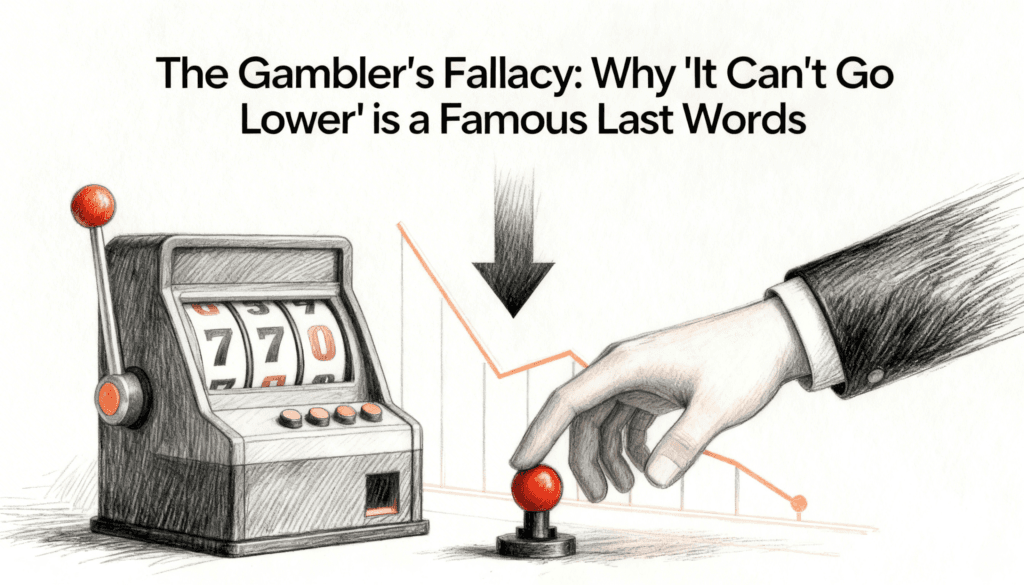
There is a particular kind of confidence that only shows up when someone is losing. You will not find it in the early stages of a trade gone wrong, when the loss is small and the ego still intact. It arrives later, after the position has bled for weeks, after the chart has become something you avoid looking at in public. That is when the voice appears. Calm, certain, almost rational. “It can not go lower than this.”
It can. It usually does. And the history of markets is, in many ways, a history of people who were absolutely sure they had found the floor.
The Coin Does Not Remember
The gambler’s fallacy is one of those ideas that sounds so simple you would think nobody falls for it. The concept is this: if a coin lands on heads five times in a row, people start to believe tails is “due.” The coin, of course, has no memory. It does not know what it did five seconds ago. Each flip is an independent event with the same odds it has always had. The universe does not keep a ledger of fairness.
And yet, something deep in the human brain refuses to accept this. We are pattern seekers by design. Evolution built us to notice sequences, to find signal in noise, to assume that if the bush rustled three times, something is probably in there. This was useful on the savannah. It is catastrophic in a brokerage account.
When investors watch a stock fall for six consecutive sessions, something shifts in their psychology. The decline itself becomes evidence that a reversal is coming. Not because of any change in fundamentals. Not because of a new catalyst. Simply because the streak feels too long. The logic, if you can call it that, goes something like this: things that go down eventually go up, this thing has gone down a lot, therefore it must go up soon.
This is not analysis. This is superstition wearing a blazer.
The Roulette Wheel at Monte Carlo
The most famous illustration of the gambler’s fallacy did not happen on Wall Street. It happened in a casino in Monte Carlo in 1913, and it is worth retelling because the sheer scale of collective delusion involved is almost artistic.
On August 18 of that year, the roulette ball at the Monte Carlo Casino landed on black twenty six times in a row. As the streak continued, gamblers began piling money onto red. Their reasoning was intuitive and completely wrong. Black had come up so many times that red was now, in their minds, practically guaranteed. They bet more and more aggressively as the streak lengthened, convinced that the laws of probability were building pressure like a spring. Millions of francs were lost.
The ball did not care. The wheel did not care. The casino, presumably, cared quite a bit, but only in the way that someone smiles when handed free money.
What happened at Monte Carlo was not a failure of intelligence. Many of those gamblers were wealthy, educated, worldly. It was a failure of intuition. Human beings have a deeply embedded sense that the universe trends toward balance. That extremes correct themselves. That what goes one way must, eventually, go the other.
In the physical world, this instinct often serves us well. Stretch a rubber band far enough and it snaps back. Swing a pendulum to one side and gravity pulls it the other way. But probability is not a rubber band. A stock price is not a pendulum. And markets have no obligation whatsoever to mean revert on your timeline.
When the Floor is Actually a Ceiling in Disguise
Here is where the gambler’s fallacy becomes genuinely dangerous in investing, as opposed to merely expensive at a roulette table. In a casino, your maximum loss on any single bet is the bet itself. In a portfolio, the losses compound. They interact. They metastasize.
Consider the investor who buys a stock at fifty dollars, watches it fall to forty, and decides to buy more because “it can not go much lower.” The stock falls to thirty. Now the investor has a larger position and a larger loss, but the conviction has actually grown stronger. After all, if it was cheap at forty, it must be a steal at thirty. More money goes in. The stock falls to twenty. Then to twelve. Then the company announces it is exploring “strategic alternatives,” which is corporate poetry for “we are in serious trouble.”
At no point during this decline did the falling price itself contain information about a future reversal. Each new low was simply a new price. But the investor experienced each drop as further evidence that a bounce was overdue, the way a gambler at Monte Carlo experienced each black as further proof that red was inevitable.
This is the trap. The fallacy does not just make you wrong. It makes you more committed to being wrong. It turns a bad position into an identity.
The Seduction of Averaging Down
Wall Street has a phrase for this behavior that makes it sound almost respectable: averaging down. You bought at fifty, you buy more at forty, your average cost is now forty five. See? Progress. You are managing the position. You are being disciplined.
Sometimes averaging down is genuinely smart. If your original thesis is intact, if nothing fundamental has changed, if you have the liquidity and the time horizon, buying more of a good asset at a lower price is rational. Warren Buffett has built a career on this, though people tend to forget that Buffett also has the cash reserves of a small nation and the patience of a geological era.
But most people who average down are not doing it because their thesis is intact. They are doing it because admitting the thesis was wrong feels worse than losing more money. The gambler’s fallacy provides the intellectual cover. “It has already fallen so much” becomes the reason to stay, when it should be the reason to leave.
There is a phrase in medicine that applies here with uncomfortable precision. When a doctor says “the treatment was successful but the patient died,” everyone recognizes the absurdity. In investing, the equivalent is “my analysis was correct but my portfolio was destroyed.” The outcome is the only report card that matters, and the gambler’s fallacy is remarkably good at making people ignore the one grade that counts.
Entropy Does Not Negotiate
There is a concept in physics called entropy, the tendency of systems to move toward disorder. It is often oversimplified, but the core idea is useful here. The universe does not owe you order. It does not owe you a reversal, a recovery, or a happy ending. Things can get worse. Then they can get worse again. And again. Without limit, without mercy, without even the decency to do it quickly.
The 2008 financial crisis was, among many other things, a masterclass in entropy. People who said “housing can not fall nationally” watched housing fall nationally. People who said “Bear Stearns will not go to zero” watched Bear Stearns go to roughly two dollars a share before being absorbed into JPMorgan. People who said “the government will not let Lehman fail” discovered that governments are capable of letting things fail in quite spectacular fashion.
At each stage of that crisis, the gambler’s fallacy was whispering in the ears of otherwise sophisticated investors. The decline had been so severe, so unprecedented, that surely it had to stop. The sheer magnitude of the losses became, paradoxically, a reason for optimism. Things this bad do not last, people told themselves. Until they did.
The point is not that every decline leads to oblivion. Most do not. The point is that the decline itself is not evidence of a recovery. The streak is not evidence that the streak will end. Hoping is not a strategy, and pattern recognition is not analysis when the pattern you are recognizing is imaginary.
The Reverse Gambler’s Fallacy is Also Real
Here is a twist that most people do not consider. The gambler’s fallacy works in both directions. Just as people assume that a losing streak must end, they also assume that a winning streak must end. “The market has been up for nine years, it has to crash soon.” This is the same error wearing different clothes.
The longest bull market in modern history ran from 2009 to 2020. For most of that run, smart sounding commentators warned that it was overextended, that valuations were stretched, that a reckoning was inevitable. And they were right, eventually. A pandemic arrived and the market fell thirty one percent in about a month. But the people who sold in 2015 because things “could not keep going up” missed five years of extraordinary returns while waiting for a correction that took half a decade to materialize.
The fallacy is symmetrical. It makes you hold losers too long and sell winners too soon. It makes you wrong in both directions. This is, if nothing else, impressively efficient.
Why Your Brain Betrays You (And Always Will)
The deeper question is why we are so susceptible to this particular error. The answer lives somewhere at the intersection of cognitive psychology and evolutionary biology.
Daniel Kahneman, the psychologist who won a Nobel Prize in economics, which tells you something about the state of economics, spent decades studying the ways human judgment fails. One of his central findings was that people rely on mental shortcuts called heuristics. These shortcuts are fast, efficient, and often good enough. But they break down in specific, predictable ways.
The gambler’s fallacy exploits what Kahneman and his colleague Amos Tversky called the representativeness heuristic. We have an internal model of what “random” looks like, and that model includes variety. If you asked someone to write down a random sequence of coin flips, they would alternate between heads and tails far more than actual randomness would produce. Real randomness contains long streaks. It looks, to human eyes, suspiciously non random.
This means that when we see a long streak in real life, whether at a roulette wheel or on a stock chart, it triggers a sense of wrongness. This does not look random, therefore it can not be random, therefore a correction is coming. The reasoning is airtight except for the part where every single step is wrong.
What You Can Actually Do About It
Knowing about the gambler’s fallacy does not make you immune to it. This is the cruel part. Awareness helps, but the instinct is deeper than knowledge. You can read every paper Kahneman ever wrote and still feel, in your gut, that a stock that has fallen eighty percent is “due” for a bounce.
The practical defense is not psychological. It is structural. You build systems that do not rely on your in the moment judgment. Stop losses. Position sizing rules. Predefined exit criteria written down before you enter a trade, when you are calm and rational and not staring at a screen that is almost entirely red.
The best investors are not the ones who have conquered their biases. They are the ones who have accepted that their biases are unconquerable and built frameworks to contain them. It is the difference between believing you will never get hungry and keeping food in the house.
You should also ask yourself a specific question every time you feel the urge to buy something because it has fallen: “If I did not already own this, would I buy it at this price today?” If the answer is no, then you are not investing. You are negotiating with your own ego. And your ego, I regret to inform you, is not a fiduciary.
The Last Word That Was Not
The phrase “it can not go lower” has been uttered about Enron, about Lehman Brothers, about Luna, about countless individual stocks and entire market sectors that subsequently went to zero or close enough to make the distinction academic. It is spoken with conviction every time. It is wrong at a rate that should be statistically humbling.
Markets are not roulette wheels, to be fair. They do have memory. They do have fundamentals. Companies earn profits and pay dividends and grow in ways that a spinning ball never will. But the gambler’s fallacy does not care about the differences between markets and casinos. It operates at a deeper level, in the firmware of human cognition, in the part of the brain that insists the universe has a sense of fairness.
It does not. The universe is indifferent to your cost basis. The market does not know what you paid. And the only thing worse than a stock that “can not go lower” is the absolute certainty that you are right about that.
Because certainty, in markets, is not a sign of wisdom. It is usually the last feeling you have before you learn something expensive.