Table of Contents
There is a particular kind of confidence that comes with owning a portfolio full of companies growing at 40% a year. It feels like intelligence. It feels like you have figured something out that the slow money crowd has not. You look at your holdings and see innovation, disruption, the future being built in real time. What you may not see is that you have simply bought a leveraged bet on the market going up.
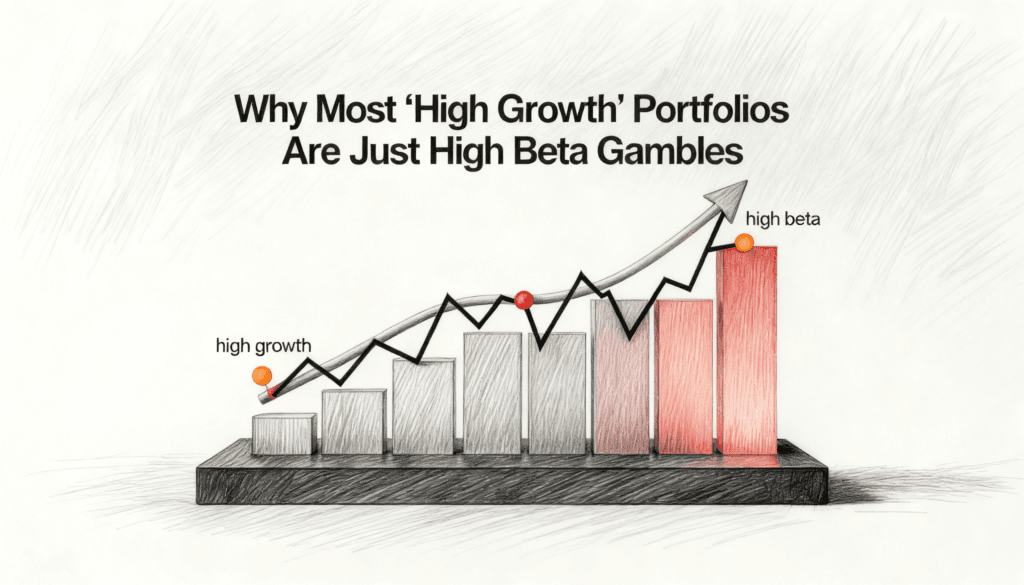
This is the quiet truth behind most portfolios that call themselves “high growth.” They are not really growth strategies at all. They are high beta strategies wearing a more flattering outfit.
The Costume Party of Modern Portfolios
Beta, for the uninitiated, is a measure of how much a stock moves relative to the broader market. A stock with a beta of 1.5 moves roughly 50% more than the market in either direction. When the market rises 10%, your stock rises 15%. When the market falls 10%, your stock falls 15%. It is not magic. It is just amplification.
Now here is where things get interesting. Many investors build what they believe is a carefully curated collection of high growth companies. They pick names with explosive revenue growth, massive addressable markets, and charismatic founders who give excellent podcast interviews. They feel like stock pickers. What they have actually done, in a surprising number of cases, is assemble a basket of stocks that mostly just move more than the market. The returns they are so proud of during bull runs are not evidence of superior selection. They are evidence of owning things that go up more when everything goes up.
This is like bragging about how fast you ran downhill.
The distinction matters enormously, because growth and beta are not the same thing, even though they often travel together. Real growth investing means identifying companies whose earnings power is expanding in ways the market has not yet fully recognized. High beta investing means owning volatile stocks. One is a thesis about the future. The other is just a sensitivity dial turned to the right.
Why the Confusion Persists
The reason most people never untangle growth from beta is that bull markets make them look identical. When the tide is rising, both the skilled growth investor and the person who just bought whatever was moving the fastest end up in roughly the same place. The feedback loop is intoxicating. You bought a stock. It went up a lot. Therefore you are good at this.
Psychologists have a name for this. It is called the self serving bias, and it is one of the most powerful forces in investing. We attribute our gains to skill and our losses to circumstances. When your high beta portfolio outperforms in a rising market, you feel like Warren Buffett. When it crashes, you blame the Fed, or hedge funds, or some geopolitical event that nobody could have predicted. At no point do you consider that you were simply on the more aggressive end of the same ride everyone else was on.
There is a beautiful irony here. The investors who feel the most sophisticated, who spend hours researching disruptive companies and building complex theses, often end up with portfolios that behave almost identically to a simple leveraged index fund. All that work, all that conviction, and you could have gotten the same return profile by buying the S&P 500 on margin.
What Real Growth Actually Looks Like
So if most high growth portfolios are just beta in disguise, what does authentic growth investing look like?
It starts with a question that almost nobody asks: where is the growth coming from?
A company can grow revenue at 50% a year for reasons that are genuinely durable, or for reasons that are entirely temporary. A software company that has built a product with deep integration into its customers’ workflows, high switching costs, and expanding use cases is growing for structural reasons. A company that is growing because it is spending enormous amounts of money to acquire customers who may or may not stick around is growing for financial reasons. Both show up as “high growth” on a screener. One is building an asset. The other is renting a metric.
The real growth investor cares about the quality of the growth, not just the quantity. They want to understand unit economics, retention curves, competitive positioning, and whether the company is generating growth that will eventually convert into durable free cash flow. This is painstaking, unglamorous work. It does not make for exciting dinner party conversation. Nobody has ever gone viral on social media for saying, “I spent three hours analyzing customer cohort data and concluded the retention curves are flattening.”
But this is where the actual edge lives. Not in finding the most volatile stocks, but in understanding which companies are building genuine economic value beneath the surface noise.
The Leverage Trap
There is another layer to this that rarely gets discussed. Many high growth portfolios carry a form of hidden leverage that has nothing to do with borrowing money.
When you own a stock that trades at 30 or 40 times revenue, you are implicitly making a leveraged bet on the future. The current price already reflects years of expected growth. If that growth materializes exactly as expected, you do fine. If it comes in even slightly below expectations, the stock can lose one fifth its value in a single earnings report. The valuation itself acts as leverage. It amplifies the impact of any new information, positive or negative.
This is why so many “high growth” portfolios can lose 30 or 60 percent in a downturn while the broad market falls 25 or 30 percent. It is not just that these stocks have high beta. It is that their valuations are stretched so far into the future that any change in expectations creates enormous price swings. You have essentially borrowed returns from the future, and like all borrowing, it works beautifully until it does not.
The clever bit is that this leverage is invisible on any standard portfolio risk report. Your brokerage account does not show you that your portfolio is implicitly leveraged 3 to 1 on future growth expectations. It just shows you that you own shares in exciting companies. The danger is hidden in the math, not in the margin balance.
The Darwinian Filter Nobody Talks About
Here is something that should bother anyone who builds a “high growth” portfolio by looking at past performance. You are only seeing the survivors.
The stocks that show up on high growth screens are the ones that worked. For every company growing revenue at 50% that made it onto your radar, there were several others that were growing at the same rate two years ago and have since imploded. They do not show up on the screen anymore. They are gone, delisted, acquired for pennies, or languishing at 90% below their highs.
This is survivorship bias, and it is devastatingly effective at creating false confidence. You look at a list of high growth stocks and think, “These are the kinds of companies I want to own.” But the list itself is a curated highlight reel. It is like evaluating whether to become a professional musician by only looking at people who won Grammy awards. The data you are missing is the data that would change your mind.
Real growth investors account for this. They do not just look at what is growing fast today. They study the base rates. What percentage of companies growing at this rate sustained it for five years? What happened to the ones that did not? This kind of probabilistic thinking is the antidote to survivorship bias, but it is also deeply unsexy. It replaces excitement with humility, and humility does not sell newsletters.
When High Beta Masquerades as Conviction
There is a word that gets thrown around a lot in growth investing circles: conviction. People say they have “high conviction” in their holdings. What they usually mean is that they own a concentrated portfolio of volatile stocks and have decided to feel good about it.
True conviction comes from deep understanding. It means you have studied a business so thoroughly that a 30% drawdown does not shake you, because you know the drawdown is about market sentiment and not about the actual health of the company. Most people who claim conviction are actually just experiencing the emotional momentum of recent gains. Their conviction was born in a bull market and has never been tested by a real one.
You can tell the difference by watching what happens when the portfolio falls 30%. The investor with genuine conviction buys more. The investor with high beta conviction starts quietly googling “how to hedge a portfolio”.
A More Honest Framework
None of this means you should avoid fast growing companies. Growth is a wonderful thing to own when you buy it at the right price, for the right reasons, with full awareness of what you are actually betting on.
The shift is in honesty. Instead of telling yourself you are a growth investor, ask whether you are really just a volatility investor. Run a simple test. Look at your portfolio returns over the past few years and compare them to a leveraged index fund. If the correlation is uncomfortably high, you do not have a growth strategy. You have a beta strategy.
There is nothing inherently wrong with taking more risk. Some investors are young enough, wealthy enough, or psychologically resilient enough to ride out the volatility. The problem is not the risk itself. The problem is the mislabeling. When you think you are being strategic but you are actually just being aggressive, you make different decisions than you should. You size positions incorrectly. You hold through drawdowns that should prompt a reassessment. You build a portfolio that is fragile in exactly the ways you do not expect.
The Compounding Paradox
The best growth portfolios over long periods of time often have lower volatility than the market, not higher.
This sounds wrong. Growth should mean more risk, right? But think about what a truly great growth company does. It generates increasing cash flows with high predictability. Its competitive position strengthens over time. Its customer base is loyal and expanding. These characteristics actually reduce uncertainty about future value, which means the stock should be less volatile, not more.
The companies that deliver the most volatile ride are usually the ones where the outcome is genuinely uncertain. Maybe the growth continues. Maybe it does not. The market cannot decide, so the stock swings wildly between optimism and pessimism. That is not growth. That is uncertainty. And there is a critical difference between owning a business whose future is bright and owning a business whose future is a coin flip that happens to be exciting.
The Uncomfortable Conclusion
Most “high growth” portfolios are not the product of superior insight. They are the product of a bull market, a preference for excitement, and an incomplete understanding of what is actually driving returns. They feel like intelligence. They look like skill. But strip away the narrative and you often find a simple, unremarkable truth: you just owned things that went up more when everything went up.
The real work of growth investing is quieter, slower, and less interesting to talk about. It requires understanding businesses at a level that goes far beyond revenue growth rates. It means being honest about the difference between a great company and a volatile stock. And it means accepting that the most sophisticated looking portfolio in the room might actually be the dumbest bet at the table.
That is not a comfortable realization. But the best investors are not in the business of comfort. They are in the business of clarity. And clarity starts with asking a question most people never think to ask: is my portfolio actually doing what I think it is doing?
If the answer is no, you have not failed. You have just found the starting line.