Table of Contents
There is a particular kind of person who buys a duplex in a boring suburb, spends a weekend fixing a leaky toilet, and then does almost nothing for the next five years except collect rent checks and watch the mortgage balance shrink. And there is another particular kind of person who, on a Tuesday afternoon, buys call options that expire in three days on a company whose ticker they learned about that morning, and spends the next seventy two hours refreshing a brokerage app like it owes them money.
These two people are both trying to get rich. They would describe what they are doing using almost none of the same words.
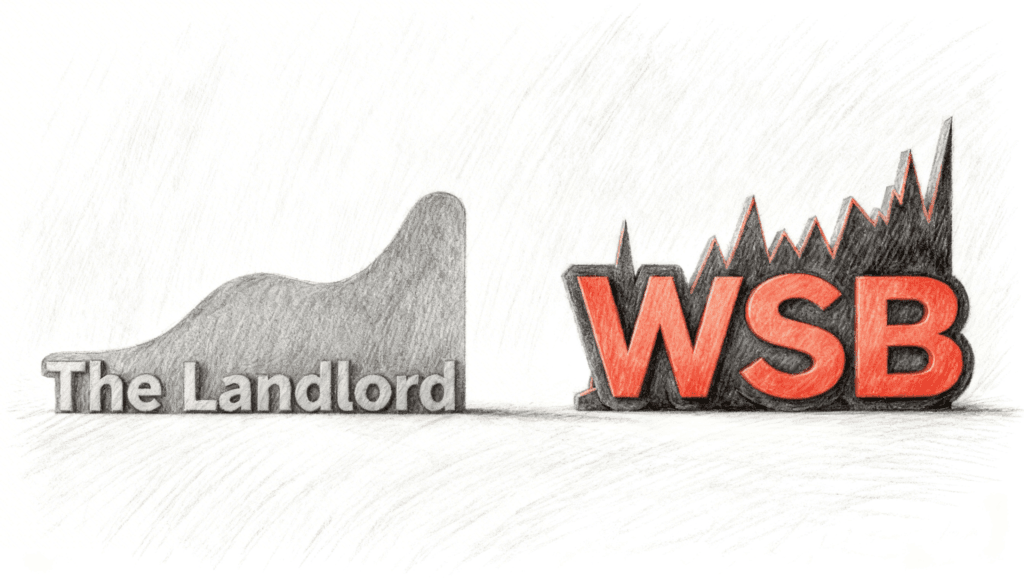
The landlord talks in decades. The WSB trader talks in hours. And the gap between those two time horizons is not really a gap about finance at all. It is a gap about what a person believes time is for.
Two Completely Different Relationships With the Clock
Most arguments about investing are framed as arguments about risk. The landlord is safe, the options trader is reckless, and so on. This framing is not wrong exactly, but it misses something stranger and more interesting underneath.
The real difference is how each person treats time itself.
For the landlord, time is an ally. It is the thing doing most of the work. The tenant pays down the mortgage a little each month. The property appreciates quietly in the background. The rent goes up a bit each year because the world has more people in it and roughly the same amount of land. The landlord is not really the one generating wealth. Time is. The landlord is just the person who had the patience to stand next to time and wait.
For the WSB trader, time is an enemy. It is the thing actively eating their position. Every hour that passes, the option they bought is worth a little less just by sitting there. This is called time decay, and it is exactly what it sounds like. The clock is not a friend in the corner. It is a small fire underneath the chair.
Think about that for a moment. One person has engineered their entire financial life so that doing nothing makes them richer. The other person has engineered theirs so that doing nothing actively drains their account. They are not playing different games with different strategies. They are playing the same game with opposite gravity.
The Farmer and the Hunter
There is an old way of dividing human temperaments that works surprisingly well here. Some people are farmers. Some people are hunters.
The farmer plants something and waits. The work is front loaded and the reward is back loaded. You dig, you plant, you water, and then you wait for months while it looks like nothing is happening. The farmer has learned to trust a process that provides almost no feedback in the short term. Most days, the field looks the same as it did yesterday. The farmer has to believe anyway.
The hunter does not have this luxury. The hunter goes out, and either comes back with something that day or comes back with nothing. The feedback loop is brutal and immediate. You either made the shot or you did not. There is no “I am slowly making the shot over eighteen months.”
The landlord is a farmer. The WSB trader is a hunter. And here is the part people rarely notice. Neither of these temperaments is morally superior to the other. Human societies needed both. The farmer provided stability. The hunter provided protein when the crops failed. What they could not do was understand each other.
The landlord looks at the options trader and sees someone who has not learned to wait. The options trader looks at the landlord and sees someone who has not learned to act. They are both partially right and mostly talking past each other.
The Strange Thing About Slow Money
Here is something the options trader notices that the landlord would rather not discuss. Slow money is boring. Not boring in a virtuous, character building way. Just boring. The landlord who bought a rental in 2011 and held it through 2026 did not make their money by being clever. They made it by being alive during a period when real estate went up. If you stripped away the marketing that surrounds long term investing, the actual activity involved is closer to sitting in a chair than to anything most people would describe as work.
This is not a criticism. It is a structural feature. Slow money requires that almost nothing interesting happens to you for a very long time. That is the entire mechanism. Compounding only works if you leave it alone. The moment you get excited and start tinkering, you break the very thing that was supposed to make you rich.
Which means the landlord and the Boglehead and anyone else running on a decade long clock has to find a way to make peace with a kind of financial boredom that most humans find physically uncomfortable. Some people manage this. Most do not. Most people, when left alone with a portfolio that is quietly doing its job, cannot resist the urge to reach in and adjust something. The discipline is not really about money. It is about sitting still.
The Strange Thing About Fast Money
Now flip it around. Here is what the landlord notices about the options trader that the trader would rather not hear.
Fast money is exhausting. Not in a heroic, grinding way. Just in a way that slowly erodes the person doing it. The options trader is not really trading options. They are maintaining a relationship with a screen that never stops asking them to make another decision. Every minute the market is open is another minute that demands attention. And unlike the landlord, who can go on vacation and come back to roughly the same financial situation, the fast trader cannot really leave. Leaving is a position. Closing the laptop is a choice. The clock keeps ticking on everything you own.
This is the counterintuitive part. The landlord, who appears passive, has actually built a life where their money works while they sleep. The fast trader, who appears active, has built a life where their money stops working the moment they look away. Who is really free here?
The options trader would say they are free because they could walk away rich on any given Friday. The landlord would say they are free because they do not have to be anywhere on any given Friday. These are different definitions of freedom and they cannot both be right at the same time for the same person.
The Question Underneath All of This
Here is what neither side wants to admit. Both of them are making a bet about what kind of person they want to be for the next thirty years.
The landlord is betting that they will still be patient in 2060. That they will not get bored. That they will not panic during a downturn and sell. That their future self will honor the commitment their present self is making. This is a huge bet about personal character, and most people lose it, which is why most people do not get rich slowly even though the instructions are free and widely available.
The WSB trader is betting that they will stay sharp. That they will keep their edge. That the luck or skill that worked last month will work next month. That they will know when to stop. This is also a huge bet about personal character, and most people lose this one too, which is why most fast traders eventually give the money back.
Both groups have found a strategy that works only if they can become a very specific kind of person and stay that person for a very long time. The landlord has to become someone who can tolerate doing nothing. The trader has to become someone who can tolerate doing something intense, every day, without flinching.
The money is almost a side effect. The real product is the personality you have to build to earn it.
The Part That Might Actually Matter
If you read any of this and felt a little defensive on behalf of your side, that reaction is worth paying attention to. It is telling you which temperament you already have.
You do not really choose between being a landlord and being an options trader based on which one makes more money. You choose based on which kind of discomfort you can stand. The boredom of waiting, or the adrenaline of watching. The long quiet, or the short loud. Most people pretend they are choosing with their brain. They are actually choosing with their nervous system.
And maybe that is the honest answer to why these two groups cannot understand each other. They are not disagreeing about returns or risk or strategy. They are disagreeing about what it feels like to be alive with money in the room. For one of them, the right feeling is stillness. For the other, the right feeling is motion. Neither can imagine being the other person for more than about twenty minutes without going slightly insane.
The market does not care which one you are. It will take money from both of you if you are bad at it and give money to both of you if you are good at it. The only question it ever really asks is whether you have built a version of yourself that can stay in the chair long enough to find out.