Table of Contents
Everyone is a long term investor. Right up until they are not.
This is one of the most reliable patterns in all of finance. Not a market pattern. A human pattern. You build a portfolio with a 20 year horizon. You read the books. You nod along to the compounding charts. You tell your friends you are not checking your portfolio every day. And then the market drops 15% in two weeks, and suddenly you are on your brokerage app at 6 AM, doing mental math about how much you have lost since Thursday, wondering if this time really is different.
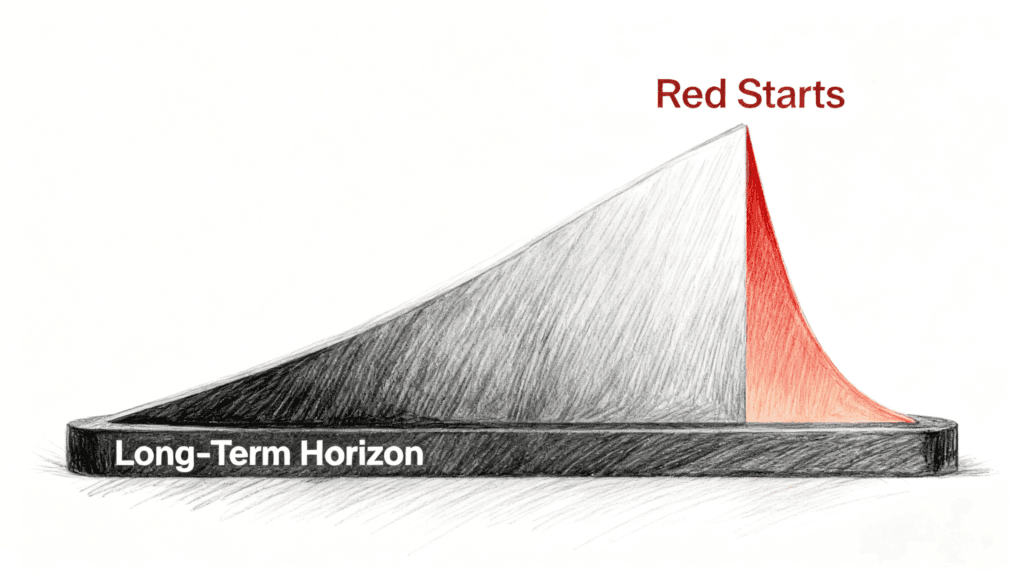
The long term horizon is not a strategy. It is a mood. And moods change.
The Rehearsal Problem
Here is something strange about the way we prepare for market downturns. We do it intellectually. We read about historical crashes. We study the data that shows markets recover. We look at charts where every terrifying dip looks like a minor wobble when you zoom out to 30 years. And we tell ourselves that when it happens to us, we will behave rationally. We will hold. We might even buy more.
This is a bit like preparing for a fight by reading about one.
The psychologist Gary Klein, who spent decades studying decision making under pressure, found something consistent across high stakes professions. Firefighters, soldiers, emergency room doctors. The people who performed well in crises were not the ones who had memorized the most theory. They were the ones who had experienced similar situations before, even in simulation, with enough emotional fidelity that the experience actually registered in their nervous system. Abstract knowledge about what to do did not transfer reliably to moments of genuine stress.
Your investment plan is abstract knowledge. The feeling of watching your net worth drop by a third is not abstract at all. It is visceral. And the visceral almost always overrides the theoretical.
So we end up in this odd situation where millions of investors have technically correct strategies that they are psychologically incapable of executing when the strategies matter most. The plan works perfectly in every scenario except the one it was designed for.
Loss Aversion Is Not a Bug You Can Patch
You have probably heard of loss aversion. The finding, originally from Kahneman and Tversky, that losses feel roughly twice as painful as equivalent gains feel good. Losing $10,000 stings about twice as much as gaining $10,000 pleases. It is one of the most cited concepts in behavioral economics, to the point where it almost feels like common sense now.
But knowing about loss aversion does not make you immune to it. This is the part people skip over. Awareness is not a cure. You can understand perfectly well that your brain is overweighting the pain of loss and still feel every ounce of that overweighted pain. Knowing the name of the trap does not teleport you out of it.
Think of it this way. You know that horror movies are fiction. You know that the monster is not real. You still flinch at the jump scare. Your conscious mind and your emotional circuitry operate on different timelines, and in moments of market stress, the emotional circuitry processes information faster and louder.
This is why the standard advice to “just ignore the noise” borders on useless. It is technically correct and practically impossible for most people, like telling someone with vertigo to just not look down. The looking down is not a choice. It is a reflex.
The Identity Collapse
There is something deeper going on when markets crash, something beyond simple loss aversion. It touches on identity.
When your portfolio is climbing, being a long term investor feels like being a wise, patient, disciplined person. It is pleasant. The identity aligns with the outcome. You are making money and you are smart for doing so. These two facts reinforce each other beautifully.
When the market drops, the identity fractures. Now holding feels less like discipline and more like denial. The voice in your head that once said “I am a patient investor” starts whispering “I am a fool who is watching his money evaporate and doing nothing about it.” The exact same behavior, holding through volatility, gets reinterpreted from wisdom to stupidity depending entirely on what the screen shows.
The sociologist Erving Goffman wrote extensively about how identity is not something we possess but something we perform. We construct a version of ourselves through our actions, and we need the world to somewhat cooperate with that construction. A bull market cooperates wonderfully. A bear market does not. And when the market stops cooperating, the performance of being a calm, rational, long term investor becomes exhausting because there is no external validation supporting it.
This is why people sell at the bottom. Not because they have done the analysis and concluded the fundamentals have permanently deteriorated. But because the psychological cost of maintaining the identity of “someone who holds” becomes unbearable. Selling is not really a financial decision. It is an identity decision. It is the moment where someone says, “I cannot be this person anymore.”
The Asymmetry of Experience
Here is a counterintuitive aspect of portfolio watching that almost no one talks about. Time moves differently in red markets and green markets.
When your portfolio is up, you might check it once a day. Maybe less. The pleasure is mild and distributed. It is background satisfaction. You do not sit and stare at a number that is going up 0.3% on a Tuesday afternoon. There is nothing urgent about gains. They accumulate quietly.
When your portfolio is down, the relationship with time changes completely. Every hour feels significant. You check before work. You check at lunch. You check before bed. The losses feel like they are actively happening to you, in real time, like watching water leak from a pipe you cannot fix. The experience of losing money is temporally dense in a way that gaining money simply is not.
This creates a brutal asymmetry. The good years feel like months. The bad weeks feel like years. Your subjective experience of investing is disproportionately shaped by the periods of loss, even if those periods are shorter and less frequent. The pain is not just greater in intensity. It is greater in duration as perceived by the person living through it.
This is partly why the advice to “zoom out” feels so hollow when you are in the middle of a drawdown. You are not experiencing the long term. You are experiencing a very intense present, and no amount of chart zooming changes what that present feels like from the inside.
The Social Dimension Nobody Budgets For
Markets do not crash in private. They crash on your Twitter feed, in your group chats, at dinner parties, and in every news headline. And this social dimension turns individual anxiety into collective panic in ways that are almost impossible to resist.
There is a concept in social psychology called informational social influence. When we are uncertain about what to do, we look at what other people are doing and treat their behavior as information. In ambiguous situations, the crowd becomes a signal. If everyone around you is panicking, that panic does not feel irrational. It feels like evidence.
During a market crash, you are not just fighting your own loss aversion. You are fighting the combined loss aversion of everyone you know, amplified by algorithms designed to surface the most alarming content because alarm drives engagement. Your uncle posts about moving everything to cash. A financial commentator you half respect says this could be 2008 again. Three people in your office mention selling.
Each of these data points erodes your conviction a little. Not because any single one is compelling, but because the volume starts to feel like consensus. And going against perceived consensus requires a kind of psychological stamina that is much rarer than people think.
The long term investors who actually hold through downturns tend to share one trait that is less about intelligence and more about social insulation. They either do not consume financial media during crashes, or they have a very small circle of people whose judgment they trust and who are themselves committed to holding. The strategy is less about the portfolio and more about the information environment.
Why Rules Beat Willpower
If you accept the premise that your long term conviction will weaken exactly when it needs to be strongest, then the logical response is not to build more conviction. It is to build systems that do not require conviction.
This is a principle borrowed from behavioral design, and it shows up in domains far beyond investing. People who successfully maintain diets do not have more willpower than people who do not. They have kitchens with less junk food in them. Recovering addicts are not morally superior to active ones. They have restructured their environments to reduce the number of decisions they need to make.
The investing equivalent is automation, contribution schedules that do not require you to press a button, rebalancing rules that execute on calendar dates rather than on feelings, and in some cases, deliberate friction that makes selling harder. Some of the most successful long term investors are successful precisely because they made it annoying to act on impulse. They chose custodians with slow transfer processes. They set up accounts they could not easily access. They engineered their own inability to panic.
This sounds unromantic. It is. There is nothing heroic about a monthly auto deposit. But it works precisely because it removes the human from the decision at the moment the human is least equipped to decide.
The Paradox of Preparation
Here is perhaps the most uncomfortable truth about all of this. The investors who will handle the next crash best are not the ones who have the strongest conviction that they will hold. They are the ones who have genuinely accepted that they might not.
This sounds contradictory but it is not. When you acknowledge that you are vulnerable to panic, you plan differently. You keep more in cash than a pure optimizer would recommend, not because cash is a great investment, but because it is an emotional buffer that prevents you from selling stocks at the worst time. You size your positions so that no single loss can trigger an identity crisis. You set rules in advance. You tell your advisor, or your spouse, or whoever serves as your accountability partner, what you intend to do and ask them to hold you to it.
The investors who insist they will be fine are the ones with brittle plans. “I will simply hold” is not a plan. It is a prediction about your future emotional state, and humans are notoriously terrible at predicting their future emotional states. Psychologists call this the empathy gap. When you are calm, you literally cannot imagine what it feels like to be panicked. Your calm self makes plans that your panicked self has no interest in following.
The solution is to plan as your panicked self. What would you need in place for even the worst version of you to stay the course? Build that. Not the plan that works for the rational, composed version of you sitting in a comfortable chair reading about market history. The plan that works for the 3 AM version of you watching futures drop.
The Long Term Is a Place You Arrive, Not a Place You Decide
There is a quiet irony at the center of long term investing. The people who benefit from it most are often the people who gave it the least thought. The 401(k) that was set up during onboarding and never touched. The account that was forgotten during a move. The inheritance that sat in an index fund because nobody could agree on what to do with it.
These accidental long term investors outperform almost everyone who is trying very hard to be a long term investor. Not because ignorance is a strategy, but because the biggest threat to a long term horizon is not the market. It is the person watching the market.
Your horizon does not shrink because the fundamentals changed. It shrinks because you are a human being with a nervous system that evolved to respond to threats in real time, social instincts that amplify fear through imitation, and an identity that depends at least partially on things you cannot control.
The market does not care about your horizon. But the interesting thing is, if you can find a way to stop caring about the market, even temporarily, even imperfectly, the horizon tends to take care of itself.
The red will come. It always does. The question is not whether your conviction will be tested. It is whether you have built something that does not depend on conviction at all.