Table of Contents
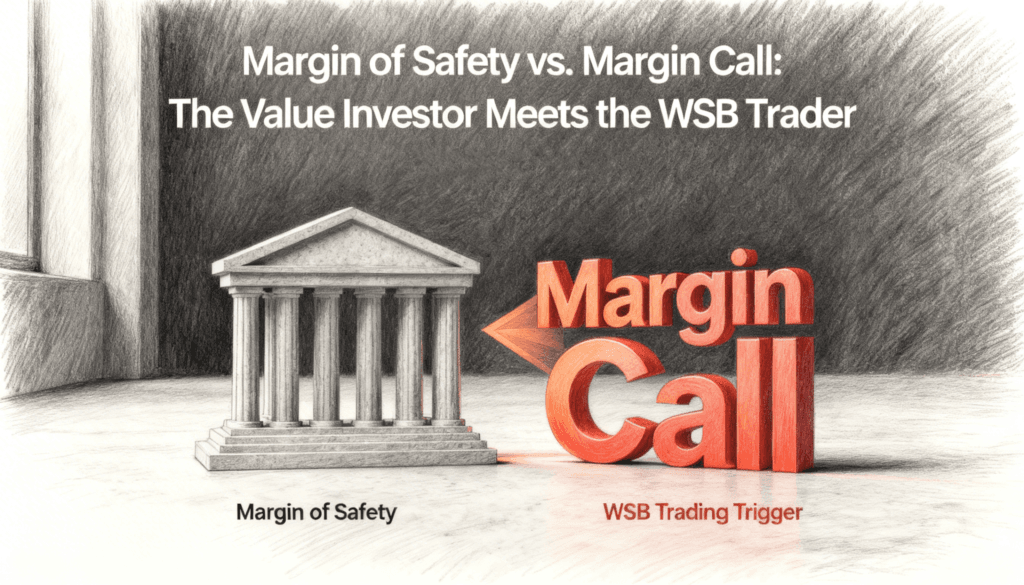
There are two phrases in finance that sound almost identical and mean almost opposite things. One is “margin of safety.” The other is “margin call.” They share a word. They share a universe. They do not share a worldview.
A margin of safety is what a value investor builds into every decision on purpose. A margin call is what happens to a WallStreetBets trader at three in the morning when the thing they were sure about stopped being sure. One is an act of humility baked into the math. The other is the universe sending a receipt.
Watching these two groups talk about risk is like watching two people describe the same word in different languages. They are both saying “safety.” They mean entirely different things.
Two Ways of Thinking About What Could Go Wrong
A value investor spends most of their time imagining failure. Not in a nervous way. In a structural way. Before they buy anything, they ask what the business is worth if everything goes slightly worse than expected. Then they ask what it is worth if everything goes much worse. Then they only buy if the price is below even that darker number. The gap between what they paid and what the business is actually worth is the margin of safety. It is the cushion. It is the space between being wrong and being ruined.
The WSB trader also thinks about what could go wrong, but the thinking happens in a different place and at a different speed. It happens after the trade. Sometimes it happens during the trade. Occasionally it happens only when a broker emails them at an inconvenient hour. The margin call is not a concept they built into the plan. It is the plan revealing what it actually was.
This is not a knock on either approach. It is just an observation about where each group puts its worry. Value investors front load their anxiety. They do all their worrying before the money moves. WSB traders back load it. They do all their worrying after. Both are handling fear. They are just sequencing it differently.
A Strange Thing About Preparation
Here is something that sounds wrong but is not. The value investor, who spends all that time preparing for bad outcomes, often seems calmer than the WSB trader, who is supposedly living for the thrill.
You would think it would be the other way around. The person who keeps imagining disaster should be nervous. The person who shrugs off disaster should be relaxed. But that is not how it works in practice.
When you have already imagined the worst case and decided you can live with it, the actual market becomes less interesting. Nothing it does can surprise you very much. You already mentally paid for the downside. Everything better than that feels like a bonus. This is why the classic value investors tend to look like they are half asleep at their desks. They already did the emotional work at home.
The WSB trader is doing something different. They are outsourcing the emotional work to the market itself. They are letting the price movements tell them how to feel. When the trade is up, they feel brilliant. When it is down, they feel betrayed. The emotional volatility is not a side effect of the strategy. It is the strategy. They are not avoiding feelings. They are buying them.
There is a word for this kind of arrangement in other areas of life, and it is not investment. It is entertainment. Which is fine, as long as everyone involved is clear about what is being paid for.
The Oldest Idea in Finance, Dressed in Different Clothes
The idea of a margin of safety is not actually from finance. It is from engineering. When you build a bridge, you do not calculate the exact weight it needs to hold and then build it to hold exactly that. You build it to hold three times that. Maybe five times. The extra strength is not waste. It is what separates a bridge from a collapse waiting for the right Tuesday.
Benjamin Graham, who taught this idea to finance, borrowed it from this physical world thinking. He noticed that the people who built things that lasted were the people who built in slack on purpose. They assumed their calculations might be slightly wrong. They assumed the materials might be slightly weaker than advertised. They assumed the load might be slightly heavier than expected. The margin of safety was how you handled the gap between what you knew and what you did not know.
The WSB trader is not building a bridge. They are jumping off one and hoping the river below is deep enough. Sometimes it is. Sometimes it is not. The activity is thrilling precisely because you cannot engineer the outcome in advance. If you could, the thrill would go away, and the whole point of being there would disappear with it.
This is why telling a WSB trader about margin of safety is pointless. It is not that they do not understand the concept. It is that the concept is hostile to the experience they are trying to have. You cannot simultaneously want to feel the wind on your face and also want a seatbelt.
What Each Side Gets Wrong About the Other
Value investors often assume WSB traders are bad at math. This is not quite right. Many WSB traders can calculate probabilities perfectly well. The issue is that they are not playing a probability game. They are playing a narrative game. The numbers are props. The real product is the story they are inside of while the trade plays out. Being early to something huge. Being the one who saw it first. Being alive in a way that quarterly reports cannot provide.
WSB traders often assume value investors are cowards. This is also not quite right. The value investor has made peace with a very specific trade. They will never get rich overnight. They have accepted that in exchange for something else, which is a reasonable confidence that they will not go broke overnight either. It is not cowardice. It is a deliberate choice about which nightmares they are willing to have. The value investor has decided that the nightmare of ruin is worse than the nightmare of missing out. The WSB trader has decided the opposite.
Neither position is irrational. They are just built around different fears, and a person’s financial strategy usually tells you which fear they take more seriously.
The Thing That Actually Separates Them
Strip everything else away and you find one question at the bottom of this whole argument. When you do not know what is going to happen next, do you lean toward protection or toward possibility?
The value investor leans toward protection. They assume the future is uncertain, and they treat that uncertainty as a reason to leave room for being wrong. The WSB trader leans toward possibility. They assume the future is uncertain, and they treat that uncertainty as a reason to swing hard while the swinging is still possible.
Both are honest responses to the same basic fact, which is that nobody actually knows what tomorrow looks like. But they produce completely different lives. The value investor ends up with a portfolio that looks boring and a bank account that grows in a way that would put most people to sleep. The WSB trader ends up with stories. Some of the stories end well. Some do not. But there will always be stories.
And this is maybe the hidden thing about the whole debate. It was never really about returns. It was about what kind of life you are willing to live while waiting for the money to either show up or not. The value investor wants their life to be quiet while the money works. The WSB trader wants their life to be loud while the money either works or blows up. The strategies are just the containers for these preferences.
The Irony Neither Side Wants to Admit
Here is the part that would make both groups uncomfortable if you said it out loud. They need each other.
Value investors need WSB traders because somebody has to be on the other side of the trade when a stock gets ridiculously cheap. Those panicked sellers at the bottom of a crash, the ones throwing shares overboard at any price, are often the same people who were buying calls at the top. The margin of safety exists because somebody else, somewhere, was not thinking about one.
And WSB traders need value investors because somebody has to hold the bag when the crowd finally gets bored of whatever the story was this week. The patient money is what gives the impatient money something to sell into. Without slow buyers, the fast sellers would have nowhere to go.
The market is not really two tribes fighting. It is one machine with two halves that insult each other while doing necessary work for each other. The irony is thick enough to chew. Neither side will ever acknowledge it, because acknowledging it would ruin the whole thing.
The Small Lesson Hiding in All of This
Most people will never be full time investors of any kind. But almost everybody has to make financial decisions that carry uncertainty. And the real question the margin of safety forces you to ask is not about stocks at all. It is about life.
How much room are you leaving for being wrong? Not in theory. In practice. In your budget. In your career. In the commitments you make. In the plans that assume everything goes the way you expect. A life without margin of safety is a life that works beautifully until it does not, and then it does not work at all. A life with too much margin of safety never gets tested and never grows. Somewhere in between is the actual art.
The value investor and the WSB trader have both picked a spot on that line. They picked different spots. They are both going to find out, eventually, whether their spot was the right one for them. And so is everybody reading this, whether they ever touch a stock or not.
The margin call comes for people who do not believe in margin of safety. Sometimes it comes dressed as a broker notification. Sometimes it comes dressed as something else entirely. It always comes. The only real question is whether you thought about it before it arrived.