Table of Contents
A value investor and a crypto investor walk into a bar, and neither of them can explain what the other is doing without sounding insulting. The value investor thinks the crypto investor is gambling on vibes. The crypto investor thinks the value investor is reading obituaries for companies that have not died yet. They are both a little right, which is what makes the argument interesting instead of exhausting.
But the real disagreement between these two groups is not about assets. It is about what makes something worth money in the first place. And once you see that, you realize they are not even playing the same game. They are arguing about which sport is real.
Two Different Theories of Value
Value investing, in its original Benjamin Graham form, rests on a very specific idea. A business is worth the cash it will produce over its lifetime, discounted back to today. Everything else is noise. The price quoted on the screen is just the opinion of a manic depressive man named Mr. Market, and your job is to ignore his moods and buy when he panics.
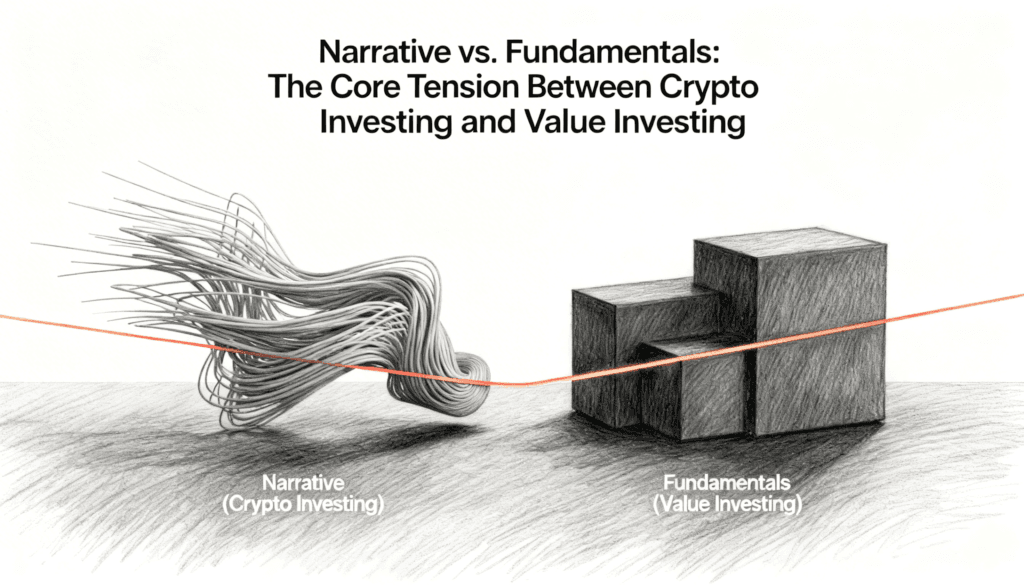
This worldview has a certain monastic dignity to it. It says that reality exists independently of what people think about it. A factory produces widgets. The widgets generate cash. The cash belongs to shareholders. None of this depends on whether the crowd is excited or bored. Patience eventually gets rewarded because math is math.
Crypto investing operates on an almost opposite premise. In most crypto assets, there are no earnings. There is no factory. There is no obituary to read because there was never a business to begin with. What there is, instead, is a network. And networks are worth whatever the people inside them collectively believe they are worth, which is a statement that sounds insane until you realize it also describes language, religion, fashion, and the US dollar.
This is the first clue that the argument is deeper than it looks. Value investors are not wrong that fundamentals matter. Crypto investors are not wrong that belief creates reality. They are describing two different layers of how money actually works, and each side thinks the other is hallucinating.
The Philosopher in the Room
Here is where it gets interesting. There is a concept in philosophy called a social fact. A social fact is something that is real only because enough people agree it is real. Money is a social fact. Borders are social facts. The value of a signed baseball is a social fact. None of these things have physical properties that make them valuable. They have collective agreement, which turns out to be just as sturdy, and sometimes sturdier, than physical properties.
Value investing pretends social facts do not exist. It wants everything to reduce to cash flows and balance sheets, because those feel objective. But even cash flows depend on social facts. A company’s revenue depends on customers deciding the product is worth paying for. A currency’s purchasing power depends on people continuing to accept it. The ground floor of value investing is not as solid as it pretends. It is just a social fact that has been stable for so long that people forgot it was one.
Crypto investing does the opposite. It treats social facts as the only thing that matters and more or less dares you to prove otherwise. If enough people believe a token has value, it does. If they stop believing, it does not. This is honest in a way that value investing is not. But it is also terrifying, because belief is a fragile substance. It can evaporate overnight, and when it does, there is no factory to fall back on.
So you have one camp saying “ignore the story, look at the cash” and another camp saying “the story is the cash.” Neither is completely right. Both are describing something true about how humans assign value.
What Each Side Gets Wrong About the Other
Value investors love to mock crypto for having no intrinsic value. This is a strange criticism coming from people who own stock in companies whose value depends on future projections, brand perception, management quality, and a hundred other things that are not exactly chiseled into stone. A stock certificate is also, at the end of the day, a piece of paper that is worth something because people agree it is. The difference is degree, not kind.
Crypto investors love to mock value investors for being slow, boring, and attached to dying industries. This is also a strange criticism, considering that some of the most boring companies on earth have compounded wealth for decades while exciting new things came and went. Boring is not the opposite of smart. Boring is often what smart looks like when it has been doing its job for a long time.
The real blind spot on each side is the same one. Value investors underestimate how much of the market runs on narrative, even in their own portfolios. Crypto investors underestimate how much of sustained value eventually requires something real underneath the narrative. Both sides are half right in a way that would be useful to them if they were willing to admit it.
The Time Horizon Trick
There is a sneaky way to understand the conflict that makes both sides look more reasonable. It has to do with time.
Narrative drives prices in the short run. Fundamentals drive prices in the long run. This is not a controversial statement. Even Warren Buffett says it, in his own slow way. The market is a voting machine in the short term and a weighing machine in the long term.
Crypto investors tend to operate in the short and medium term, where narrative dominates. Value investors tend to operate in the long term, where fundamentals eventually assert themselves. When they argue, they are often arguing about the same market at different time scales, like two people describing the weather when one is looking out the window and the other is looking at a climate chart.
This does not mean both approaches are equally wise. It means the question “which one works” is incomplete. The better question is “which one works over the time horizon I actually care about.” A trader who needs returns this year has no business pretending to be Warren Buffett. A retiree who needs stability for the next thirty years has no business pretending to be a DeFi farmer. The mistake is not choosing a side. The mistake is choosing a side that does not match your actual life.
What This Resembles Outside Finance
You can see this same tension play out in the art world, which is maybe the closest cultural cousin to this debate. There are people who think art is worth what the materials, skill, and labor cost. And there are people who think art is worth whatever a collector will pay for the story attached to it. A banana taped to a wall sold for a lot of money not because the banana was valuable but because the concept was. A value investor looking at the banana would call it insane. A crypto investor would immediately understand.
Both views have coexisted in art for centuries without resolving, and the reason is that they are both true at different moments. Sometimes the craftsmanship is the value. Sometimes the story is the value. Sometimes, in the best cases, they fuse and you cannot tell where one ends and the other begins. Finance is slowly discovering the same thing.
The Uncomfortable Middle
The most useful thing you can do after watching this argument is to stop picking a team and start asking better questions. When you buy something, are you buying because of what it produces, or because of what people believe about it? Both are legitimate reasons. But they are not the same reason, and confusing them is how people get hurt.
If you buy a cash flowing business and then sell it the moment the narrative turns sour, you were never really a value investor. You were a narrative investor who liked the vocabulary. If you buy a token because you believe in its long term fundamentals, you should be able to say what those fundamentals actually are without waving your hands. If you cannot, you are a narrative investor who likes the vocabulary of the other side.
The embarrassing truth is that most people are narrative investors who tell themselves they are fundamentals investors, because fundamentals sound more respectable. And the equally embarrassing truth is that narrative investors, when they are honest about what they are doing, sometimes make more money than people who are pretending to be something they are not.
So What Is Actually Happening Here
The clash between crypto and value investing is not really about crypto or value investing. It is about a much older question: does the world become real through what it produces, or through what we believe about it? Philosophers have been arguing about this for thousands of years without settling it, and there is no reason to expect a group of people with Bloomberg terminals and Discord accounts to do better.
What you can do is notice which camp you instinctively belong to, and then spend a little time with the other side to figure out what you are missing. Value investors could use a dose of humility about how much narrative props up their own holdings. Crypto investors could use a dose of humility about how much narrative, untethered from anything real, tends to end.
In the end, both communities are trying to answer the same question. What deserves to be trusted with your money. They just disagree about whether trust is built from spreadsheets or from stories. The honest answer, if anyone is willing to hear it, is that it has always been built from both, and the people who win tend to be the ones who know which ingredient they are using and why.