Table of Contents
The Casino Joke That Explains Everything About Diversification
There is an old joke in finance that cuts deeper than most textbooks. A man walks into a casino, places everything he owns on red, and wins. He is called a genius. Another man walks into the same casino, spreads his chips across red, black, green, the dealer’s tie, and the chandelier, and loses slowly over six hours. He is called prudent.
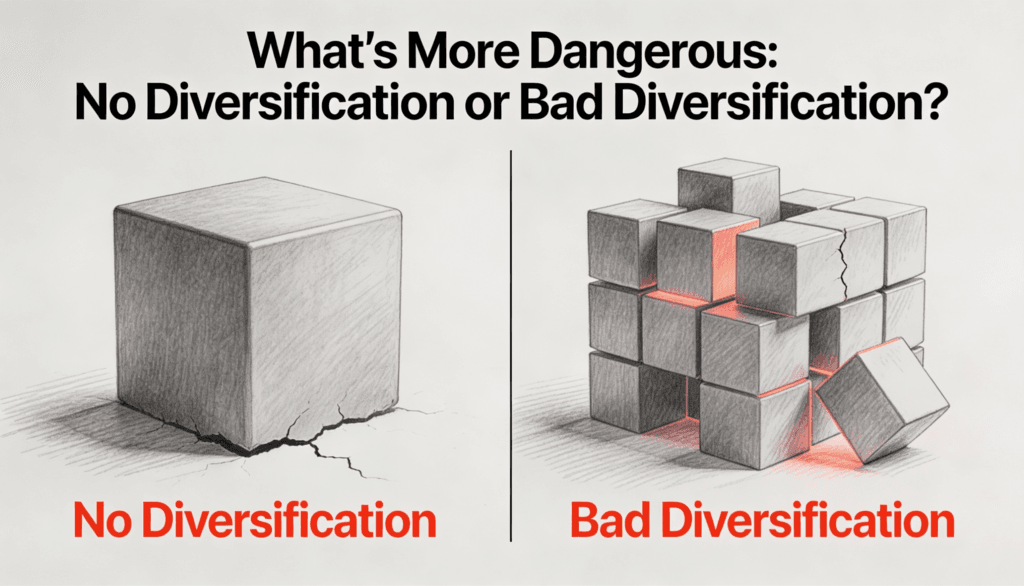
This is the strange country we live in when we talk about diversification. The undiversified investor who wins is celebrated. The poorly diversified investor who loses is comforted. And somewhere between these two figures sits a question almost nobody asks honestly. Which one is actually more dangerous? Owning too little, or owning too much of the wrong things dressed up as variety?
Most people assume the answer is obvious. Concentration is risky, diversification is safe, end of story. But that framing is lazy, and lazy framings tend to cost money. The truth is messier and far more interesting. Bad diversification can quietly do more damage over a lifetime than a concentrated bet ever could, because it hides. Concentration at least has the decency to announce itself.
In this article we will examine both dangers honestly. We will look at why spreading your money thin often feels like protection while delivering the opposite, why concentration fails cleanly while poor diversification fails silently, and what genuine diversification actually looks like when you strip away the pie charts and the marketing language. By the end you should be able to look at your own portfolio and answer one simple question that most investors never ask.
The Illusion of Safety in Numbers
There is a peculiar comfort that comes from owning many things. The human brain treats quantity as a proxy for protection. If one stock is risky, surely fifty must be safe. If one fund is uncertain, surely ten funds across five providers must be a fortress. But the brain is doing arithmetic where it should be doing biology.
Diversification is not about counting. It is about ecosystems. A forest with a thousand identical trees is not diverse. It is a fire waiting for a spark. A portfolio with forty stocks that all rise and fall together is not diversified. It is one bet wearing forty costumes.
A portfolio with forty stocks that all rise and fall together is not diversified. It is one bet wearing forty costumes.
This is where bad diversification earns its quiet danger. It looks like safety. It feels like safety. It even shows up on reports as safety, complete with pie charts in soothing pastel colors. And then a single event, a rate hike, a credit event, a currency move, reveals that everything you owned was actually the same thing in different fonts.
The investor who owns one stock at least knows they are exposed. The investor who owns twelve sector funds that all hold the same forty companies underneath does not know.
Why Our Instincts Mislead Us Here
Human beings evolved to count threats, not to model correlations. When you see many different labels on your account statement, your nervous system relaxes because variety historically meant survival. More food sources, more shelter options, more allies. But financial markets do not reward the appearance of variety. They reward exposure to genuinely different outcomes. The gap between how diversified you feel and how diversified you actually are is precisely where the danger lives.
Concentration Has Honest Failure Modes
Let us be fair to concentration. It is not a moral failing. It is a strategy, and like all strategies it has terms and conditions. When you concentrate, the bargain is clear. You accept volatility, sleepless nights, and the possibility of permanent loss in exchange for the chance of outsized returns.
Nobody who buys a single business and holds it for thirty years is confused about what they are doing. They have read the fine print. They have signed it in their own handwriting. Concentration kills, but it kills cleanly. You can see the wound. You can study what went wrong. You can learn. There is a feedback loop, painful but functional, that tells you whether your thinking was right or wrong.
How Most Real Fortunes Were Actually Built
Most great fortunes, incidentally, were built this way. They were not built by people who owned a little of everything. They were built by people who owned a lot of one thing they understood deeply, often a business they ran themselves. The diversification came later, after the wealth existed, as a way to preserve it rather than create it.
The tool that builds wealth is rarely the same tool that protects it. Confusing the two is one of the more expensive mistakes in finance.
This is worth pausing on. The tool that builds wealth is rarely the same tool that protects it. Concentration is a creation engine. Diversification is a preservation engine. Treating them as interchangeable leads young investors to over diversify when they should be concentrating, and leads wealthy investors to gamble when they should be protecting what they already have.
The Hidden Costs of Spreading Thin
Bad diversification has costs that do not appear on any statement. Some of them are financial. Many of them are not. Understanding these hidden costs is the first step toward fixing a portfolio that looks responsible but performs poorly.
The Cost of Attention
Every position you own demands a piece of your mind. You cannot deeply understand fifty things. You can barely deeply understand five. The investor who holds a sprawling portfolio of holdings they cannot explain is paying a cognitive tax for the illusion of breadth. They will sell at the wrong time because they never had conviction in the first place. Conviction requires understanding, and understanding requires focus.
The Cost of Dilution
Your best ideas, the ones you actually researched and believed in, get drowned in a sea of also-rans. If your best idea is two percent of your portfolio, even if it doubles, it adds only two percent to your wealth. Meanwhile the forty mediocre ideas around it move with the market, charging fees, generating tax events, and producing nothing memorable. You have built a museum of compromises.
The Cost of Fees
Every layer of diversification, every fund, every advisor, every wrapper, takes a small bite. The bites are individually invisible and collectively enormous. A portfolio diversified across twenty funds is often a portfolio paying twenty fees to own something that one cheap index fund would have delivered for less. This is diversification as performance art. It exists to be seen, not to work. Over a span of decades, fee drag of even one or two percent annually can quietly consume a third of your final wealth.
The Diversification That Is Not Diversification
The most dangerous kind of bad diversification is the kind that looks the most sophisticated. Consider the investor who owns United States stocks, European stocks, emerging market stocks, real estate, private equity, and venture capital. They feel diversified. Their advisor tells them they are diversified. The pie chart is a rainbow.
But every one of those assets is essentially the same bet. They all depend on global growth, on liquidity, on risk appetite, on the willingness of large institutions to keep buying things. When the tide goes out, they all reveal themselves to be swimming in the same ocean. The 2008 crisis taught this lesson, and then the lesson was forgotten, as lessons usually are.
What Real Diversification Requires
True diversification means owning things that respond to different forces. It means owning some assets that do well when others do badly, not because of luck but because of structure. It is harder than it sounds, because most assets these days are quietly correlated. Money is a global river, and most boats float on the same current.
Counting positions is not the same as counting risks. The investor who owns twenty stocks across five countries may be less diversified than the one who owns a single stock, a single bond, and a single piece of farmland.
The investor who owns twenty stocks across five countries and three sectors may be less diversified than the investor who owns one stock, one bond, and one piece of farmland. Counting positions is not the same as counting risks. The first number is easy to compute and feels reassuring. The second number is what actually determines whether you survive a downturn.
Why Bad Diversification Is the Quieter Killer
Here is the uncomfortable thesis. Concentration kills a few investors cleanly. Bad diversification underwhelms many investors silently. Over a lifetime, the silent underwhelming probably does more damage in aggregate, because it is invisible and therefore uncorrectable.
The concentrated investor who blows up has a story. They learn. They sometimes recover and become wiser. The badly diversified investor never blows up. They simply underperform, year after year, by a percentage point here and a percentage point there.
They blame the markets. They blame their luck. They never blame the strategy, because the strategy looked correct the whole time. This is the cruelty of bad diversification. It does not deliver a moment of clarity. It delivers a slow drift, a quiet erosion, a lifetime of doing the right thing badly. There is no funeral, no postmortem, no lesson. Just a smaller number than there should have been.
The Absence of a Feedback Loop
The deepest problem with poor diversification is that it never generates the pain required to change behavior. A concentrated investor who loses fifty percent in a single position feels something visceral and reconsiders. The badly diversified investor feels nothing sharp enough to prompt reflection. Without a feedback loop, mistakes do not get corrected. They get compounded.
What Good Diversification Actually Looks Like
Good diversification starts with honesty. It begins by asking what you actually own, not what your portfolio looks like on paper. If everything you own rises and falls together, you own one thing. If you own a handful of things that respond to different parts of the world, you are diversified, even if the handful is small.
Accept That Not All Risk Should Be Hedged
Good diversification also recognizes that not all risks need to be hedged. Some risks are worth taking. Some volatility is the price of returns. The investor who tries to smooth every bump is also smoothing away every gain. There is a sweet spot between exposure and protection, and it sits closer to exposure than most advisors will admit, because exposure does not generate fees and protection does.
Respect the Limits of Attention
Good diversification respects the limits of your own mind. It is better to own ten things you understand deeply than fifty things you understand vaguely. The portfolio should be small enough that you can hold it in your head. If you cannot describe each position in a single sentence, you do not own it. It owns you.
A Simple Test for Genuine Diversification
Here is a practical exercise. List every meaningful holding you own. Beside each one, write down the single force that would hurt it most. Rising interest rates. A recession. A currency collapse. An energy shock. Now group the holdings by that force. If most of your money clusters under one or two forces, you are concentrated in risk no matter how many positions you hold. If your money spreads across genuinely different forces, you have built something durable. This exercise takes fifteen minutes and reveals more than any pie chart ever will.
The Question Worth Asking
So let us return to the original question. What is more dangerous, no diversification or bad diversification? The honest answer is that they are dangerous in different ways. The young investor with time, energy, and a few good ideas may be better served by concentration, because concentration is how fortunes are built. The older investor with wealth to preserve may be better served by real diversification, because preservation is a different game than creation.
But the worst position, the one that quietly traps most people, is the middle. The middle is where bad diversification lives. It is the portfolio that is too spread out to win and too concentrated in correlated risks to truly protect. It feels safe. It feels responsible. It feels like adulthood. And it underperforms quietly for decades while everyone involved congratulates themselves on being prudent.
The real question is not how many positions you own. It is whether you can defend each one in a sentence. If you cannot, you are not diversified. You are decorated.
Choose Your Danger Deliberately
Pick your danger deliberately. The investor who chooses concentration with eyes open is taking a real risk for a real reason. The investor who chooses real diversification with eyes open is buying real protection at a real cost. Both are honest. Both are legitimate. Both are better than the third option, which is to drift into a portfolio that looks like a strategy but is really just a collection of things acquired over time.
Diversification is not safety. It is a tool. Like any tool, it can build, or it can be dropped on your own foot. The difference is not the tool. The difference is the hand holding it. Understand what you own, understand why you own it, and understand what it is meant to do. Do that, and the question of concentration versus diversification stops being a source of anxiety and becomes a deliberate choice you make with full knowledge of the bargain you are signing.