Table of Contents
Every investor eventually arrives at the same uncomfortable crossroads. You find a company you like, the story makes sense, the product seems useful, and now you need to figure out if the stock is actually worth buying. This is where the toolkit comes out. And like any toolkit, it contains instruments of wildly different philosophies pretending to do the same job.
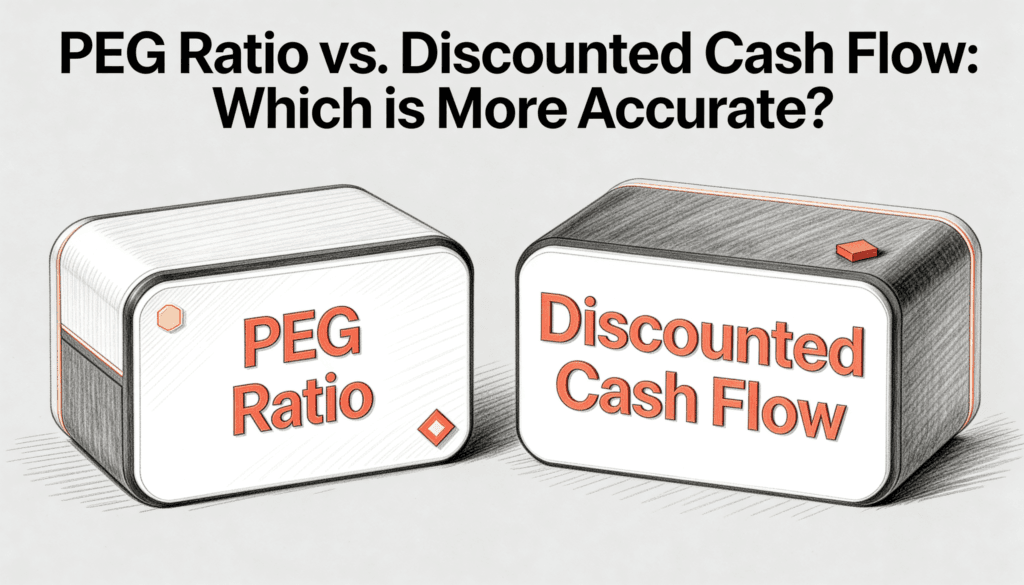
Two of the most popular tools sit on opposite ends of the spectrum. The PEG ratio is the pocket knife. Small, quick, oddly satisfying to use, and capable of getting you through most situations if you do not ask too much of it. Discounted cash flow analysis, on the other hand, is the full carpenter workshop. Powerful, precise on paper, and capable of producing beautiful results or absolute disasters depending on who is holding the saw.
The question of which one is more accurate sounds simple. It is not. And the answer reveals something deeper about how we think about value, time, and our own ability to predict the future.
The PEG Ratio: A Shortcut With Hidden Assumptions
The PEG ratio is what happens when investors got tired of arguing about whether a stock was expensive. It takes the price to earnings ratio and divides it by the expected growth rate. The logic is elegant. A company growing fast deserves a higher multiple, so we should compare the multiple to the growth. Anything under one is supposedly cheap. Anything above two is supposedly expensive. Easy.
Except nothing about investing is easy, and the PEG ratio has a quiet philosophical problem hiding underneath its arithmetic. It treats growth as if it were a substance you could weigh on a scale. But growth is not a quantity. Growth is a prediction. And predictions, especially in finance, are stories we tell ourselves while pretending they are numbers.
Consider the irony. The G in PEG stands for growth, but the growth used is almost always an analyst forecast for the next years. Five year forecasts have a track record somewhere between weather predictions and horoscopes. Yet we plug this fragile number into a formula and treat the output as if it were measured by a laser. The ratio is precise. The inputs are guesswork wearing a lab coat.
Discounted Cash Flow: A Cathedral Built on Sand
Now consider the other side. Discounted cash flow analysis is the method finance professors love. The idea is beautiful. A business is worth the cash it will generate in the future, adjusted for the fact that money tomorrow is worth less than money today. You project the cash flows, you pick a discount rate, you sum it all up, and you arrive at intrinsic value.
If the PEG ratio is a pocket knife, the DCF is a cathedral. And like any cathedral, its grandeur depends on what you put in the foundation. The problem is that the foundation is poured from three of the slipperiest substances in finance: future revenue, future margins, and a discount rate.
Change the growth assumption by two percent and your fair value shifts. Change the discount rate by one percent and watch the result move like a drunk pendulum. The model does not lie. It just amplifies whatever opinions you already had. An optimist running a DCF will discover, to their genuine surprise, that the stock is undervalued. A pessimist will run the same model on the same company and discover the opposite. The math is identical. The conclusions are opposite. This is not a flaw of arithmetic. It is a feature of how the human brain works when given too many knobs to turn.
There is a wonderful piece of black comedy in academic finance. The DCF is taught as the gold standard, the theoretically correct way to value any asset. And yet professional fund managers, the people who actually live and die by these decisions, use it as a sanity check, a way to think about the business, a structure for asking better questions. They do not actually trust the number it spits out.
What Accuracy Actually Means in Investing
Here is where most articles would line up the pros and cons and declare a winner. But the question of accuracy itself deserves examination, because investors use the word as if it meant the same thing it means in physics or engineering. It does not.
In physics, accuracy means how close your measurement is to a real value that exists out there in the world. The mass of an electron is what it is, and your equipment either measures it correctly or it does not. In investing, there is no such fixed value waiting to be discovered. The intrinsic value of a stock is not a number sitting in a vault somewhere. It is a function of an unknowable future. So when we ask which method is more accurate, we are asking a question that contains a hidden assumption. We are assuming there is a right answer, and that our job is to find it.
This is the wrong frame. The right frame is to ask which method produces better decisions over time. Accuracy in investing is not about finding the true price. It is about being less wrong than the next person, often enough, to come out ahead. The methods should be judged not on their elegance or theoretical purity, but on whether they help you avoid stupid mistakes and recognize obvious opportunities.
By this standard, both tools have value, but they fail in different ways. The PEG ratio fails by being too confident in its simplicity. It tells you a stock is cheap based on a number that itself is a guess. The DCF fails by being too confident in its complexity. It produces a precise number from imprecise inputs, and the precision tricks the user into thinking the answer is reliable. One method is wrong because it is too easy. The other is wrong because it looks too hard. Both errors come from the same place. The human desire to convert uncertainty into a single number we can act on.
The Tortoise and the Hare Problem
Take a real flavor of the difference. Imagine two companies. The first is a steady utility, growing earnings at four percent a year, generating predictable cash flow, paying a dividend, and basically behaving like a slightly more expensive savings account. The second is a young software company growing at forty percent, burning cash, and promising to dominate its market within a decade.
The DCF actually works reasonably well on the utility. The future is mostly a continuation of the present. Margins are stable, regulation provides a kind of guardrail, and the discount rate is the dominant variable. You can build a model that produces a sensible range of values, and the range will not be embarrassingly wide. This is the natural habitat of the DCF.
The PEG ratio, meanwhile, would tell you the utility is overvalued because its growth is so slow. But low growth at high stability is not the same as low growth at high risk. The PEG ratio cannot tell the difference, because it has no concept of risk or quality. It just sees a small G and panics.
Now flip to the software company. The DCF here becomes a creative writing exercise. What is the terminal growth rate? Nobody knows. What are the margins at scale? Nobody knows. What is the right discount rate for a business that might be worth a hundred billion or zero? Pick a number and commit. The model becomes a way to justify whatever you already believed.
The PEG ratio is not better here. It just fails more visibly. Plug in a forty percent growth rate and the formula will tell you the stock is cheap. Of course it does. The math has no idea whether forty percent growth is sustainable for one year or ten. It treats both possibilities identically, which is to say, it treats them wrongly.
So which method is more accurate? It depends entirely on the company. The DCF is more accurate when the future looks like the past. The PEG ratio is more accurate when you do not want to think too hard and the company is in a normal range of expectations. Neither is more accurate in any absolute sense, because accuracy itself is contextual.
The Insight Most Investors Miss
Here is the part that most analysis skips, and it is the part that matters most. The choice between PEG and DCF is not really a choice between two methods. It is a choice between two attitudes toward uncertainty.
The PEG ratio represents the attitude that says, let us not pretend to know more than we do. Let us use a quick approximation, accept its limitations, and move on. The DCF represents the attitude that says, let us think carefully about the business, build a structured view of its future, and discipline our thinking with rigor. Both attitudes are valid. Both can lead to good decisions. And both can become traps.
The PEG ratio becomes a trap when investors mistake speed for wisdom. A number you calculated in thirty seconds is not necessarily a useful number. The DCF becomes a trap when investors mistake complexity for accuracy. A model with a hundred cells is not necessarily a better guide than a thoughtful paragraph.
Where This Leaves Us
If you forced me to pick one method as more accurate in the typical investor toolbox, I would say the DCF, narrowly and with caveats. Not because it produces better numbers, but because building one forces you to think about the business in a structured way. The exercise is more valuable than the result. You cannot run a DCF without confronting your assumptions about growth, margins, and competition. You have to write them down. You have to defend them. The PEG ratio asks none of this. It takes two numbers off a screen and divides them.
But this is a narrow victory, and it comes with a warning. A DCF that you do not actually understand is worse than a PEG ratio you trust appropriately. Tools only work when their users know their limits. The investor who treats a DCF output as a fact is more dangerous than the investor who treats a PEG ratio as a quick approximation.
The deeper truth is that valuation methods are not really about getting to the right answer. They are about asking the right questions. Both PEG and DCF are flawed. Both are useful. And the investor who understands why they are flawed is the one who actually benefits from using them.
Accuracy, in the end, lives less in the formula and more in the mind of the person using it.