Table of Contents
There is a particular thrill that comes with finding a stock trading at 8 times earnings. It feels like walking into a luxury store and discovering a mispriced jacket on the clearance rack. Your pulse quickens. Your internal monologue starts whispering things like “the market is sleeping on this one” and “this is a steal.” You feel smarter than everyone else in the room.
That feeling is the problem.
The price to earnings ratio, the beloved P/E, is probably the most widely cited number in all of investing. Financial news anchors say it like a reflex. Your uncle at Thanksgiving mentions it between bites of turkey. Online stock screeners use it as the default filter. It has become so embedded in how we think about value that most investors never stop to ask a deeply uncomfortable question: what if the number we are all obsessed with is the wrong one?
This is not an article about why earnings do not matter. They do. This is an article about why your brain is drawn to P/E like a moth to a porch light, and why the less glamorous, less discussed price to free cash flow ratio often tells you something closer to the truth. The difference between the two is not just mathematical. It is psychological.
The Comfort of Familiarity
Let us start with why P/E dominates the conversation in the first place.
Earnings per share is a clean number. Companies report it every quarter. Analysts forecast it. It shows up on every financial summary page. The P/E ratio takes that number and divides it into the stock price, giving you what feels like a definitive answer to the question “is this cheap or expensive?”
And that is exactly the kind of answer your brain craves.
Behavioral psychologists have a term for this: the fluency heuristic. We tend to trust information that is easy to process. If a concept feels simple and familiar, we assume it is also accurate and reliable. P/E is the investing equivalent of a catchy song. You do not need to understand music theory to hum along. The ratio is intuitive, it is everywhere, and it requires almost no effort to interpret. A P/E of 10 feels cheap. A P/E of 40 feels expensive. Done. Move on. Buy the cheap one.
But fluency is not the same as accuracy. In fact, the easier something is to understand, the less likely we are to question it. This is where the trouble begins.
The Earnings Illusion
Here is what most people do not think about when they look at earnings: the number is, to a significant degree, a work of fiction.
That sounds dramatic, so let me be precise. Net income, the “E” in P/E, is an accounting construct. It is governed by rules that allow for enormous flexibility in how revenue is recognized, how expenses are timed, how depreciation is calculated, and how one time charges are classified. Two companies with identical business operations can report very different earnings depending on the accounting choices they make. None of this requires fraud. It is all perfectly legal. It is just not as solid as it looks.
Think of it this way. If earnings are a portrait of a company, they are a portrait painted by the company itself, using a set of brushes chosen from a very large and permissive toolkit. The painting might be beautiful. It might even be mostly accurate. But it is still a painting, not a photograph.
Free cash flow, on the other hand, is closer to the photograph. It measures the actual cash a business generates after paying for everything it needs to keep operating. You cannot massage cash the way you can massage earnings. Either the money came in or it did not. Either it went out or it did not. The bank account does not care about accounting elections.
This is why P/FCF, the price to free cash flow ratio, often reveals things that P/E conceals. A company can report robust earnings while burning through cash. It can show a low P/E while its free cash flow is negative. The portrait looks great. The photograph tells a different story.
Why We Resist the Better Metric
If free cash flow is more reliable, why does not everyone just use P/FCF instead?
Because it is harder. And your brain does not like harder.
Daniel Kahneman, the Nobel laureate who spent his career studying how humans make decisions, described two systems of thinking. System 1 is fast, automatic, and effortless. System 2 is slow, deliberate, and requires concentration. P/E is a System 1 metric. You glance at it and feel informed. P/FCF is a System 2 metric. Understanding it requires you to think about capital expenditures, working capital changes, and the difference between accrual accounting and cash accounting. It is not complicated, but it is not instant either.
And in a world where investors are scrolling through stock screeners on their phones, instant wins.
There is another psychological factor at play here, one that is less discussed but arguably more powerful: anchoring. Once you see a P/E number, it becomes your reference point. Everything else gets judged relative to it. If a stock has a P/E of 9, you are already anchored to the idea that it is cheap. Now, even if someone shows you that the same stock has a P/FCF of 35 because its free cash flow is a fraction of its reported earnings, you will feel resistance. The anchor has been set. Your brain does not want to let go of the first number it latched onto.
This is not a character flaw. It is just how human cognition works. But in investing, the gap between how cognition works and how money works can be very expensive.
The Divergence That Matters
Let us talk about when P/E and P/FCF diverge, because that is where the real insight lives.
When a company reports strong earnings but weak free cash flow, it usually means one of a few things. The company might be spending aggressively on capital expenditures, which reduces cash but does not immediately hit earnings because the spending gets depreciated over time. It might be recognizing revenue before it actually collects the cash. It might be benefiting from favorable tax timing. Or it might be managing its working capital in a way that flatters the income statement while draining the balance sheet.
None of these scenarios are necessarily catastrophic. But they all represent a gap between what the company says it earned and what it actually produced in spendable, distributable, debt reducing cash.
A high P/E stock with strong free cash flow can actually be cheaper than a low P/E stock with weak free cash flow. The headline number tells you one thing. The underlying economics tell you another. This is roughly the financial equivalent of judging a book by its cover, except in this case, the cover was specifically designed to look appealing.
The reverse divergence is equally telling. When a company shows modest earnings but robust free cash flow, it often means the business is better than it appears. Maybe it is taking large depreciation charges on assets that still have plenty of useful life. Maybe it made a big investment a few years ago that is now generating returns but still weighing on the income statement. The P/E looks mediocre. The P/FCF whispers that something more interesting is going on.
The Social Proof Trap
There is a social dimension to this that deserves attention. P/E is the metric that people talk about. It is the one that shows up in headlines, in casual investment conversations, on financial television. When everyone around you is using the same yardstick, there is enormous psychological pressure to use it too.
This is classic social proof, the tendency to assume that if everyone is doing something, it must be correct. In many areas of life, social proof is a useful shortcut. If a restaurant is packed, the food is probably decent. But in investing, social proof is a trap, because the crowd is not trying to help you. The crowd is the market. And the market is what you are trying to outsmart.
Using P/FCF will not make you popular at dinner parties. Nobody has ever impressed a date by saying “well, the price to free cash flow ratio adjusted for normalized capex suggests otherwise.” But investing is one of the few domains where being socially awkward about your methodology can be financially rewarding.
The Effort Premium
Here is something worth sitting with. The metrics that require more effort to understand tend to be the ones that reward you more for understanding them. This is true across many domains, but it is especially true in investing, where the average participant is actively looking for shortcuts.
Every time you default to the easier metric, you are making the same choice as the majority of market participants. And if you are making the same analytical choices as everyone else, you should expect average results. There is no edge in consensus.
The edge lives in the gap between what most people look at and what actually matters. P/FCF is not the only metric that occupies that gap, but it is one of the most accessible examples. It does not require a finance degree to understand. It just requires a willingness to slow down, to resist the pull of the familiar number, and to ask a slightly more demanding question: not “what did this company earn?” but “what cash did this company actually produce?”
The Real Cost of Mental Shortcuts
We all use mental shortcuts. We have to. The world is too complex to analyze everything from first principles every time. But the shortcuts we choose have consequences, and in investing, those consequences compound.
If you consistently evaluate stocks using a metric that can be manipulated, smoothed, and dressed up, you will consistently overpay for businesses that are better at accounting than they are at generating cash. You will buy the portrait and miss the photograph. Over a decade or two of compounding, that systematic error is not a rounding error. It is a lifestyle difference.
The irony is that the “cheap” stock, the one with the low P/E that makes your brain light up with the thrill of a bargain, is sometimes the most expensive purchase you can make. Because cheap on the wrong metric is not cheap at all. It is just a number that made you feel something. And the stock market, for all its chaos and unpredictability, has never once cared about your feelings.
What to Do With All of This
I am not suggesting you throw away every P/E ratio you have ever looked at. That would be absurd. But I am suggesting a reordering of priorities.
The next time you find a stock that looks cheap, take an extra five minutes. Pull up the cash flow statement. Look at free cash flow. Calculate the P/FCF. Compare it to the P/E. If they tell the same story, great. You might have found something genuinely undervalued. If they diverge, pay attention. The divergence is information, and it is information that most investors will never bother to find because they stopped at the first number that felt good.
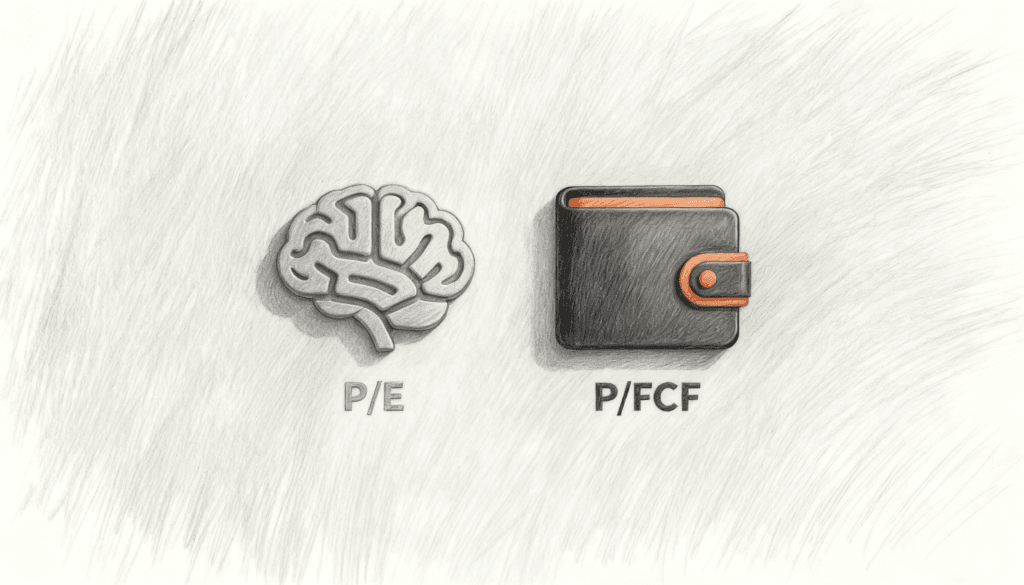
Your brain wants the P/E because it is easy, familiar, and satisfying. Your wallet needs the P/FCF because it is honest.
In investing, as in most things, the honest answer and the comfortable answer are rarely the same one.